Idées trouvé

If it is possible to create visual art by, deliberately and with purpose, assembling pieces of unrelated non-art objects (and it is…one term for such art is objets trouvé), then doesn’t it follow that it is possible to create literary art by, deliberately and with purpose,  assembling the concepts held within unrelated writing?

Regardless of the answer to that question, today, I may attempt to create idées trouvé. I may begin today or tomorrow or the day after or even the day after that.  If I do, I will do it by assembling, in such as way as to build as cohesive a meaning or message as possible, my own writing.  It’s still not clear, is it? No, so let me attempt more precision.

I’ve written—in this and other of my blogs and in pieces I have not shared elsewhere—quite a bit of unrelated stream-of-consciousness “stuff” (to use a charitable term) that cannot hope to have a life standing on its own.  But, buried within this mass of words, if I look carefully and with an open mind, I may find the wherewithal to create something more worthy of the term literature.

For example, just recently I have posted brief rants about:

  • the effects of climate change on agricultural output;
  • how access to money tends to coincide with a sense of entitlement;
  • communal living;
  • music;
  • food;
  • weather;
  • sources of our news;
  • dreams;
  • political lies;
  • joy;
  • friendship;
  • nature;
  • empathy;
  • religion;
  • art;
  • poetry;
  • gifts;
  • money;
  • history; and
  • hallucinations.

If I were able to successfully meld those shreds of disparate thoughts into a single, interconnected piece, it might have some merit.  It might be interesting.  It might say something, collectively, that its pieces could never say separately.  And bear in mind these are just some of the most recent posts; I’ve written 308 posts on this blog, alone, and there is so much more material from which I may choose.

And, so, I will spend time reading and re-reading what I’ve written with the objective of identifying and classifying the messages I had intended to convey through my words. Then, I will endeavor to construct an intricate bridge between pieces, tying them together in some cohesive fashion.  The result is likely to require significant time and effort to polish the components so they fit well into the framework of the bridge.  Perhaps the single biggest challenge will be to determine whether the components, either individually or collectively, have the capacity to adapt to the transformation from a tangled mass of unrelated ideas to a more streamlined superstructure of intent.

Having read and re-read what I’ve just written here, I know the task will be daunting, perhaps far beyond my capacity to accomplish.  If nothing else, it will be a challenge.


Posted in Art, Literature | Leave a comment

Getting Fat on Expectations

I sneaked back onto Facebook and noticed something right away.  My absence wasn’t noticed.  Not even by me.  The lives of the Facebookies did not erupt in turmoil at my absence.  There were no huge, gaping holes where my contributions should have been. It was as if my existence was minimal to Facebook. Or worse…not noticed.  Oh. Boy. What a surprise.

That’s the thing.  Facebook gives its devotees a false sense of value.  As if they mattered. The reality, of course, is that no one really matters on Facebook.  It’s an anonymous ego machine that gets fat on expectations.

Yet it has replaced the front porch.  And the bar (sort of).  And the barbershop.  And the corner grocery.

I do not like this.  But, then, I don’t like war and famine, either, yet I was not asked to permit them to intrude on my planet.  It’s reasonable to want to end war and famine.  But Facebook?  It doesn’t quite compare, does it?

Hard to say.  Very hard to say.

Posted in Philosophy | 11 Comments

Sharecroppers

Amos Cartwright descended from sharecroppers who barely survived the Flood of 1851. Fortunately for his forebears, Sampson and Blanche Cartwright, the owners of the land they worked did not survive.  Through a convoluted web of bureaucratic wizardry, helped along no doubt through the intervention of a liberal legislator by the name of Baxter Chisholm, the land became theirs. Sampson and Blanche also were recipients of a substantial loan from the 30-year-old State of Missouri, permitting them to rebuild what had become their farm, including a large house, a number of outbuildings, and docking facilities on the Mississippi.

The Cartwright estate, for it truly had become an estate, then passed from Sampson and Blanche in 1884 to their son Raymond, who later married Marissa Lopez.  Then, the land passed on to his youngest boy, Clarence, in 1924. Clarence farmed the land until 1942, when the war suddenly commanded much of the fuel and chemicals his crop-hands needed to keep the place productive.

No one could have prepared adequately for the dislocation that followed the government’s forced redistribution of output.  But the bloodline that flowed from Sampson and Blanche Cartwright were better prepared than most.  Fiercely materialistic, competitive, and physically unable to give up, these people grabbed the bull by the horns and built new enterprises.

Though, by that time, the land had become a valuable target for residential real estate development, the Cartwright clan stubbornly refused to sell to developers.  The St. Louis Dragon Ranch was created in 1950, a direct response to an effort by a developer to pressure the state and the city of St. Louis to force the sale of the land.  The Cartwrights succeeded in holding the developers at bay. During the next fifty years, the land’s agricultural use continued.  That suited the Cartwrights well, because the agricultural valuation was far lower than residential valuation, saving them literally millions in taxes.

Over the years, the value of the land, three-hundred and twenty acres, multiplied many, many times over.  Finally, in 2010, the agricultural tax exemptions came under the most severe pressure in the history of the Carthwright family’s ownership of the property.  Well-financed developers, whose political clout with both Republicans and Democrats had been cultivated for years and fed a steady diet of campaign contributions, put immense pressure on legislators to force land-use restrictions on the Carthwrights.  Their success would have catapulted pastoral, bucolic scenes from the 1940s, there in the shadow of the arch, into the frenzied life of the city.

But in 2012, Amos and his wife, Lucinda, to whom the now massive estate had passed, made a final, last-gasp effort to turn the tide.  They began raising dragons. Raising dragons honored the name given to the acreage in the fifties but, more importantly, it was a roadblock the developers had never encountered before.  Much like the short-lived but effective approach many farmers used in the 1980s, introducing ostriches and emus to their land, the tactic confused and confounded both the developers and the legislators in their pockets.

Aside from the herculean foes the Cartwrights faced by introducing dragons to the land, it was not easy to introduce a dragon population into an environment in which, previously, only horses, cattle, cotton, okra, and wheat had flourished.  But the most challenging aspect of dragon husbandry in Missouri had to do with the herds the dragons replaced.

A few years earlier, many local farmers whose land had been threatened with unchecked development, started raising unicorns.  The Cartwrights jumped on the bandwagon and quickly assembled one of the largest unicorn herds in North America.  Those efforts, though, like the ostriches earlier, turned into just a delay, not a solution.  It was the sheer number of unicorns that scuttled the effectiveness of their introduction.  Had they maintained low numbers, the very scarcity of the mythical beasts might have permanently derailed the developers.  But that was not to be.

After their large-scale introduction, and the failure of their introduction to stop the developers in their tracks, in 2007 the unicorns begun dying in large numbers.   The sickness that befell them was unknown to the veterinarians in the area.  The symptoms of the disease, which included vomiting rainbow-colored blood and cracks forming in the crystalline forelegs, were mysteries.

Thomas McClinchy, a noted veterinarian and lepidopterologist, suggested the problems might be traceable to the butterflies in the unicorns’ diets. McClinchy was on the Cartwrights’ payroll, but he was impossible to bribe and everyone knew it; he was a man with conviction and integrity and was as honest as the day is long; in short, he was the antithesis of the developers and legislators.  But that is not the point here; the point is that the real problem with eating butterflies, as he said, had to do with their metaphysical structures.

“Though butterflies may look magical and simply ooze beauty and grace,” McClincy said, “they are not of the same dimension as unicorns. By ingesting foods of this realm, the unicorns’ metaphysical composure is put at great risk.”

Before he could finish his assessment of the unicorn problem, McClinchy became the first victim of the developers’ efforts to eradicate the dragon problem.  Seamus Adams, a man employed by the Cartwrights to tend to the dragons and keep their notorious tempers in check, succumbed to the temptations posed by the developers by accepting a charge to dispatch McClinchy in return for a large cash outlay.  Late one afternoon, when McClinchy was innoculating the dragons against rabies (an outbreak of which would have been nothing short of cataclysmic), Seamus Adams slipped in the dragon barn ahead of him and fed a young and incompletely tamed dragon a hallucinogenic pharmaceutical cocktail. By the time McClinchy arrived at the dragon’s stall, it was fully engaged in what has become known as dragonisticality, a monstrously dangerous fury in which dragons pulverize with their tails beings they perceive as threats, then eat the remains.

Now, you may think this is all nonsense.  You may say this could not have happened.  It is happening.  It is happening now, today, in that very stall in which McClinchy was tormented and tortured by a creature about which he cared deeply.  I am truly offended that you might question the veracity of what I am telling you.

All right, then, I’ll just stop.

 
Posted in Fiction | 4 Comments

You Die Twice

I watched a report, entitled Remembering with Dignity, on the PBS Newshour the other night. It was about efforts to remember and recognize people who had died while in a state mental institution in Minnesota years ago. When those people died, they were buried on the institution’s grounds; their graves were marked with numbers, not names.  One of the people in attendance at a ceremony to remember one person said something that struck a nerve. She said: “The Jewish saying is that you die twice. You die once, when you do die, but the second time you die is when your name isn’t spoken anymore.” Her point, I think, was that the people who were forgotten during their lives and then dispatched with a number upon their death were being given another opportunity to be remembered.

I have heard that quote, or something similar to it, many times, but I did not recall when nor where. I went looking for the origin of the saying about which the woman referred, but didn’t find it.  It’s probably older than the Internet can cope with.  But I did come across this video clip from the film Stand Up Guys.  It has its own power.

Posted in Death, Philosophy | 9 Comments

Singular Solutions

I once had enormous faith in the ability of science and technology to solve the monstrous problems confronting humankind.  Lately, though, my confidence has ebbed as I’ve come to acknowledge that astonishing breakthroughs in science and technology frequently come with a cost: unintended consequences.   Not only that, these marvels of innovation require human intervention to direct them and to ensure that they are put to good use and that the good use is not hijacked by greed-fueled manipulation.

The discovery of nuclear fission in the late 1930s, whose primary first use admittedly was pretty nasty, could have led exclusively to positive outcomes.  I believe even the issue of what to do with spent nuclear fuel could have been addressed successfully if the same energy (pardon the pun) poured into the Manhattan Project had been directed, instead, toward constructive solutions.  The wisdom of the use of atomic energy to devastate Hiroshima and Nagasaki will be forever debated; no one will ever be able to answer the question with unequivocal certainty: would the loss of life been even greater had the war continued, thereby “justifying” the use of nuclear weapons?

I think such monstrous results of technological “solutions” have made the public, worldwide, justly skeptical of technological solutions to the biggest problems facing humankind.  The simple outcomes, as in Hiroshima and Nagasaki, coupled with highly suspect uses and misuses of technology, combine to cause skepticism to spread like cancer.

That can be good.  Think of the issues presently being debated with respect to genetically modified crops and the large and growing list of pesticides once in common use but now banned.  And think of the pesticides still used but incompletely assessed as to their long-term effect on health. Skepticism can be good.  It can be life-saving.

But skepticism can close our eyes and our minds to the possibility of real solutions to the very real problems the human race has created for ourselves.  Potential (and very real) mass starvation. Mass dehydration.  Overpopulation. Diseases born of, or at least supported by, population density. There are a thousand others.

Skepticism has taken hold because, despite breathtaking, stunning, truly miraculous advances in science and technology, as a species we seem incapable of using those advances in entirely positive ways.  And we seem blind to the unintended consequences of unleashing these grand new technological and scientific marvels.

Despite my growing skepticism, though, I have to wonder if we might still be able to get it right.  Can we eventually reach a point in the evolution of our species at which we are able to limit the practical implementation of every scientific and technological advance only after sufficiently understanding its potential shortfalls and how they will be addressed?

I started thinking about these questions after seeing the tail end of a television report on the Singularity University Summit Europe, held in November in Budapest.  The concept of bringing together the world’s brightest minds to tackle the world’s toughest challenges has enormous appeal to me.  The concept suggests someone is getting serious about what it will take to address some of the most indomitable problems facing humankind.  First and foremost, I think, we have to step away from the edge of denial and actually admit the problems exist and we must admit how grave they are.  I liked the idea!

Yet, when I started looking online at the event program, my excitement abated.  Not entirely, mind you, because a list of topics does not really cover the heart of the conversations that took place, but I have to admit my enthusiasm waned.  Seeing a list of corporate sponsors contributed to my flagging support for the concept.  It didn’t help my excitement to recognize that this event was exclusively about science and technology. While I may have an overabundance of confidence in science, I believe “solutions” that fail to account for the vagaries of humankind will never become solutions. The best and brightest psychologists and sociologists and urban planners and farmers and…the list is almost endless…must be invited to participate if reality is to be found somewhere among the fantasy.

I don’t really know precisely what was discussed, so I cannot condemn the event.  I like to think my skepticism is simply a healthy response, learned through a lifetime of watching great ideas and wonderful advances be swallowed by greed.

With all that said, I still believe there may be a chance that science and technology can, indeed, be the “salvation” of humanity.  But science and technology need help.

I’d like to see a completely nonpartisan effort (I’ll call it the Global Solutions Initiative, or GSI) be undertaken by the governments of the world, whereby the greatest minds from science and technology are teamed with the greatest minds from the social sciences and with the brightest people who have real, day-to-day experience dealing with problems like growing food, finding and harnessing energy, finding and purifying and delivering water, and a host of related real-world challenges.

The United Nations might be in a position to convene the GSI, but I suspect partisan distrust would call into question the credibility of the endeavor.  It would be best to start fresh, with the GSI convened and funded by joint resolutions of every country on earth. The GSI could be charged, at the outset, with the following:

  1. Identify the twenty most pressing problems facing, or likely to face, humankind and the planet, within the next century;
  2. Prioritize the problems according to their acuteness, the severity of their outcome if left unsolved, and the breadth of their impact, globally;
  3. Assemble teams best equipped to consider and develop solutions to achieve the problems, in priority order, but taking into account that severity may trump acuteness;
  4. Articulate, in layman’s terms to the extent possible, the problems to be addressed;
  5. Establish mechanisms for the general population to offer ideas, suggestions, etc. to each problem;
  6. Determine the resources necessary to arrive at and begin implementation of the solutions;
  7. Conduct the necessary work to identify suitable solution(s) and, for each solution identified, conduct a full-scale assessment of confounding factors and potential unintended consequences;
  8. Come to consensus on the best solution(s) and present those solutions, along with recommendations regarding public policies to support their implementation, to world governments.
  9. Hope for the best.

That last item is an appropriate admonition for every human being on the planet, regardless of whether the GSI were ever to come to pass.

I do have faith in science and technology.  I am not sure how much faith I have in humankind to take appropriate advantage of them, though, without mucking up the world in the process.

Posted in Economics, Food, Government, Philosophy, Politics, Population, Poverty, Urban planning, Water | 7 Comments

Holiday Meal Extraordinaire

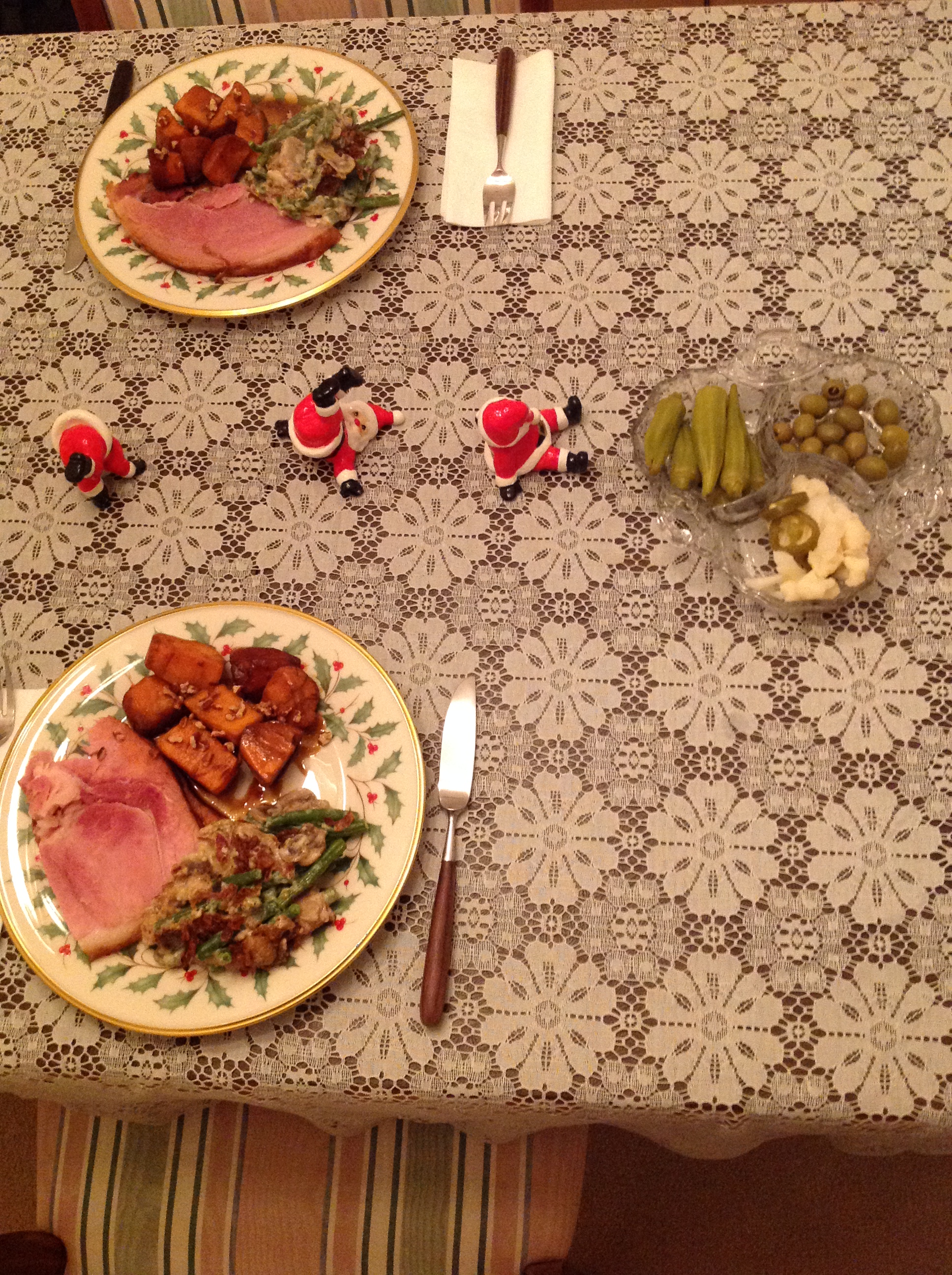
We had every good intention of having Christmas dinner on Christmas day. But a big midday meal of tamales and chile con queso, for the second day in a row, coupled with my wife’s tendency to enjoy her long afternoon naps (and the rarity of my own long afternoon nap) got in the way. So we decided to have a Christmas nibble on THE DAY. But my favorite wife outdid herself on the DAY AFTER! Behold, our Christmas table:

XMAS1013-3

The Santas were head-over-heels in love with the Christmas plates and the nice condiment tray!

XMAS1013-1

Santas continued convulsing in joy as they saw ham, sweet potatoes imbued with the goodness of fine Jim Beam whiskey, and the most spectacular green bean casserole ever to grace the face of the earth.

XMAS1013-2

A closer look at the joy of food among rollicking Santas and exceptional condiments.

It was just the two of us for our post-Christmas Christmas dinner. While it would have been nice to have more family with us on this holiday, being together with the love of my life (and likewise, I’d like to think) made for a wonderful holiday celebration.

Again, Merry Christmas! May this holiday season and the year ahead be full of goodness for you and yours!

Posted in Family, Food, Love | 10 Comments

Superficial

I wrote a very short vignette a few days ago in which a character changed his first name from Dan to Bravado.  It was a silly, completely transparent piece suggesting the idiocy and dangers of superficiality.

When I wrote it, I intended bravado to be synonymous with pretentious false courage. The definition of bravado, though, does not necessarily suggest falseness. It suggest bragging or bluster, bombastic assertions, and the like.  Perhaps the word I should have used was braggadocio. No, the context called for bravado, even though its dictionary definition was not in precise alignment with the meaning I intended to convey.

The more I think about the word bravado, the more I question whether it’s my understanding of the word that’s out of sync with current usage or if it’s the dictionary that’s got it slightly wrong.  To me, bravado connotes artificiality and shallowness, hidden under a thin veneer of boastful and highly ephemeral “matter.” Bravado is made of a substance that can rupture at the slightest disturbance.

This very conversation I’m having with myself is the stuff of superficiality.  It is superficiality at its abundant best, living there as it does on the fringes of my imagination.

It sometimes pains me to come back to reality, where I find the fact of the matter is my interpretation of the nuanced meaning of bravado is irrelevant.  It doesn’t really matter beyond the width of a hair. The world around me will go on, regardless of how I define bravado.

The world will go on regardless of whether Iran builds nuclear bombs.  And it will go on regardless of whether Britney Spears buys a Porsche or a Prius.  And it will go on regardless of whether Facebook or Twitter win the war of social media.

Everything, you see, is superficial.  Everything.  It’s superficial and it’s fleeting.  Everything around us is shallow and temporary. If I were to measure the time I spend caring about the homeless on a time scale that reaches back to the “Big Bang,” the measurement of my moments of care would be such an infinitesimal blip on the scale that it would be invisible. So, on the macro scale, it’s meaningless; superficial and shallow and utterly void of meaning and merit.

But on the micro scale, that infinitesimal  dot on the scale of time is everything. It does have meaning.  It does have merit.  Its macro scale superficiality takes on an intensity of control at the micro level that is hard to escape.  At that level, for someone, Britney’s car choice does matter. It matters, at that level, whether Iran builds a bomb. It even matters whether Facebook or Twitter reach a truce.

All of this is to say I am of two minds when it comes to superficiality.  Superficiality depends on the context. On the macro level, caring about the fashion choices of an actress may be absolutely superficial.  But, to Dan in the vignette referenced above, intense superficiality at the micro level led to consequences serious in the extreme.

Back to my own world.  My interpretation of the nuanced meaning of bravado is absolutely relevant.  It is relevant to me.  And that’s superficial, I suppose.  It is what it is.


Posted in Philosophy, Selfishness | 2 Comments

Food Features and Fantasies

Yesterday, Christmas Eve, we departed from our usual tradition of having tamales and chile con queso and beer for dinner. Because we had arranged to go to dinner with friends last night, we instead honored the tamale tradition at lunch. Because the pork & jalapeño tamales we bought (at Supermercado El Rancho…made fresh daily in the store) were enormous, each of us needed only two to make a meal. So we had a similar lunch today. And we’ll probably do the same tomorrow.

Last night, we ate at Canary by Gorji, a very good place we enjoy when we’re looking for an evening more upscale than normal. Chef Gorji greets every guest and cooks every meal; he is an amazing guy.  His Mediterranean-inspired meals almost always have plenty of pomegranate among the ingredients; it was no different last night.  Last night, he offered only two entrees: pork chop or turkey breast, both served with grilled carrots, grilled green beans, and his amazing garlic potato salad.  Janine and I got the pork chops; incredible!  For desert, we each selected one of the two pies: pecan and pumpkin; again, exceptional!

Today, as we were wandering aimlessly around north Dallas and the suburban wasteland to the north (AKA McMansionville), we commented about each “open” restaurant we passed.  There were Asian places here and there and, as we got closer to home, we saw an Indian place surrounded by a clutch of cars and a sign advertising “OPEN” in big orange neon letters.  I asked if she wanted to stop; “No, I’d rather have tamales again today.”  I made some sarcastic remark about her keeping me away from the vindaloo to punish me for some imaginary wrong, but then it hit me: why not make Mexican-Indian fusion sometime soon?

My mind is racing as I consider the possibilities:

  • lamb vindaloo tamales;
  • chicken vindaloo tacos;
  • tandoori carnitas;
  • bhindi masala burritos;
  • picadillo samosas;
  • arroz con gobhi Manchurian (to really mix it up);
  • baigan guisada;
  • biryani con camarones;
  • the list goes on and on and on.

Of course, the names don’t always convey the complexity of the dish, nor the challenge one might face in creating it. But I remain undaunted.   The idea of a little storefront chaat-taqueria is really appealing.  I’ve even come up with a few appropriate (?) names:

  • Taqueria Mumbai;
  • Chana Tijuana;
  • Luna Nueva Delhi
  • Samosaria
  • Burritos de Bangalore

This may be my ticket out of here!  Who’s on board?  Who’s ready to invest in my idea?  I’ll put up 60% for my 80% ownership (hey, it was my idea!).

Are you having a Merry बिदा?

Posted in Food | 3 Comments

Merry Christmas!

Whether Christian, Jew, Muslim, Buddhist, Atheist, Agnostic, or Other, most people acknowledge this day as Christmas day.  We’re not all celebrating the same thing when we celebrate today, but I think we’re all acknowledging the capacity of humanity to have good intent and to do good.

I’d like for nothing more than for the philosophical, emotional, intellectual, and social divides that fuel pettiness and hatred to disappear today, just for a moment.  People worldwide could see the beauty that so often is buried beneath ugliness of our own making.

Whatever you celebrate today, and whether you celebrate at all, I wish you and yours a Merry Christmas!

Posted in Peace, Philosophy | 6 Comments

Missed Opportunities

Ill-fitting clothes and a devil-may-care green plaid newsboy cap.
Grey herringbone tweed jacket with brown trousers.
Hiking boots, no socks, no match for the smile
fresh from lukewarm coffee and a cold cinnamon bun.

Impossible to forget that sad café, so full of joy,
flush with familiarity and comfort, born of cracked formica
and stained paper menus, and worn wooden stools,
their broken rungs patched together with toothpicks and glue.

The building is gone now, with her cap and her smile.
Chrome fixtures and polished granite and so much glass!
The worn wood, replaced with  leather and silk,
removed from the place, like that tweed and the boots.

We spoke of missed opportunities and moving to Brazil and
the way the old barbecue joint chained knives to the tables.
We knew it was just a matter of time, but not how little,
before those knives and those opportunities would be gone.

Posted in Poetry | 2 Comments

Canadian Tomatoes and Kansas Grapefruit

Last summer, one of my brothers planted tomatoes.  The plants grew and produced blossoms, but the fruit never set.  He theorized the high temperatures, both day and night, might be to blame.  From what I’ve read this morning, he’s probably right.  According to this article, “When temperatures rise above 85 to 90 degrees F (depending on humidity) during the day and 75 degrees F at night, pollen will become unviable.”  Those temperature ranges certainly describe the kind of growing seasons in Texas the last few years.  Daytime temperatures have, for years, risen well about that range, but it’s only within the last few years that I’ve noticed, in Dallas, that nighttime temperatures in the heat of the summer frequently don’t fall below 80 or 82 degrees. That’s a godawful hot, sticky night.

As I was scanning various news sources this morning, I read more about the impact our warming climate is having other crops.  Okra is under cultivation farther north than it has been in memory.  At the same time, there’s a decline in corn production in the Midwest due to temperature and rainfall; corn is being replaced by cotton and sorghum, both of which are more tolerant of water and temperature stresses.  In the Midwest, the article notes, tomatoes and broccoli were unable to withstand the lethal combination of heat and drought.  Goats, too, haven’t been doing so well, either.

These are not just isolated examples of the effects of climate change on our food supply.It’s not just Texas and the Midwest USA that’s dealing with climate change. Vintners in France have been receiving grapes for their wine earlier and earlier over the past several decades; warmer temperatures bring earlier harvests.

Lest you think I’m writing this as a rallying cry to do everything we can to prevent further warming of the climate, let me be clear: I’m not.  Whether the vast majority of scientists (who argue that human activities are causing climate change) are right or not (I’m in their camp), I don’t think the human race has the will to change our ways.

In any event, I suggest that, for those of us fortunate enough to be facing the effects of global warming today, rather than twenty years from today, there are changes ahead that will influence what we eat,  where we get our food, and when certain foods are available.    I wonder if Canadian tomatoes will be more expensive than Mexican tomatoes?  And will the Kansas City area be a good grapefruit producing area?


Posted in Food, Weather | 5 Comments

Guest Post: Red Ale & More!

My friend, Juan Flores, is a connoisseur of fine, home-brewed beer and an accomplished brewer himself. He has allowed me to post this brief rumination on his current brewing endeavor.

##########################################################

I’m priming my ale some 5 days before I planned, but  the working yeast has slowed significantly, and I’ve fermented in both bucket and carboy much longer than what was needed. The Flores Ale & Beer Company continues production, and with another 5 gallons to boil into a fine wort called “Midnight Stout,” tonight —  my storage refrigerator will be filling to capacity.

OLYMPUS DIGITAL CAMERA

This ale has been fermenting some three weeks: Two in the bucket and one week in the carboy you see. Bottles are sterilized and are ready for me to bottle the ale and cap it. Ale is primed with added sugar in order to ferment for that champagne quality.

OLYMPUS DIGITAL CAMERA

It’s a long process. I had started preparing things for bottling at 5 this morning. I was finished at 10. After I cap them, I place them on the table so I can wipe them down with a moist cloth. When you’re bottling, the fermenting drink gets all over the floors. The house smells like a brewery, and so afterwards clean-up means mopping and sterilizing again.

OLYMPUS DIGITAL CAMERA

From the table they go to my cart so I can wheel them to the storage refrigerator and transfer them there for yet another 30 days of bottled fermenting.

OLYMPUS DIGITAL CAMERA

It’s a Red Ale that tastes absolutely delicious. The aroma is fantastic — this may even better than my last batch. Maybe, I’m just getting better with practice. This particular ale has been treated with just tinge of Red Chili pepper. I think I made a wise choice in that seasoning. It’s very good!

OLYMPUS DIGITAL CAMERA

Of course I have to taste-test it. My big nose picks up the aromas — very nice and the taste is absolutely ale — a bit sweet, but it’s been primed for bottle fermentation, so the real taste tasting comes in another 20 days for trial.

OLYMPUS DIGITAL CAMERA

I’m “Breaking Bad,” as my “cold-brewing refrigerator” is filling to capacity. This is generally referred to as LAGERING. These bottles represent three different time periods, and there is everything here from American Bock to Irish Stout and now Red Ale. I’ve got room for another five gallons, which I will begin the wort mix later today. The next batch is my Midnight Stout — one that I will experiment with by using a significant portion of natural Maple Syrup in the wort; I’m thinking it will lend that mapley taste to the stout.

Posted in Beer | 5 Comments

Privilege and Compassion: Incompatible?

I’d be very interested in getting feedback about this short PBS video from visitors to this page. What do you think about the research? Do you think financial advantage, real or fabricated, influences the way people treat others? Are rich people less altruistic, more likely to cheat and lie and steal, and more aggressive than poor people?  If so, what does that say about the “middle class?”  Are they imperfect liars who occasionally care that their modest privilege robs the less privileged?

I have opinions, but I’d rather hear others’ points of view before I start spouting off about my own.  I did find this video VERY interesting.

Posted in Poverty | 3 Comments

Relief Valve

My decisions are revocable. That’s what makes them seem wishy-washy; by definition, I suppose they are.

My latest decision is to take another temporary breather from Facebook.  It’s not because I think it will have any lasting effect on me, nor on Facebook; it’s because Facebook makes me tired.  I’m tired of looking at every post as if it matters.  I’m tired of participating in my own teen angst factory.  Enough!  For awhile.

So, for at least a short while, I’ll not see the posts to which I feel an obligation to “like” or to which I feel a need to respond for one reason or another.  And I will not post comments that, the moment I post them, make me sorry I’ve done it; I won’t post those comments that look for all the world like I’m desperately seeking acknowledgement.

My comments here are more private, more measured.  I don’t expect answers to every thought.  I don’t expect every post will even be seen by anyone but me; most probably aren’t.  I know there is a small cadre of followers who get notification of my posts, but those followers are not like Facebook posters; they don’t expect every comment to garner a reply. Nor do I.  I rather like knowing my comments here sometimes go unnoticed; responses are just that much more meaningful to me when they come.

I suppose I’m posting this message simply to say to those who read this blog, but who notice I’m not presently on Facebook, that I’m just taking a break.  I need a break from my own attachment to Facebook.  I chose not to announce on Facebook that I’ve temporarily closed my account; no need to call attention to it there, the way I’ve done before.

So there you are.

Posted in Peace | 12 Comments

Vignette: The Importance of Names

Dan and Melanie Churchpepper married 31 years earlier.  Like every married couple, they’d had their ups and downs, but generally their time together had been pleasant, if not overwhelmingly exciting.  Their lives were predictable, if somewhat dull.

After 31 years in the same neighborhood in the same house with the same jobs, though, both of them began to feel mildly dissatisfied with their lives.  They talked about their tedium, occasionally, but there seemed to be no answers to what caused it, nor any solutions to cure it.  It hadn’t reached the point of being really troubling, so they took no action.   They let it stew.  And like a wheelbarrow full of wet cement left unattended, then forgotten, by the side of the house, the mild dissatisfaction hardened into something rigid and seemingly impossible to remove: full-blown ennui.

One day, Melanie returned to the house from a Home Depot demonstration workshop where she had watched latex paint dry on a piece of HardiePlank lap siding.   She opened the front door and exclaimed, “Dan, I know the problem!  Or at least I know the answer! We need to change our names!”  Dan had been watching Days of Our Wives, his favorite reality show; her exclamation caught him off guard. “What? What problem?”

“I had an epiphany,” Melanie continued, “while I was sitting there at Home Depot, thinking about what’s wrong with our lives. It’s not the 31 years of the same routine that’s got us down. It’s the 55 years with the same identities! We’re bored with who we are! We need to change our names.  Not our last names, just our first names.”

Melanie explained that changing their names could add some excitement to their lives.

“We can lead more mysterious lives! People will be curious about us.  They will be drawn to us because we’ll be exciting! Changing our names will be like starting over.  It will let us renew our youthful exuberance!”  Melanie’s excitement demonstrated her commitment to the idea.  Dan had little choice but to go along for the ride.

Two days later, after considering a very long list of possibilities, Melanie had selected her new name.  And she chose a new name for Dan; at first, he didn’t like it…thought it sounded too elitist…but Melanie prevailed.  They agreed: Dan would change his name to Centurion Churchpepper and Melanie would change her name to Inebria Churchpepper.

That change, alone, Melanie promised, would bring fulfillment to their lives.  These new names, she said, would ascribe joy and new challenge to their otherwise dull lives.

The process of changing their names was no more exciting than the names they were leaving behind.  It was just filing papers, waiting, and waiting some more.  Finally, the paperwork was finished, the judge rendered his decision, separately, to accept the changes, and, presto, they were different people.

Eight months later, Inebria was sitting at the dinner table with Centurion, silently eating the leftover meatloaf, when she brought it up.

“Centurion, the problem isn’t with us, it’s with the neighborhood.  We’ve lived here for 32 years and we hardly know anyone; it’s like everyone stays barricaded in their houses and isn’t interested in mingling.  If we lived someplace else, the name changes would have generated excitement.  But, here?  Hardly anybody even knows!  Everybody here is Dick and Jane and Mike and Susan and John and Linda. They are boring  people who live boring lives and we need to get out of here! ”

Dan didn’t immediately embrace the idea of moving.  He countered with “Melanie..Inebria, we know some of our neighbors! I mean, you have the Wednesday bridge club and we go to the Saturday movie matinee with Ken and Barbara.”

“Movie matinees?  Really?  We know two people whose lives are as predictable as our own and we know our neighbors?  Ken and Barbara acted like we’d lost our minds when we told them we were changing our names!  And they still laugh at us!  And the bridge club?  It’s like we’re living in the 1950s.  This is Stepford Wives, 2013!  Are those women even real people? Granted, we know a few people, but we don’t know most of  our neighbors, so it’s not like we’ll be leaving friends.”

Centurion’s caution was no match for Inebria’s ferocity of purpose.  The house sold quickly, so quickly, in fact, that they decided to put their belongings in storage.  They would rent a furnished apartment in a more exciting area, Inebria decided, until they could decide where life would be more to their liking.

The last day, as the moving truck was preparing to pull away, a neighbor couple, out for a walk with their Boston terrier, came by.  Seeing the moving van in front of the house and seeing Centurion and Inebria outside, they stopped.

The woman spoke first. “Oh, you’re moving!  And we’ve never even met you, though we’ve seen you as we passed by.  Good luck with your move! ”

Chit-chat all around followed, then the introductions.  “I’m Centurion Churchpepper and this is my wife, Inebria.”  The neighbor woman responded, “Nice to finally meet you!  We’re the Smiths. I’m Eagervixen and this is my husband, Bravado!”  And then they trundled off with their Boston terrier, Bob.

Centurion Churchpepper was charged with first degree murder in the death of his wife, Inebria Churchpepper, just six months later.  Her body was found encased in cement left to harden in a large, construction-sized wheelbarrow; it was left near the clubhouse of the apartment building, off to the side, in the back yard.

When I first wrote this, the names of the two guys were reversed; Centurion was Bravado and vice versa.  For a number of reasons, I like that better.  If and when this finds its way into a book or a compilation or a collection of self-published drivel, their names will be reversed.  The “main” character really should be Bravado.  Dammit.
Posted in Fiction, Philosophy | Leave a comment

Le jeu n’en vaut pas la chandelle

“The game is not worth the candle.” It’s a favorite phrase of mine; it says so much, so economically.

The last time I used it was well over a year ago.  The phrase is said to have originated with a French (hence the title of this post) writer, Michel de Montaigne, though the concept behind it is far older than the phrase itself.

The original point of the phrase, as I recall it, was in reference to an evening card game in which the value of the pot was less than the expense of a candle to provide light so the players could see the cards. Le jeu n’en vaut pas la chandelle.

Today, the phrase refers to an endeavor whose outcome is not worth the effort invested in achieving it or whose outcome will be worse than the present state of affairs.

When last I used the phrase, I was frustrated by this country’s political prospects and disillusioned with both major political parties.   Here’s what I wrote in September 2012, before the presidential election:

Though I have just enough hope left in me to vote for the Democratic candidate and wish for the best, I believe the outcome of the election will have few truly meaningful results. Sure, a Republican win will mean a sharp turn toward selfishness, imperialism, and class hatred, but a Democratic victory will mean that we will continue to slog through the porridge, making no appreciable progress toward tackling the real issues that face humankind, the environment, and every country on the planet.

I gave my support to the Democratic Party in the 2012 Presidential election, but I committed to abandon both major parties once the election was decided because I viewed both parties as corrupt, useless, and vile.  Unless the two major parties change, radically, between now and the next presidential election, I am sure I will be joined by many hundreds of thousands of others who will withhold their votes from the candidates of both parties.

In the interim, though, President Obama has three years to show me he’s the man I believed him to be when this country first elected him.  I am a realist, though; I do not expect that to happen.

By electing the government that exists today, a government with such a heterogeneous mix of political perspectives, I believe the American people have collectively tried to sent a message to the people they elected: “We do not want a government controlled by any single political perspective.  We demand that members of our government work TOGETHER to get the job done! ” The American people are tired of stalemate, tired of mindless political animosities, and tired of their elected representatives caring more for their own political careers than for the welfare of the country.  Yet by electing people with conflicting points of view, we did not achieve compromise; instead, we got stalemate and inaction.

I believe the American people, regardless of their political leanings, would very much like to eliminate the problem by throwing the bastards out.  If ballot boxes had been equipped with syringes filled with lethal cocktails that could be delivered to select candidates, the outcome of the last election might have been different. Today I look around at the political landscape and see what could have been the carcasses of rabid political animals.  But, instead, they have been kept alive thanks to extreme measures, probably involving powerful chemicals, dirty needles, and stolen money.   Regretfully, preemptive political euthanasia is illegal.

Today, more than a year after the election, I remain utterly disillusioned with the political machinery that continues to burn through what little humanity and integrity and practicality remain in our three branches of government.  I’ve come to the conclusion that my favorite phrase applies with respect to any support I may have considered giving to the Democratic Party. Why invest time, money, and even hope in a party whose only alignment with my principles is its vague assertion that it is “progressive?”  Its claims of progressivism are empty, hollow statements utterly disconnected to facts.  And, though I’ve never had much, philosophically, in common with the Republican Party, I tried to look at it to see if there may be kernels of logic and validity buried beneath the rotting fecal matter on its surface.

No, the Republican Party has gone off the rails with insanely loathsome attacks on people who dare express compassion for the less fortunate among us.  Not only that, the Party is attempting to starve the country into prosperity and lead us into goodness through religious bigotry, forced adherence to spiritual fantasy, and massive infusions of corporate welfare to the richest and meanest companies. On top of that, the Republican machinery is intent on transferring what little wealth remains in the middle class to the oligarchy that no longer even tries to hide its lust for money and power.

But the Democratic Party has gone off the rails just as badly with vapid promises of “looking out after the people” without even considering the social and economic costs of bungling everything it touches.  I’m not referring here just to the Affordable Care Act, about which I have reached an ugly conclusion (it’s bad to the core and can hardly be worse). I’m referring to efforts to buy its way out of a spiraling social and economic calamity.

I am the first one to say government (as in we, the people) has an obligation to provide a social safety net for people who are unable to look out after themselves, whether permanently or on a temporary basis.  But we MUST ask and attempt to answer this before running out and attempting to serve those in need: Where do “want” and “need” diverge in the context of a societal safety net?  Put another way, if society has an obligation to provide for those who cannot provide for themselves (as I believe it does), at what point does an individual’s inability to “provide” cross the threshold to warrant society (viz, government) stepping in? I would argue that there is, today, no truly satisfactory answer to those questions; and that lack of an answer requires a healthy assessment of the admixture of compassion and capability.

There are so many variables that a single response, or even a lengthy string of responses, cannot anticipate all the circumstances in which it is required that society step in. Conversely, there is no simple way to know when it is “time” for society to stop providing support.  Obviously, we cannot wait for the answer; we have to act, but act in ways that allow us to backtrack if we must. We must act when it is vital to act, but we must be prepared to require the individual benefitting from society’s assistance to participate in the process and not simply be a recipient.

The Republican Party insists it is fiscally responsible, yet its every effort seems not to be responsible but to be miserly and harsh to the majority of Americans (especially those in real need), while overly generous toward those for who generosity is utterly unwarranted and unneeded.  While Democratic mistakes can cost money and economic turmoil and general chaos, Republican mistakes can cost lives.  That, alone, is reason enough for me to loathe Democratic approaches a bit less; but I still find it utterly wrong to approach problems with the unreasonably positive attitude that money we don’t have can fix every problem.  If a doctor happily told me I’ll be just fine as soon as I get a transfusion when he knows full well there is no blood to be had, I’d be reasonably confident he belonged to the Democratic machine. If a doctor told me I need a transfusion, but it’s up to me to provide the blood that I should have been setting aside all along, I’d be confident she is part of the Republican oligarchy.

So, from my perspective, supporting either of the two main parties is fruitless: the game is not worth the candle.

What, then, am I to do?  If I can’t support either major party, shall I simply retreat into my shell, knowing I have no power to make change, or should I throw my support behind another political party that might have a chance of generating sufficient support in the coming months and years so as to actually get things done?

There are other options, of course.  I could focus my assessments not on the party, but on the person running for office.  I might be able to support a Democrat whose stances are more in line with mine and who is openly willing to challenge party doctrine.  I might be able to support a Republican under the same conditions.  But I would be concerned in both cases that the individuals have aligned themselves with parties that I have written off as corrupt, useless, bloated, greed-fueled beasts.

As I began trying to crystallize my thoughts about creating and/or supporting one or more alternatives to the Democratic and Republican Parties, I read the 2012 platforms of the Green Party, the Democratic Party, the Libertarian Party, the Republican Party, and the Socialist Party.

Before reaching any conclusions about which party(ies) to support, I believe it is necessary to clearly understand and articulate the proper and legitimate roles of government and how those roles come to be granted to government.  I need to comprehend, too, the nature of our Constitution and to understand what it says about the role of government.  Finally, I need to understand how each party views the roles of government and how each party justifies the view it holds of government’s roles.  Then, and only then, can I begin to formulate my support for one or more parties if, indeed, I can support any of them.

I’d done this before. When I did it again, I left the process with no more certainty than when I started it.

During the process of researching the various parties, I came to the conclusion that only by examining the platforms of the different parties can one surmise how they define the proper role of government.  I could find no explicit statements in any of the party platforms that clearly stated that party’s position on the role of government.  The party’s position on the role of government became obvious, if not absolutely clear, on reading its platforms, but I wondered whether the people who wrote the platforms actually gave any thought to the legitimate role of government while they were writing it. In fact, in some cases I wondered whether the fundamental role of government had ever been considered as the party drafted its platform.  I have come to believe some of the platforms were, indeed, written without sufficient consideration being given to the role of government and how that role intersects with the party’s platform.

As I learned during this process, I have not given sufficient thought to government’s role, though I had adopted a number of “positions” that I believed government should take.

One might think that someone of my age (60) would have long since clarified his beliefs about the role of government.  In my assessment of the parties to which I could conceivably throw my support in the future, though, I learned that I had long since clarified what I wanted my society to look like, but not what role government should play in achieving the objective.  And, during my assessment, I was deeply surprised at how my wishes for my society and my rational determination of the proper role of government frequently are at odds with one another.  In other words, many things I want in my society do not fall within the province of government as I have come to define that role.

I’m still not there; I don’t know whether any of the parties I mentioned above have it right. I don’t know whether any of them can count on my respect, much less my support, in the coming years.  I have not delved deeply enough to know whether the ones toward which I am leaning have truly practical approaches to dealing with economic realities.  And I may have to concede, ultimately, that my choice(s) may be among the lesser of many evils. Utopia does not yet seem to exist.

But I’ll share a secret.  Today, as of 11:38 a.m. Central, I am leaning toward the Socialist Party USA.  but a look at the organization’s principles reveals wishful outcomes that, in too many cases, offer no clear path toward achievement.  Here, for example, is a statement on Full Employment from the organization’s website:

Under welfare capitalism, a reserve pool of people is kept under-educated, under-skilled and unemployed, largely along racial and gender lines, to exert pressure on those who are employed and on organized labor. The employed pay for this knife that capitalism holds to their throats by being taxed to fund welfare programs to maintain the unemployed and their children. In this way the working class is divided against itself; those with jobs and those without are separated by resentment and fear. In socialism, full employment is realized for everyone who wants to work.

A lofty goal, reaching full employment.  And how is it achieved?  Ah, there’s the rub; if wishes were horses, we’d all have wings, as my wife is fond of saying! (I know it’s “if wishes were horses, beggars would ride;” I like hers better.)

In the final analysis, is my effort to try to understand the pros and cons of each party worthwhile?  Will it make any difference?

Is the game worth the candle?

Only time will tell.

Posted in Philosophy, Politics | Leave a comment

Communal Living

For the last few years, I’ve grown increasingly interested in a budding trend toward what I’ll call communal living, though it’s called by a number of other names including co-housing,

The concept is that groups of individuals or families live together in a community of private dwellings (whether single-family homes or apartment-style units), supplemented by common shared facilities like kitchens, dining areas, recreational areas, laundries, guest quarters, etc.   It is more than just a way to share expenses, it is a way to create and sustain social cohesion.  I see it as the “modern” equivalent of an extended family living under the same roof, or at least in the same tiny neighborhood.

I’ve been following a local group’s Facebook page (Dallas Cohousing/Ecovillage) for some time, as they attempt to create their “ecovillage.”  This morning, I read about collective efforts to deal with the absurdly high cost of housing in the San Francisco Bay area.  From there, I went on to read about a 50+ housing project called Elderberry Commons, located within the Yarrow Ecovillage site in Chilliwack, British Columbia.

The concept of co-housing is extremely attractive to me.  Cost-savings is not the most attractive part and, in fact, I can imagine there may be no cost-saving if a community were built to provide more amenities than one would except in one’s own private, non-communal home.

A couple of years ago, we hosted (through couchsurfing.org) for one night a couple from Vermont.  They live in a village called Island Pond and they belong to a religious community called Twelve Tribes.  The members of the Twelve Tribes community own everything communally; while our guests said they live in a house by themselves, it is owned by Twelve Tribes, as is everything else.  They spoke in highly positive terms of the value of communal living. While the idea of living in a religious community is anathema to me, the non-religious aspects of the community they described was highly appealing.

The more I have explored the idea of co-housing, the more appealing it has become.  The Elderberry Commons, mentioned above, is especially intriguing.  A community of like-minded people in the same age cohort, living together and sharing certain community assets is appealing to me.

Here’s what I envision for a network of co-housing communities in which I would be comfortable and happy:

  • Homes would be clusters of stand-alone private residence cottages and/or multi-unit buildings with private residences;
  • Private residences would be small–they would have kitchens and eating areas, but those would be small because most meals would be taken in house-cluster group meal areas;
  • These clusters would be served by connected, communal parking structures that would also have both shared and private storage areas;
  • Multiple housing clusters would face on public squares/parks that would include retail/restaurant/commercial space and garden/natural areas;
  • Roadways would be limited; within housing clusters and between housing clusters, there would be footpaths, but cars and trucks would be restricted to the limited roadways, except for emergency vehicles which could enter the “squares;”
  • Each housing cluster would have a public building that would include laundry facilities, large kitchen, group eating areas, community rooms for socializing, and perhaps exercise facilities.

As I envision it, the homes would be private property (to satisfy the practicalities of modern life), however each piece of private property would be linked to shared ownership of community property.  No one could buy a private home without accepting the obligations attendant with living in the community.  This concept is similar in many respects to condominium ownership, I suppose, except for the “forced” social cohesion aspect.

From my perspective, co-housing is far more attractive than the typical “buy your house and stay away from neighbors” lifestyle.  Though there are additional responsibilities and obligations, the benefits outweigh them, I think.

I doubt I’ll ever have the opportunity to live in a co-housing community, but I wish I would.


Posted in Housiing | 5 Comments

The House You Live In

I know I may be opening myself up to criticism, snickering, and accusations that I’m a whimpering dreamer, but the lyrics to The House You Live In are some of the most touching, most moving, most INSTRUCTIONAL words of any song I know.

It’s not far from the truth for me to say listening to those words when I was an impressionable teen and a lost young man helped shape my attitudes about charity. I believed, still believe, it is my obligation to help people who need help. If they need a place to stay, it’s my obligation to offer one, or find them one. This doesn’t necessarily coincide with my wife’s attitudes, and she has her ideas for completely valid reasons, yet I still feel that sense of obligation to people who are less fortunate than I.

My shame, my embarrassment is that I let my fear of condemnation as an innocent, someone who buys into the stories of the homeless and underprivileged, prevent me from living according to my beliefs that I have an obligation.  Though I try to help when I can, a five dollar bill doesn’t begin to do what an 8-hour sleep in a clean bed can do for someone who’s living a hard, hard life.  It’s hard to reconcile living up to a social metric that I find abysmal with a belief that I owe a debt of service to my fellow man.   That disconnect says unpleasant things about me; not just me, of course, but anyone who know what they should do, but who doesn’t do it in order to escape ridicule for doing the right thing.

Here, in the second half of my life, I hope I have the courage and the wherewithal to do the right thing.  A friend of mine will serve meals to the needy over the holidays; another will spend time and energy in a “soup kitchen” in Arlington.  I don’ t have any such plans. There are reasons, but not good enough reasons.

So, here are the words I love, the words I wish I’d live by:

The House You Live In (Gordon Lightfoot)
Go first in the world, go forth with your fears
Remember a price must be paid
Be always too soon, be never too fast
At the time when all bets must be laid
Beware of the darkness, be kind to your children
Remember the woman who waits
And the house you live in will never fall down
If you pity the stranger who stands at your gate

When you’re caught by the gale and you’re full under sail
Beware of the dangers below
And the song that you sing should not be too sad
And be sure not to sing it too slow
Be calm in the face of all common disgraces
And know what they’re doin’ it for
And the house you live in will never fall down
If you pity the stranger who stands at your door

When you’re out on the road and feelin’ quite lost
Consider the burden of fame
And he who is wise will not criticize
When other men fail at the game
Beware of strange faces and dark dingy places
Be careful while bending the law
And the house you live in will never fall down
If you pity the stranger who stands at your door

When you’re down in the dumps and not ready to deal
Decide what it is that you need
Is it money or love, is it learning to live
Or is it the mouth you must feed
Be known as a man who will always be candid
On questions that do not relate
And the house you live in will never fall down
If you pity the stranger who stands at the gate
And the house you live in will never fall down
If you pity the stranger who stands at the gate


Posted in Secular morality | 9 Comments

Real Estate

A house in our subdivision, just a couple of blocks from us, came on the market over a month ago at $325,000.  It’s about 200 square feet larger than ours and has four bedrooms.  It’s located on an entrance to an alley that runs behind our house and  in the opposite direction to an alley for houses on another street.  Very odd and tiny back yard, with no fence and no privacy.  So I hope that’s why it hasn’t sold yet and the price has dropped to $300,000.  I’m hoping our house will command a good price; I hope the price drop on this place doesn’t foretell what we can expect.  I don’t think so, but I’m a little nervous.  The price we get for our house will dictate, in large part, the next place we buy.

Anyone with immediate cash in hand who wants our place can have it for $820,000, today only!  Don’t let this pass you by!

Posted in Housiing | 3 Comments

One of My Musical Interests

Some music I find of interest. Neutral Milk Hotel, playing “In the Aeroplane over the Sea.”

Posted in Music | Leave a comment

What Odds are being Offered by the Facebookie?

I’ve made the decision before, more than once.  The decision to abandon Facebook, that is. I suppose the most significant aspect of deciding to leave Facebook is facing the reality that my social life is almost entirely electronic.  And by leaving Facebook, I put many of my electronic friends in the position of deciding either to visit my blog to stay in touch with me or to simply do without interacting with me.

Of course, my most immediate concern is that everyone, or at least most, will opt for the latter.  That decision would be understandable, of course, especially in light of the fact that my blog tends to be more intense than my Facebook posts.  And intensity is something many of them, us, are trying to avoid when we can.  The structure of Facebook social relationships is intentionally casual, too, so relationships we develop on Facebook are not only less intense than “real” relationships, they tend to be more fleeting, more ephemeral, less “real.”

And that, then, forces me to acknowledge that electronic friendships are as lasting, as solid and substantial as the electric current powering my computer. How many online friends do we really have?  Are they all, or most of them, online acquaintances, rather than friends? Probably.  And that’s what’s lost with abandoning Facebook.  The decision, then, boils down to how much value I place on casual, shallow, acquaintance relationships.  Or, how important it is to have a small number of casual relationships versus a tiny number of more substantive relationships.

These are questions teens must ask themselves.  Not 60 year-old men.  But here I am, behaving like a teen again!  I’ll mull this over.  But not for long.  One of my recent Faceb00k-linked psychological profiles (which are no doubt highly reliable….hmph) suggests I like to get decisions out of the way quickly.  And I will.

Posted in Communication, Friendship | Leave a comment

Photographic Evidence of Hyperdistance and Uberspace

IntoTheEyeIf you stare intently enough into the highfalutin shot glass from which you’re sipping rye, you can see the other side of the universe.   This photo simply doesn’t do it justice. I recall, when I took this photo a couple of nights ago, seeing the other side of the universe quite clearly.

The unimpressive quality of the photo notwithstanding, taking a long, hard look at the center of the shot glass will reveal quite a lot if you let it.  Let your mind wander.  Open the gates normally shut by bias and belief and certainty. Entertain the possibility that time and space and reason all dwell quietly in darkness at the bottom of this one simple shot glass. Consider that the other side of the universe is looking back up at you.

You can get inside the oddest, yet most informative, ideas if you try.  You can unleash creativity by considering things that don’t belong in the realm of reason.  Or you can bury it by adhering to all the rules, all the time, following patterns prescribed for you for reasons you don’t try to, or don’t want to, understand.

Who knows whether hyperdistance and uberspace are real?  Who cares?  It’s what you do with your imagination that matters, not where it comes from.


Posted in Philosophy, Wisdom | Leave a comment

What’s Love Got to Do with It?

They met at the public Christmas party at Whole Foods.  Both of them were unimpressed with the party, but intrigued by one another’s selection of beer.  He bought a six-pack of locally-brewed IPA.  She had her 32 ounce growler filled with a just-released milk stout from the same brewer.

Beer was the lubricant for their first conversation.  It was the lubricant for many of their future conversations.  And when she bought a bottle of Maker’s Mark straight bourbon, it became an even better lubricant.

The conversation turned, as it always does, to transportation.  If they had been in Chicago, they would have talked about the commuter trains.  But they were in Dallas.  You don’t talk about commuter trains in Dallas, unless you’re on a DART line.  Most people aren’t.  So you don’t talk about commuter trains.  So they talked about cars.

Both of them may have had ulterior motives for talking about cars. I can’t say; I don’t know.  But I can say the car thing became measurable not long after.

He bought a 2013 Kia Soul.  He liked cars with attitude. He was 23 years old.  It was his first new car as an adult.

She bought a 2013 Volkswagen GTI.  She liked cars with attitude. She was 36 years old.  It was her first new car as an adulteress.

The question ultimately arose, of course; what’s love got to do with it?  What’s love, but a second hand emotion?

And there, as they say, you have it!


Posted in Fiction | 4 Comments

Cornish Pasties

I did it.  I made Cornish Pasties, ostensibly a “Great Lakes” regional dish.  It was my second “Regional Cuisine of the U.S. and Canada” endeavor of the month, the first being American Chop Suey. I did not bother with photos of the first one; I must have been distracted..  This may be an opportune time to admit my “Doing Without” plans for December have gone to hell in a handbasket. That is, I have not avoided restaurants the way I promised I would.

I will regroup by having a stern talk with myself in January; I must recover from going badly astray.  But in the interim, I’m still having some fun with my efforts to cook regional cuisine.  And here is the saga of my effort to make Cornish pasties, in photos and captions:

Pasty1

The ingredients for the filling; ground beef, ground lamb, rutabaga, onions, potatoes, carrots, salt, pepper, beef bouillon, etc.

Pasty2

The aftermath of my pastry-making; this was after considerable clean-up. I now believe bakers and anyone else who makes pastry dough are powerful, wonderful people. Making pastry is not for sissies.

Pasty3

Six chunks of dough, after I made a large round lump and cut it into pieces. I was awash in flour.

Pasty5

The first pasty patty, in preparation.

Pasty6

The dough, filled with 1-1/2 cups of the filling mixture. Did I mention this is a HUGE recipe? Why didn’t I figure out a way to reduce the recipe? Dunno. Maybe next time.

Pasty7

My favorite wife caught me in the act of rolling out the dough. Pretty classy apron, huh?

Pasty11

On the next-to-last pasty, I glanced up; I do that sometimes, just to see who’s watching me.

Pasty10

And here they are; monstrous in size and showing their wounds. I was supposed to make small slits across them. Instead, I made deep gashes.

Pasty12

And here they are in the oven, browning as they prepare to be eaten in the near-term.

Pasty13

Poor babies bled from the deep lacerations; I don’t know slit from evisceration.

Pasty14

Trying to show how big these monsters are; I’m holding my hand next to one of them for scale.

Pasty15

Finally, taking a bite, trying both ketchup and whole-grain dijon.

OK.  They’re done. We’ve eaten one (one is enough for two).  There are others in the freezer to be eaten another day.  So, how was it?

It was not bad.  But being a spice freak, it was a bit bland for my taste.  Even eating it with a bit of ketchup or a bit of mustard left me thinking it was a bit bland.  I jazzed it up a tad with some Sriracha sauce, but if I were to do it again, I’d spice up the filling.  Some Indian spices, perhaps, maybe a jalapeño, possibly some chile powder or cumin….but that would take it far afield from its “authentic” roots in northern Michigan (Jennifer, can you verify?  And while you’re at it, are they traditionally eaten cold with ketchup?  And what’s your preferred term for someone who is from Michigan: Michiganian, Michigander, Michiganer, Michiganese, Michigine, Wolverine, Michiganite, or something else?)

Well, that’s done. I still have to eat foods from the Pacific Northwest and must have some “Floribbean” food and, of course, I will make Joyce’s oyster pie (if I can find a quart of oysters…no luck at Tom Thumb, ALbertson’s, and Kroger this week). And there’s more. Much more. I wish food didn’t love to stick with me as much as I like to stick with food.

Posted in Doing Without, Food | 3 Comments

Hate and Rage and Video Breath

They play video games, all dark and dank,
lots of blood and bullets and an army tank.
They’re wired on Red Bull and coffee and lust,
with a shot of vodka; that’s always a must.

Almost time to go hunting, time to shoot and to stab,
time to hide in the bushes, spring from the back of a cab.
Quietly waiting, they’ll target their prey,
keep killing tomorrow, start killing today.

Preparing’s a frenzy, almost erotic to them,
there’s the odor of fear, and the light’s getting dim.
Soon, blood and false courage will ruin a life,
Maybe someone’s husband, maybe his wife.

Sharp’ning their knives and oiling their guns,
they swill fresh coffee and toast fresh buns.
Breakfasts of champions, before the great hunt,
prepared by the young one, a scurrilous runt.

One more round of gaming, before it begins.
He’s explosively angry if the other guy wins.
But that makes it easy to seize on their task,
finding the victims, with questions to ask.

Why do you have more money, more things and more fun?
What did you do to deserve this, why don’t you run?
Are you frightened of dying, of pain, or of me?
Will you give in completely, will you try to flee?

The games work their magic, they’re ready to kill,
not seeking the game so much as the thrill.
Fueled by rage, thriving on death,
filled with hate and rage and video breath.

They stalk and they murder, slice throats and thighs,
stab aimlessly, wantonly, gouging out eyes.
If hope springs eternal, it’s at the moment of death,
faced with hate and rage and video breath.

Let’s argue causation, disagree on the cause,
while they rip us to shreds with their video claws.
Maybe it’s something unrelated to playing their games,
but let’s weep as they read the long list of dead names.

Children were murdered, snuffed out in their prime,
but these video lovers have had such a good time.
Could it be they were guilty, causing pain, dealing death,
while defending their rights to hate and rage and video breath?

Posted in Poetry | Leave a comment