I may be approaching adulthood

The time approaches for me to determine what I will do to reignite the economic engine.  I have enjoyed my near-year of indolence more than I can possibly say, but I have a fear of running out of money, soon, so I must take the appropriate steps.  Will I try to find a “job,” or will I create a new enterprise?  Decisions, decisions, decisions.

Maybe i should read this book?

I have literally dozens of things I’d like to explore, but I have to be prudent with my money and my time.  Ideally, I’d find a suitable partner who would serve as a good sounding board, and vice versa, to help narrow the field of ideas.  I’m still not certain whether I’ll resurrect my old business, but probably not.  The corporate shell remains and can serve as the foundation upon which to build, but at the moment my interest in association management is more an interest in consulting and project management than in full service, day-to-day management.

I am old enough to know what I want to do when I grow up.  Maybe that’s the issue; I haven’t grown up yet.  There are days…a lot of days…when I catch myself having a sense of wonder about something that, in an adult’s world, probably shouldn’t be such a source of wonder.  I can stare for hours as clouds swirl and reinvent themselves; not an awfully productive use of my time, perhaps, but an experience that humbles me against the sky. It doesn’t have to be clouds.  I can drift into the same sense of awe and wonder at a stream flowing by.  And it doesn’t even have to be natural; I can stand beneath a spaghetti-bowl of freeway overpasses and be equally mesmerized by the simplicity and complexity of the beast.

There are so many things out in the world that could give me sufficient income to survive and sufficient satisfaction to survive happily.  I just have to figure out which ones to pursue.  I’m open to spending a week in an entrepreneurial retreat, exploring the best ways to generate income and contentment from a new enterprise.  Anyone want to join me?

Posted in Economics, Philosophy | 7 Comments

When I Die

From Wikipedia; this image is in the public domain because the copyright has expired.

When I die (which I hope will not happen for many, many years), if things go according to what I am in the midst of planning, representatives of the University of Texas Southwestern Medical Center Willed Body Program will pick up my body. The medical school will harvest usable organs for transplants.  The rest of my body will be used for research, training, etc. by the medical school.  I expect to sign the appropriate documents before witnesses, within the next few weeks.

Unless otherwise directed by the donor when signing the agreement, after completion of the medical use of the body, UT Southwestern Medical center cremates the remains and inters them, anonymously, in the Memorial Garden on the university campus.  Done.  No fuss, no bother, no funeral, no expense.

I am writing this both as a record of my wishes and as a platform to suggest that others consider the same.  Here are my reasons:

  • There is a real need for human bodies for medical training and research.
  • I do not anticipate needing my body after I die.
  • There will be no cost to my family; the ability to plan so my death will not require any funeral, cremation, or other disposal expenses is a good thing, in my opinion…I will be a skinflint even in death!

The range for the cost of a full funeral in the Austin, Texas area (I could find no such figures for DFW) was $2,600 to $7,200.  That excludes a casket (which ranged in price from $600 to $3,500) and “related services.”  According to the figures I found, those costs range, on average, from $4,000 to $8,000.  I have nothing against funeral directors and others involved in the death industry; they serve a need and help people get through tough times.  I would rather that kind of money be put to more productive use in the family, though.  I hope my family and friends will get through the tough time by coming together to celebrate life!

I consider the last “act,” the use of one’s body for research and training that might save lives or make them more bearable, a better way to leave a legacy than serving as support for a headstone.  Many people would disagree.  I only hope the idea is at least given a bit of consideration.

I’m off my soapbox now.


Posted in Death, Philosophy | 7 Comments

If I Use Pinterest, Am I “Unmanly?”

A photo I found on Pinterest (originally from Kottke.org)

It seems to me that the world of Pinterest is overwhelmingly inhabited by women.  After futzing around with Pinterest this morning, re-pinning stuff I found intriguing (Yeah, like this photo of a gun being fired underwater.  Can you see the veins in my neck bulge as I lift my Harley over my head?), I wondered…for the umpteenth time…are there really as few men using it as it appears to me?

And I wondered whether people who see that I pin to Pinterest think, because I am swimming in a pool full of women, I am effeminate or, god forbid, gay.  Actually, I don’t care whether  people think that, but I wondered, nonetheless.  So I thought I’d explore it a bit.

Depending on where you look for the information, anywhere between 58% and 97% of Pinterest users are women.  Based on my own limited experience, I’d say the 97% figure is closer to the truth.  But why? One of the articles I read suggests the design of the site itself is more appealing to women.  According to that article, most social media sites are designed by, and to appeal to, men,  But on Pinterest, it says, the colors, the emphasis on graphics and the heavy use of photos are, according to that piece, geared toward women users.  Another consideration I read somewhere seems to acknowledge that design might have been responsible for a higher number of women than men jumping on board initially, but reckoned the disparate growth rate leading to the current mega-majority for women was caused by exponential growth of “pins.”  If the number of pages pinned grows exponentially, then it would stand to reason that a small head start in initial numbers oif women would quickly grow to massive lopsidedness in favor of women.  Assuming, of course, men and women have different interests.  More on that later.

The NPR piece cited above led me to this board and this this one designed explicitly to appeal to men.  Clearly, there are a few boards designed to appeal to the manly-man.   But I still wonder…why aren’t men using the service more? While the rate of growth in, and the larger proportion of, women users might be explained by mathematics, the apparent paucity in absolute numbers of men just doesn’t seem to have a simple connection to math.  It must be something else.

It could be, in spite of the man-directed boards on the site, that there just is not yet sufficient male-focused content yet.   But the site’s “content” is essentially created by users.  Granted, the larger the proportion of women, the larger the proportion of content that might be of interest primarily to women might help explain small numbers of male users.   (This argument makes some sexist assumptions of male-female interests, I know, but you have to admit the sexes do have different interests…arguments about their different interests would have real legitimacy only regarding the causes of those disparate interests.)

When I first subscribed to Pinterest, I didn’t just pin images and page-links that someone else had already pinned, I used the service as a place to “store” links to specific places on the internet that were of interest to me.  For example (he growls and flexes his biceps), I created a board on “welding how-to.”   I created another one (he stands, hammer in hand, and glares menacingly at the box of nails) on DIY Resources.  The fact that you can and do create your own content, in addition to swiping content from others, mutes the “there’s only content for women” argument.  The fact that there plenty of content areas which are of real interest to both women and men (even men who are NOT effeminate) dulls the argument, as well.

So, still, I wonder what is it that explains why so few men, in absolute numbers, use Pinterest?  Before I answer, let me say I understand there are plenty of BOTH women and men who absolutely do not and will not have any interest in Pinterest. To them, the concept of using an online pictorial file cabinet for items of interest simply has no appeal.  But, STILL, I wonder…do men in general simply not find the concept of having such an online service of interest?

My explanation is admittedly conjecture, purely a guess based on my admittedly modest, perhaps miniscule, knowledge of the motives of people who choose to join Pinterest and those who choose not to join. But here goes, anyway:

I think many, many men may not make use of Pinterest because they DO think it’s effeminate and they DO care that others might think them less manly for participating. I’m talking here about the men who do make ample use of other social media, not about the guys who steer clear of social media altogether (except for the guys who think social media is just a girlie thing).

If I’m right about their motives for staying away, let me just say to them: I wish you’d grow out of this teenage insecurity.  Seriously, I wish there were more men posting on Pinterest because that would just improve its utility for everyone.  The greater the number of people sharing information, the more valuable the service.

If, on the other hand, I’m wrong…if the relative paucity of males using the service has nothing to do with insecurity and fear of what others might think, then I’d STILL like to know why men are not using it in greater numbers.

If my assumption that men who don’t participate in Pinterest  worry that people will consider them effeminate is wrong, then all I can say, to paraphrase Gilda Radner’s SNL character, Emily Litella, is “Nevermind.”

 

Posted in Demographics | 3 Comments

My Mother’s Birthday

My mother, in a moment of quiet and bemused reflection, the summer before her death.

Today is my mother’s birthday.  She has been dead now for more than a quarter century, but many days I think about her and wish I knew what she’d think about something or another, usually something related to language.

She was an English teacher, in love with language, both from the perspective of a writer and from the perspective of a “technician,” the latter evidenced by her fascination with the mechanics of grammar.  She was a stickler about correct grammatical usage, an old school teacher who believed it necessary to properly diagram a sentence (at least mentally) to understand it. The sentence diagram gene didn’t make it to me, her sixth child.

Even 30 years ago, the autonomy of teachers in their classrooms was under attack, a deeply upsetting situation for my mother, who for most of her teaching career had been in control of her classrooms with no undue interference, neither from school administration nor parents.  So, when she could retire, she did.  I think she had some bitterness about what she perceived as the disintegration of the quality of education in light of giving administrators, children, and their parents more choice in educational content and delivery. Though she was a believer in individual rights, those rights had limits.  Children did not have the experience nor the wisdom to know what they needed to know.  And somehow, parents and administrators had decided children’s immediate desires should take priority over the opportunity to have an educational foundation that would serve them for the rest of their lives.   She had no hope of winning the battle, so she left the war.

Hers was a retirement into tight finances, having reared and funded at least part of the education and mobile lifestyle and post-teen living expenses for some of her children, on top of the enormous expense of simply having to provide for six children for 18 years each.   She and my father chose to spend their very meager incomes on getting by with their six kids.  Witnessing the  absence of vacations, the needed home repairs going undone, the lack of little luxuries, and the miniscule savings account they built over a lifetime contributed, in large part, to my decision not to have children.  Having children and the lifetime commitment that entails did not correspond with the life I saw for myself.  She never scolded me for my decision, early on, to forego having children.

The year after my father’s death, she finally began to come out of her self-imposed geographic isolation in South Texas, joining friends for a cross-country trip or two.  My brother, who lived in Alaska at the time, had convinced her, I think, to finally board a plane to go visit him, but she died before that came to pass.

Every year on her birthday, I gave my mother flowers.  Since she died, I have acknowledged her passing on her birthday.  I think each year of getting her flowers.  This year, this realistic remembrance will serve as the flowers.  I think she would approve.

Posted in Family | 3 Comments

Poetry

I love you without knowing how, or when or from where. I love you simply, without problems or pride: I love you in this way because I do not know any other way of loving but this, in which there is no I or you, so intimate that your hand upon my chest is my hand, so intimate that when I fall asleep your eyes close.

~ Pablo Neruda, 100 Love Sonnets

A Facebook friend posted this earlier this morning. Even amidst the noise of Facebook, there are gems of such incredible beauty.

Posted in Love | 1 Comment

A Love Affair

For as long as I can remember, I have been in love with early mornings.  This morning, out of the blue, I think I came to understand why.

After I awaken from a night’s sleep and shake off the haze and confusion of the transition from sleep to consciousness, I’m alone with my thoughts.  I’m able to focus my mind on important things.  I use that time to ask questions that have no answers, at least no answers I understand. Questions like, “If we had no way to measure time, would the concept of time have any meaning to us?”  Some people might consider such a question frivolous, a waste of brain cells. I don’t. I think giving long, serious consideration to questions like that leads to a deeper understanding of the world around us.

But back to the issue at hand.  I think I understand why I love the morning so very much.  Part of it is the sense of wonder at those complex questions.  The single most important explanation, though, relates to the nature of morning, itself, and the way the day unfolds from darkness to light.

There is a period very early in the morning—a time before hints of the sun’s glow begin to show in the dark sky— that is remarkably peaceful. Even if the sky is clear, the moon full, and stars abundant, darkness wraps me in a cocoon.  I know, but can’t see, most of what surrounds me as I stand outside, glancing around me and looking up at the sky.  That darkness and the absence of the sounds of human activity is calming.

When I stand outdoors, basking in that predawn tranquility, I feel closer to nature than to humanity.  I feel I’m about to enter a day that I’ve never experienced and that, just by being there at this very moment, I will have an opportunity to shape a little slice of time simply by deciding how I will react to the day that is about to unfold before me.

Then, as the glow of the approaching day brightens and my cocoon lifts from around me to reveal the trees and the grass and the earth beneath my feet, I feel I’m sharing a secret with the sky and the ground and even the air I breathe.

This morning, just days after Fall began, I saw the connection between early morning and early Spring.

The trees begin to leaf and plants start to show themselves above the soil, announcing Spring, a new season that will be brighter and softer and more vibrant than the one just ended.  There is promise of new growth and the return of flora and fauna that ran away from the harshness of Winter.  I experience early mornings in much the same way I experience early Spring.  By witnessing the world as it changes from predawn darkness to early light, I feel like I’m witnessing something like the change from Winter to Spring.

That must be it.  What else could it be?  What else could explain this love affair I have with early mornings?

Posted in Philosophy | Leave a comment

The New Malthusian Imperative

Thomas Malthus

Image of Malthus; linked from Wikipedia

If the world’s population is allowed to grow unchecked, there will come a time when the planet cannot sustain those who inhabit it.  Simple extrapolations of population growth, coupled with measured analyses of the rate of growth in food productivity, will show that there is a point at which productivity will fall below minimum demand.  Famine and the attendant response to it are among the results one would expect.

Instead of devoting our energies toward finding solutions, there appears to be an increasing need to discredit “deniers” who seems to suggest we just need to have faith in humankind’s ability to overcome every obstacle.    This might not be so important if it weren’t for the fact that some of those who argue against scientific logic and reasoned extrapolation seem almost persuasive…if only their words, and not their logic, energizes the debate.

There is danger in assuming eloquence to be based in knowledge and reason.  A forcefully expressive and persuasive orator or writer is not necessarily one who speaks the truth.  He or she may simply be a highly skilled liar or someone who excels at building magnificently worded, and utterly empty, arguments.  Robert Zubrin, the author of Merchants of Despair: Radical Environmentalists, Criminal Pseudo-Scientists, and the Fatal Cult of Antihumanism is in my opinion among those whose arguments are empty, supported only by his own odd interpretations of “facts” to which he, alone, may be privy.

I believe Zubrin is a skilled writer with a facility for specious arguments.

The book includes a well-orchestrated set of what I consider utterly absurd arguments against the propositions put forth by Thomas Malthus in the late 18th and early 19th century in connection with the need to establish mechanisms to control unrestrained population growth.  Aside from his pseudo-scientific accusations against what he calls the pseudo-science of theories about the impact of global warming and explosive population growth, among other things,  the assertions I find most disturbing are Zubrin’s zealous attacks on well-reasoned science and his utter dismissal of even a legitimate concern about overpopulation.

Like so many others who decry rational science in favor of irrational, politically-generated “faith,” Zubrin ignores or dismisses without basis, the work of the majority of scientists with whom he disagrees.  Zubrin’s irrationality is in clear view in an article (entitled The Population Control Holocaust) published online in The New Atlantis, in which he states:

If the idea is accepted that the world’s resources are fixed with only so much to go around, then each new life is unwelcome, each unregulated act or thought is a menace, every person is fundamentally the enemy of every other person, and each race or nation is the enemy of every other race or nation. The ultimate outcome of such a worldview can only be enforced stagnation, tyranny, war, and genocide. The horrific crimes advocated or perpetrated by antihumanism’s devotees over the past two centuries prove this conclusively. Only in a world of unlimited resources can all men be brothers.

That is why we must reject antihumanism and embrace instead an ethic based on faith in the human capacity for creativity and invention. For in doing so, we make a statement that we are living not at the end of history, but at the beginning of history; that we believe in freedom and not regimentation; in progress and not stasis; in love rather than hate; in life rather than death; in hope rather than despair.

The emphasis added above is mine. I simply cannot understand how anyone can do anything BUT accept the idea that earth’s resources are fixed.   Zubrin twists the matter even more when he asserts that those who do accept the concept of fixed resources also accept that every person is the enemy of every other person.  His use of a bizarre false syllogism would be humorous if it weren’t so frightening.  A scientist who asserts, as does Zubrin, that any evidence or line of reasoning proves anything “conclusively” may be a bit unfamiliar with the scientific method. What makes Zubrin’s public assertions about the illegitimacy of population control so frightening to me is the fact that he has educational credentials that are impressive, though those credentials signify nothing in the way of expertise on the topic of .  Wikipedia has this to say about Zubrin: “Zubrin holds a B.A. in Mathematics from the University of Rochester (1974), and a masters degree in Aeronautics and Astronautics, a masters degree in Nuclear Engineering, and a Ph.D. in Nuclear Engineering — all from the University of Washington.

Zubrin cleverly states as fact a number of opinions, most of which have long since been discredited, that support his contentions that people who are in favor of developing reasonable, fair, and workable means of population control are “antihuman.”

No reasonable person today would claim that everything Malthus asserted was true and correct.  But Zubrin exploits the fact that some of the arguments posited by Malthus were incomplete or erroneous, condemning Malthus’ entire hypothesis about population.   I suggest that no reasonable person today would claim that the solution to aggressively misused and dwindling resources, along with a growing population, is simply “faith in the human capacity for creativity and invention.”  I applaud those who have faith in humanity, but it is delusional, in my opinion, to view reality through a rose-colored lens created from magic dust and wishful thinking.

Malthus asserted that unchecked population growth would quickly lay waste to available resources; while that did not occur as quickly as he envisioned, the reasoning behind his arguments remains valid.  There really are limited resources available to humankind.  Unless reasoned arguments about ways to control population take place and unless steps are taken to implement the steps that have the greatest likelihood of giving humankind a long-term solution, we will continue to rush headlong into the eventual global catastrophe that Malthus anticipated.  Zubrin argues that anyone who accepts the urgency of the problem and wishes to solve it is “anti-human.”  I argue that Zubrin, and those like him who attach political motives to scientific problems, is the one who should look in the mirror when uttering that word.

Several years ago, I used the phrase “new Malthusian imperative” to argue about the need to have serious public policy discussions, based on science, about population control.  I still believe there is a new Malthusian imperative facing us as a species. If Zubrin and his adherents believe what they are saying about the SCIENCE of the matter, then they should be willing to debate other scientists, using only demonstrable data to fuel their arguments, leaving accusatory labels and magic dust back at home where they belong.


OK.  This might not be your thing.  I can accept that.  But I hope you will accept that what I have written here expresses my opinion…what I believe to be true.  I have strong opinions about a lot of things, some of which are pretty sketchy in terms of supporting data (this isn’t one of those).  I am open to argument, provided those arguments are based on defensible information.

Posted in Demographics, Economics, Essay, Philosophy, Religion | 4 Comments

He who knows he has enough

I keep a book on my desk: The Essence of Zen: An Anthology of Quotations.  When I feel the need to reflect on myself, life in general, and the world I live in, I pick it up.  I find myself doing thumbing through the book frequently.

This morning, after I got home from a four and a half mile walk in the darkness, I picked it up.  These words struck a chord with me:

Within yourself
is a stillness and a sanctuary
to which you can retreat at any time and be yourself.
~ Hermann Hesse
 
Your vision will become clear only
when you look into your heart.
Who looks outside, dreams.
Who looks inside, awakes.
~ Carl Jung
 
Love not what you are
but what you may become.
~ Miguel de Cervantes
 
The real voyage of discovery
consists not in seeking new landscapes
but in having new eyes.
~ Marcel Proust
 
He who knows
he has enough
is rich.
~ Lao-Tzu


Posted in Philosophy, Wisdom | 1 Comment

Must We Be Subservient?

I am writing this post to try to sort out, in my own mind, an issue involving people and work.  Perhaps putting down in black and white my evolving thoughts will help me come to grips with the issue.

Specifically, I am writing this post in an attempt to understand why so many of us…the vast majority of us… in this country and, quite possibly, worldwide seem to believe we have to be hired by someone else if we are going to work.  Our culture assumes people who want or need the ability to buy goods and services will go out and find a job.   We don’t assume they will go out and create products or services that people want to buy.

Of course, we educate our young people so they can exchange their capabilities and knowledge for regular infusions of money and the label “employee.”  But that’s by no means preparing them to go out and create their own futures.  It appears we’re preparing them to go in search of the best, most lucrative caregiver. It’s as if society’s role is to prepare people to go in search of someone else upon whom to depend for their livelihoods.  Why is that?

Why isn’t it the other way around?  Why  doesn’t our culture assume the people we educate and prepare for the world of work will work for themselves, creating products or services of value that others want to buy?  Could the reason be, quite simply, that our culture inculcates in us a belief that we couldn’t possibly be successful in earning our way without depending on being “on the dole” from an employer of one kind or another?

Wait, I think I know what you’re thinking.  Your first reaction to these questions and inferences is to label my thought process right-wing and bathed in regressive, deeply conservative values.  Nothing could be further from the truth.  In fact,  my questions emerge from my left-of-center political perspectives and my growing distrust of the foundations of capitalism.  You see, I think society DOES push us toward being “worker bees” who do the bidding of our employers, the majority of whom benefit financially from their employees’ efforts far more than do the employees themselves.  I think society has reached that point over a long period of time because a relatively small and, in today’s world, increasingly powerful “production elite” has deliberately (over a very long period of time) manipulated it in that direction.

The success of this scheme depends heavily on the vast majority of people unwittingly reinforcing it.  Parents tell their children to finish school so they can get a good job.  Teachers discuss career choices with their students from the perspective of finding employment. Don’t get me wrong, I am not suggesting parents and teachers or, for that matter, employers are part of a vast conspiracy to intentionally “serve the capitalist monster.”  What I am suggesting is that the capitalist monster does nothing to dispel the idea that the right thing to do for most people is to go find a “job” so that golden ring of the worklife, stability, can be achieved.  “Normal” has been manipulated to mean “find someone to pay you, for you are not equipped to figure it out on your own.”  We continue to accept that “normal,” even as the imaginary economic wonder-world disintegrates around us.

As stability in employment has become increasingly ephemeral, it is harder to understand how the average working person can continue to fully and unquestioningly accept the idea that his or her future is completely tied to one or two or, more likely, a string of employers, rather than his or her own willingness and ability to take risks, accept defeat, and pick oneself up and move on toward self-reliance.

Over time humanity has either succumbed to subtle economic blackmail that led to what amounts to de facto servitude or simply stumbled into today’s normalcy.  Whatever the route to get here, most of us, in fact, rely on others to give us money that allows us to find shelter and put food on the table.  How many among us would be able to continue to eat if we were suddenly faced with joblessness and no prospects for employment?  How many of us have been “educated” into the position of being utterly, completely, irrevocably dependent on being allowed to keep the highly limited, almost robotic role of “employee” simply to be able to live.

We, most of us,  can’t grow our own food and we can’t create the tools and implements we would need to build our own shelter.  Most of us either are employees or just one step away from it.  We need the economic structure we created.  Unfortunately, it really doesn’t need us, at least not all of us.

Do we all need employers?  Until we decide we don’t, we do.

None of this is meant to downplay the importance of employees.  Even the most aggressive entrepreneurial spirit cannot overcome the simple fact that entrepreneurs cannot do it all alone.  Employees are necessary, they are important, and they matter.  But I think there are many people who, absent the socialization that minimizes the expectation of productive risk\, would be far less dependent on capitalist machinery.

Your thoughts?


Posted in Economics, Philosophy | 2 Comments

View of the Earth from ISS

I found this video of the International Space Station flying over the earth extremely interesting. Set to music, it is an experience to behold.

Posted in Music, Photography | Leave a comment

Residential Segregation by Income

Opulence gone awry

Yesterday, my wife and I went for a drive.  It was a relatively short drive, just a few miles, but  it was as if we drove into another dimension.  Just a few miles north of where we live in north Dallas is Plano and, a bit further, Frisco.  Both communities have experienced exponential growth during the last several years, changing from sleepy bedroom communities into massive housing developments for people who have enormous income levels.

As we drove past mile after mile of gigantic homes decked out in all the latest and greatest designer materials (e.g., stone facades, slate roofs, massive cedar timbers, etc.), I noted that it must take access to vast wealth to live there.  I said it must be like Stepford living.  Here are people who live in perfectly groomed houses, people who have perfectly groomed children who play hockey on perfectly groomed horses on perfectly manicured fields.  Even the pockets of retail among the vast stretches of million-dollar homes looked too perfect and too clean.  “Where is the reality here,” I asked?

Then, this morning, I came across a fascinating piece on our local PBS station’s website that deals with residential segregation by income.  My dislike of, and discomfort with, these high-income ghettos may be explained by the article.

Posted in Demographics, Economics | 6 Comments

Damn

Today.  What about today?  Nothing of any real import, but I am not happy about it.  I have not been able to address the world the way the world deserves to be addressed.   Such is life.  That is the way things so often are.  Damn.

Posted in Depression | Leave a comment

Tilting at Windmills

I was surprised and pleased to see the size of the turnout at a seminar this morning, sponsored by Dallas Water Utilities, on water-wise landscaping.  I estimate there were a couple of hundred people in attendance.

Image Credit: All Things D

Unfortunately, the demographics of the group were not so encouraging.  If there were any people in the room under 30, I missed them.  If there were any under 40, they were outnumbered 100 to 1.  And the number under 50 probably could be counted on two hands.  The rest were in their 60s and beyond.

The seminar was held in south Dallas, an area with a large black and brown population, but the vast majority of people in attendance were white.  Are old white people the only ones interested in reducing the amount of water they use in their yards and gardens?

My sense of cynicism about the human condition deepens.  My hope for the future of our planet wanes.

Here we were, attending a seminar designed to address water usage to help assure there’s enough for future generations, if only in a superficial way (you want water for future generations, you better do more than reduce the amount you use on your azaleas), yet almost the only people in attendance represented a generation that won’t be helped much and a declining race demographic.  Talk about tilting at windmills!  The windmills aren’t working; they’re no longer pumping water.

Maybe I’m too cynical.  Maybe there are less depressing ways to look at the group demographics.  Tell me about them.  Please.

Posted in Demographics, Philosophy, Water | 2 Comments

Considering the Concept: Selfishness

A good friend, someone I’ve never met but who has become a good friend nonetheless, made a comment to me that piqued my interest.  He said he was considering writing an analysis of selfishness, what it is and how it has affected American culture.

My comments to him, off the cuff as I rattled off a typed reply to his email, suggested selfishness may mean different things to different people. By that, I think context is highly important in framing the meaning of the term.

One person boarding a crowded bus may think it selfish for another person to rush to take a seat.  But the subject of his scorn may know an elderly and feeble woman normally boards the bus at the next stop and, so, is securing a seat to give to her when she boards.  Is the bus rider who is securing a seat selfish?  Would that rider be considered selfish if, by securing the seat, he prevented another, equally feeble, man from taking it?

Context.

Whatever the context, though, an act (or a person) being labeled selfish involves someone making a negative judgement about the person or act being characterized as selfish.

I went on to suggest to my friend that the concept of selfishness may represent many more states of mind than a single word can fully convey.  Perhaps our understanding of the concept is clouded; perhaps we are limited in our ability to generalize about what selfishness means because our language does not give us adequate ways to differentiate “selfish” behaviors with respect to the contexts within which they take place.

My friend raised the matter at the same time he mentioned what he (and I) considers a travesty of justice.  A teacher in Florida was fired, because she ostensibly  intimidated some of her students to allow her to view Facebook posts, critical of her, made by other students.    While the circumstances surrounding the matter were incomplete in the newspaper article that addressed the decision to fire her, the decision seemed, to me, to be unreasonable.  Was the teacher selfish for wanting to read what was being written about her?  Were the students who wrote negative comments about her selfish in their disregard for their words’ influence on the teacher and other students?  Were the parents who pursued the teacher’s termination selfish for wanting to punish a teacher for monitoring students’ online conversations…perhaps something the parents should have been doing themselves but failed to do?

There are thousands of questions about what constitutes selfishness and how it manifests itself in our society today.  It’s  topic about which I’m looking forward to reading when my friend, Juan, writes his analysis.

Posted in Philosophy, Selfishness, Wisdom | Leave a comment

About Facebook

A few people have asked me why I shut down my Facebook account and whether I’ll be back. I’ve explained to them, a few of them at least, that my reasons for leaving were many, but the real trigger for my decision had to do with a bit of self-reflection.

I looked at my presence on Facebook and saw evidence, not of John Swinburn, but of Kim Kardashian.  There was a lot of vapor, but very little substance.  I’ll be quick to say that several of my Facebook friends have not succumbed to the temptation to use Facebook chatter as a substitute for the real exchange of ideas.  But I did.  I think I get an endorphin rush when interacting with people about ideas, issues, likes and dislikes, etc.     But Facebook was my crack; I allowed it to transform communications into something odd and a little grotesque.

So, in an effort to repair and rebuild my intellectual capacity, I opted to withdraw.  At least for awhile.  And that leads to the next issue: will I be back?

The answer to that question is much more difficult.  On one hand, I see enormous value in Facebook as an adjunct to more traditional forms of “keeping in touch.”  Facebook is a tool for communication, pure and simple.  It is not a magical, transformative new technology, but it does make unique use of technology to enable users to communicate in ways that were heretofore difficult, if not impossible.  So, I can envision returning to Facebook at some point, perhaps soon, to take advantage of its capabilities.

If I return to Facebook, though, I think…I hope…I will be less prolific.  I will be more judicious.  That is, I will  post only when I have something to say and not simply to exercise my fingers.  Maybe you can’t play with crack, though.  Maybe you have to either use it and face the consequences or avoid it entirely.  I suppose I’ll answer that question in good time.

Posted in Communication | 2 Comments

The Mortar of the Morning

I am back at home, fresh from a five mile walk.  I sit at the breakfast table, the casement windows open wide so I can enjoy temperatures hovering in the low 60s.  The clear sky this morning is bright but soft.  The sun hasn’t yet squeezed the gentleness from the air. I love to break the barriers between inside and outside, to have the blinds drawn so I can see the world outside my window.  I sit and gaze out at the greenery and the street and the occasional person walking by, sometimes alone and sometimes with a dog straining at its leash, eagerly sniffing at the lawn, as it passes.

Across the street, an old truck is parked.  It’s hard to say what color it is; it may once have been beige or gold or an odd yellowish-brown, but time and the elements have dulled and muddied the finish.  A sign on the side reads “House Cracks.  Brick and Mortar Repair.”  I watch as a guy who I’d judge to be in his mid to late 60s takes a bucket of mortar to the front of the house and gets about his business.   Just a few days earlier, a crew of four or five very dark-skinned men, all of them wearing straw “cowboy” hats  had taken down a portion of a brick privacy wall on the corner of the house; Mr. House Cracks is there to do the finish work, I imagine.

Shortly after I begin to hear his metal trowel tapping on the bricks, the sound stops suddenly.   I then hear him engaging in conversation with the woman who lives there, a woman I recognize but whose name I don’t remember, if I ever knew it.  I can’t hear what they are saying, but I am able to see them as they talk.  A moment later, she goes inside the house and then returns, holding a red can in her hand; it looks like a can of Raid from where I sit.  She hands it to Mr. House Cracks, who begins to spray up and down the side of the edge of the wall where he’s working.  I hear them talking, but I can’t quite make out what they’re saying…”carpenter” “they get behind….” “should do it.”  I decide he must have encountered a nest of carpenter ants and the woman has come to his aid with a can of poison.

Just as I notice the gentleness of the light has waned while I was eavesdropping on my neighbor and Mr. House Cracks, I realize the street outside my window has become busy.  The sound of cars driving up the street reminds me I am in a neighborhood of people who have jobs; they are driving off to work.

I remain behind, alone in my kitchen, paying more attention to my surroundings than I did in years past.  I enjoy experiencing each moment and thinking about my moments of experience.

Soon, my wife will wake up and will come into the kitchen, expecting me to hand her a glass of tomato juice and finish preparing our breakfast of turkey bacon, a plain egg-substitute omelet, and a few pieces of the cantaloupe I cut earlier this morning after I returned from my pre-dawn walk.  I appreciate that expectation.  I relish it.  I enjoy meeting it.

Life is good now.  Right at this moment, I do not need anything else.  Nothing else at all.

Posted in Happiness, Housiing, Peace, Philosophy | Leave a comment

The Game is Not Worth the Candle. Again.

If you are among the few who have read my comments in years past, you may recognize my assessment of the political choices that face us this November: the game is not worth the candle.  It hurts me deeply to come to this conclusion, but it’s one I reach only after giving our social and political landscapes more thought than I care to admit.

My political philosophies lean far to the left, considerably farther than the Democratic Party is willing to go.  I understand the Party’s reasoning for maintaining its generally centrist position.  In fact, I’ve argued for centrism and I continue to do it. But my arguments are based only on my desire to minimize the likelihood of spiraling into oblivion, not on my wishes for a future in which all people worldwide can live in reasonable prosperity.

Realistically, though, we effectively have only two parties, Democratic and Republican, neither of which is stocked with sufficient intellectual muscle to set aside its stupid partisan mantra for long enough to let reality seep into its world-view.  We are faced, this November, with a choice between a corrupt, right-wing, inhuman Republican party with its suitably like-minded candidate and a corrupt, left-leaning, inflexible Democratic party with its discredited purveyor of hope and change.

Though I have just enough hope left in me to vote for the Democratic candidate and wish for the best, I believe the outcome of the election will have few truly meaningful results.  Sure, a Republican win will mean a sharp turn toward selfishness, imperialism, and class hatred, but a Democratic victory will mean that we will continue to slog through the porridge, making no appreciable progress toward tackling the real issues that face humankind, the environment, and every country on the planet.

The only real hope this earth has is for intelligent people, worldwide, to reject parochial views of the world, to reject the path toward global annihilation, and to embrace a world free of religious intolerance and driven by humanitarian motives.  It isn’t going to happen.  Unless there  is radical and complete change in humankind’s culture and in this country’s arrogant treatment of the planet and every thing on it as a personal slave of the good old USA, we are doomed.

There, my friends, is my Wednesday evening inspirational.  I hope you, and I, are better in the morning.

Posted in Philosophy, Politics, Religion | 2 Comments

Black Bread

It’s rare that I am able to eat pumpernickel. My wife does not like it, so I rarely buy it, as I would have to eat the whole loaf myself, which I can do but which is not a good thing to do in one sitting. I have learned through experience that pumpernickel does not age well, not even for a day. It becomes rock hard and dry as dust.

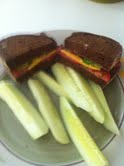
All those reasons notwithstanding, I bought a loaf a few days ago. I sliced it and put the unused slices in the freezer. Today, I took two slices out for my lunch, thawing them quickly in the microwave. And it was good. The image below show the sandwich under construction. Yes, black bread is good, especially when dressed up with thin slices of jalapeńo, tomatoes, and finely sliced strips of sharp cheddar. A bit of grey poupon mustard on the bread, a turn of the peppermill, and some wedges of cucumber and you have a fine lunch.

Posted in Food | 2 Comments

Susanne Sundfør – White Foxes

While I was driving back home from my grocery store run this afternoon, I heard a piece of music I liked quite alot. When I got home, I looked for more information. Here is a video of the piece I so enjoyed.

Posted in Music | Leave a comment

A Just Reward

I reward myself with trips to the grocery store.

Finally, after yielding to the weather and my own slothful indolence for several days, I got out and mowed the lawn a few hours ago.  Inasmuch as I did the deed after walking 6.29 miles early this morning, pride erupted from me like magma from a volcano! I am counting on the proverb, pride goeth before destruction, and a haughty spirit before a fall not being literal.

After that massive expenditure of energy, I had to relax, so I did so by taking a drive to two grocery stores, Fiesta (a grocery chain catering primarily to Hispanic, African, and Caribbean customers) and Sprouts (a grocery chain catering to food snobs and others).  My take: lots of tomatoes on the vine, lots of Roma tomatoes, a cantaloupe, some jalapeños, a huge sack of seedless green grapes, a bunch of cilantro, 10 limes, 4 lemons, and a few other odds and ends.

I have a weakness for tomatoes.  Even tomatoes from the store (instead of my own garden which, incidentally, does not exist) excite me and make me smile and fidget.  I enjoy tomatoes for breakfast, something I have discovered my wife does not.  She tolerates them for breakfast, or at least she used to, but she has made it clear that she does not want me to put them on her plate any more. Ach, such a disappointment to me.  I’ll get over it.   I’ll interpret her distaste for breakfast tomatoes as yet another reason to reward myself at that meal with more TOMATOES!

Posted in Food, Walking | Leave a comment

Little Luxuries, Big Essentials

Fall weather is upon us, for the moment, at least temporarily ameliorating my loathing of the north Texas climate. With temperatures in the mid-sixties to start the day, I can tolerate Dallas weather for the moment. I welcomed yesterday’s on-again, off-again rain and mist, despite the fact that it interfered with my plan to mow and otherwise tidy up the yard. It’s still early, so I don’t know yet whether I’ll be able to do yard word today. It certainly won’t be until the afternoon because today we are visited by our maid, who comes every few weeks; when she is here, we clear out, leaving her to get her work done without us being in the way.

Having a maid is a luxury we cannot afford, especially in light of the fact that I turned off the income faucet when I decided to take a year’s sabbatical, but we continue to deplete our financial resources with abandon, assuming I can turn the faucet back on when I decide I must.  Such a luxury seems even more decadent, now that we’re not working.  It means more now than it did when we spent so much time at the office; then, it felt almost like (though it was not) a necessity.  Now, it is a luxury, pure and simple.  We have cut back on the frequency of her visits, but we decided not to eliminate them all together; I do not want this time of freedom to be suffocated under a blanket of worry about money.

Her visit today will be the first in quite some time that coincides with tolerable outdoor temperatures, giving us the opportunity to enjoy the morning outside if the rain holds off.  If not, I’ll still revel in the absence of artificially conditioned air.

I wonder whether I’d put so much value on days with cool temperatures if they were much more common?  I wonder whether I’d put as much value on periodic visits by the maid if the frequency of the visits were dramatically increased?  I suspect the answer is “not” to both questions, but I like to think I appreciate the little luxuries for what they are, opportunities to savor the experience, regardless of the rarity of the experience.

The vast majority of people on this earth, through circumstances outside their control, have far less than we.  Aside from sharing much of our abundance with them, which we should do, we should recognize that our little luxuries might mean nothing to them.  What would mean more would be to have access to just a fraction of what we consider necessities.  And then we might consider what, really, are the little luxuries; they surround us, envelope us, define us.  We might consider, instead, what we would give up to give everyone else the barest of essentials.


Posted in Dreams, Philosophy, Wisdom | Leave a comment

Rampart

Based on the trailer we watched yesterday, I expected Rampart to be much better than it was.  My wife picked up something different; she had no interest in watching it, so after I reserved it online on Redbox and then picked it up at Kroger as I was buying some groceries, she opted to let me watch it alone.

How did she know it would not meet expectations?  She saw the same previews I did!  But she opted to let me watch it alone.  She was right. My rating? 3 out of 10.  It’ s a good thing I didn’t pay $100,000 to rent it; I would have gone approximately insane.

OK, I should chill. This will help:


Posted in Film | Leave a comment

Precipitation Leads to Pictures and Painting

In spite of evidence of recent light rain, I left the house for my morning walk.  Because I opted to sleep in a bit after my alarm woke me, I didn’t get out of bed until 5:20 a.m. and didn’t leave the house until a few minutes after 6:00.  The streets were wet and I could hear sporadic thuds and pops from the rain gutters, signs that large drops of water were falling from the trees near the house.

Just two or three minutes from the house, a very light mist began to collect on the thin hair on my arms, making the 65 degree temperature feel even cooler.  A minute later, though, the mist has dissipated, leaving just the thick moist air, humid enough to keep my arms wet. Perhaps ten minutes later, the intermittent mist became more consistent.  I considered returning to the house or at least severely shortening my walk because I dreaded the thought of drops of water on my eyeglasses, making it impossible for me to see.  That quickly passed, though; my  thoughts turned to the route I might make from the one I’d already begun.

Forty minutes later, when I was well on my way to the end-point of a nearby walking trail, the mist returned.  At first, it was light.  But it grew heavier and heavier; the drizzle continued for the remainder of my five-plus mile walk.  My glasses were spotted with water, but when I reached the end-point of the trail and started by walk back on the street, the traffic was light, so I did not have to contend with many headlights in my eyes.  Headlights shining onto rain-spotted glasses are unwelcome intruders into my inner peace.

The rain has dashed my plans to mow and edge the yard, yet again.  I may use the rain as an excuse to rent another “motion picture” from Redbox or put my newly-purchased painter’s easel to use.

Yesterday, I bought a “used” easel and stool, which I found on a Craig’s List posting; the owners had purchased it for a photo shoot and had no other use for it.  My price was less than half of the new price.  I have paint, an easel, two canvasses, and an interest.  Now, if I had talent and technique, I’d be all set.  Instead, I’ll just pretend I can paint and will enjoy myself as much as I can.


Posted in Painting, Walking | 2 Comments

Mourning Shadows

ShadowsInexplicable shadows mill about in the pre-dawn darkness, shadows that follow the early-morning walker, occasionally darting in front of him, then slipping quickly from view. Street lamps and the headlights of passing cars and the weak light of a waning moon and a still-distant sunrise give them sustenance.

In one instant, when they are flush with the fuel of strong light, they are dense, their smoky near-black forms weighty and threatening.  Then, they become thin and ephemeral; barely visible, then they are simply gone.  But they return, first from one side, then another, then from the front, then from behind, stalkers who peek from every alleyway and side street, silently chasing the walker as he moves steadily forward.

Off he goes, dodging tree branches and streams of water erupting forcefully from the buried pipes of irrigation systems, timed, he imagines, to douse early morning walkers. On he walks, stooping to avoid spider webs and stepping gingerly across cracked concrete curbs, victims of the long summer of oppressive heat.  He tries to step over and around pieces of broken sidewalk that have sunk several inches beneath the street.  He walks on, hoping the shadows don’t lay waiting to trip him on a shard of asphalt ripped from the pavement by the  demonic heat of summer gone awry.

The shadows’ movements are, like the walker, steady and measured, as if they are consciously tracking each step he takes.  The shadows grow more distinct from the blackness of the streets as the enveloping darkness succumbs to a dim, blurred wash of light across the sky. The now translucent shadows appear to become more animated, more agitated, more aware that the wash of sunlight will dissolve them into pools of light, indistinguishable from the air around them.  The walker senses the shadows’ impending disappearance and wonders whether they know they will be back.  He wonders whether, instead, they sense an inevitable end and whether they will mourn their own passing.

Then, as if the sky were connected to a fluorescent tube, the darkness disappears in a muted flash.  The shadows are gone.  The walker nears the place where his early morning  journey began, thinking how only an hour earlier there were inexplicable shadows where there is now an irrepressible glow.


Posted in Walking, Wisdom | Leave a comment

A Homicidal Mood

For months, my wife and I were devouring episode after episode of Homicide: Life on the Streets.  We would get at least two DVDs at a time from Netflix, watch one, then send it back immediately so its successor would arrive in the mail about the time we finished the second DVD.

I think the demise of the DVD player was largely responsible for that routine being abandoned.  That, and the fact that we subscribed to services that allow us to record multiple programs, then watch them later.  I have not recorded much; my wife, on the other hand, has recorded season after season of programs I find patently annoying and insulting.  Finally, though, I hooked up the new DVD/blu-ray player so I could watch a DVD (Goodfellas) sent to me by a friend. (That was a very interesting film, by the way.)

That action got us back in the groove of watching  Homicide: Life on the Streets.  Today was the perfect day to return to it.

My morning started very early, at 3:30 a.m., when I awakened from a very disturbing dream.  On most other days, I would have simply waited for 5:15 a.m. to come around and would have taken a long walk.  Today, though, just about the time I was ready to leave the house, it started to rain; nothing heavy, but enough to make it unpleasant to look through rain-spotted eye glasses.  So I made another cup of coffee and fiddled with the internet was unproductive.  By 6:30, though, I was ready to try to sleep again, which I did, until almost 8:30 a.m.

Light rain, a cloud cover, and cooler temperatures conspired against my plan to mow the yard this morning.  I was not in the mood to argue the point, so I opted to join my wife on a trip to the post office and then to the grocery store to get bread for our lunches.  By the time we left the store, we had bought a loaf of country white, a loaf of pumpernickel, a “combo” deal (chips, ketchup, sauerkraut, and hot dog buns free with the purchase of the franks), some Spanish chorizo, some made-fresh-in-the-store-this-morning sushi, and maybe another item or two.

Following a lunch of chicken breast sandwiches on our newly-acquired bread, we opted to let the gray day and cool temperature transport us into a homicidal mood.  We watched the three episodes from season 5 (we’re that far along) on the only Netflix DVD in the house, then scheduled the next two deliveries.


Posted in Television series | Leave a comment