Soulmate

I believe Norah Jones could have been my soulmate in another life.

Posted in Music | Leave a comment

Music in my soul

Here are some videos reflecting my moods tonight. I admire people who have skills and creativity to make music that allows me to feel emotions I might not otherwise feel. They give us so much value. They really do.

Posted in Music | 4 Comments

The Law

Years ago, long after I graduated from college and even after I spent time pursuing and then abandoning a graduate degree, I seriously considered going to law school.  There were many reasons.  First and foremost, I found law extremely interesting; it presented an opportunity to participate in the social order I had learned to appreciate while achieving my degree in sociology. It seemed to me to offer an opportunity to think for a living; attorneys, as I saw it, occupied the enviable position of spending their lives exercising their minds.  I liked that.  I envied that.  I wanted that.

Unfortunately for my desires, law school was expensive and time-consuming.  And I was money-poor and time-poor and afraid of failing.  So I opted not to explore what appealed to me; I accepted the impossibility of the wish, though I never really abandoned it.

It wasn’t a hard decision.  Or, I should say, it wasn’t a decision. It was default.  Such is life.

Tonight, I watched The Good Wife on television.  I realize, full-well, that it’s a television series.  It’s not reality, not even close.  But it amplifies bits and pieces of reality that recalled for me the wishes and dreams I abandoned so long ago.  I don’t know whether I made the right choice or not.  I could have done some good. Or, like Ted Cruz and his psychotic associates, I could have done some serious harm.  I’d like to think I am a better person than that.

In the context of “the law,” I’ll never know.

Posted in Dreams | 3 Comments

Big Bend and Beyond

Day 1: We left the house early, around 6:00 a.m., a 570-mile drive ahead of us. We didn’t bother with breakfast before we hit the road, as every minute we delayed would put us deeper in heavy Dallas traffic; breakfast would wait until the Dallas/Fort Worth metro area was sufficiently behind us.  BigBend1It took just over an hour to reach the outskirts of Weatherford, where we stopped before dawn at an old cafe for a nice breakfast, a very big, filling breakfast.  Normally, we have light morning meals; not this one, though.  By the time we left the cafe after daylight, the sky was overcast with  odd, iridescent clouds.  We had been expecting clear, blue skies, so the somber grey and pink iridescence was surprising, but pretty.

BigBend3

Crepuscular rays lent an air of majesty to the scene before us as we headed west.  The first scene here, the one with the road ahead, appeared earlier than the one with the crepuscular rays; the brightness of the sun’s light in the sky darkened the appearance of the landscape to the side of the car as we drove west.

The landscape west of Fort Worth can best be described as rolling hills occupied by scrub, a tangle of spindly weeds and grass hardy enough to can survive the rocky alkaline soils, and stunted mesquite and a mix of cottonwood and oak trees.  Though the scenery is stark and hard, there’s a beauty to it; even in times of drought, the dying grass and trees are somehow stately as they wither.

The big breakfast left us too full for a big lunch.  When we stopped in San Angelo for gas, we bought a couple of green chile and bean buritos from the convenience store; we drove a few miles out-of-town, found a roadside picnic area, and had our fill…not much, but all we needed.

We took Interstate 20 west only as far as we had to, turning southwest onto Highway 67 a bit west of Cisco, then driving through Coleman, Balinger, San Angelo,  intersecting with Interstate 10 about fifteen miles east of Fort Stockton. We stayed on Interstate 10 just those few miles to get into Fort Stockton, where weBigBend4 stopped long enough to take in the butterfly gardens at the Fort Stockton Visitors Center.  Then, I took a photo of Paisano Pete, the sculpture of a road runner that makes Fort Stockton memorable, before we turned south on U.S. 385 for the last leg of the trip into Big Bend National Park.

The drive from Fort Stockton to the Chisos Mountain Lodge, where we stayed while in the park, is long (135 miles) and lonely, with very little traffic and almost no signs of civilization along the way, save the tiny town of Marathon, where U.S. 385 intersects with U.S. 90. About 98 of those 135 miles are outside the park; it’s another 37 miles from the park entrance to the Chicos Mountains Lodge in the basin, which is about 10 miles from the park headquarters at Panther Junction.

Along the way, we saw a sign that puzzled us, reading: “Entering Sierra Madera Astrobleme.” We learned what it was after we were able to get internet connectivity a few days later, after we left the park.  It is a meteorite crater, about 6 miles in diameter, with the central structure of the rebound structure of the impact crater rising 793 feet above the surrounding land.

After arriving at the Chisos Mountains Lodge sometime before 6:30 p.m., we settled into our room and headed over to the deck outside the restaurant, where a park ranger gave a talk about the park.  Then, we ate dinner at the lodge restaurant (Elk Chili, chicken fried steak, and Texas toothpicks [slivers of breaded and fried jalapeños and squash]) and went back to our room and made an early night of it.  There was no internet, no television; just the clear sky and watching the Milky Way overhead when it got dark. And then, sleep.

Day 2: We started the day with a buffet breakfast at the Lodge, then headed out to see what we could see. We saw spectacular scenery of mountain passes, mountain peaks, the Rio Grande at Santa Elena Canyon, massive deposits of volcanic ash amid fields of huge sharp-edged boulders, and a surprisingly amount of greenery, courtesy of recent rains.  As for Day 2, I’ll let the photos tell the story.

IMG_0762 IMG_0752 2013-10-22 08.48.15 IMG_0751 2013-10-22 08.48.04 2013-10-22 08.47.50 IMG_4763 IMG_4762 IMG_4805BigBend8

BigBend10

BigBend11

BigBend13

BigBend12

BigBend14

IMG_0762

IMG_4762

IMG_4763

IMG_4780

IMG_4782

IMG_4783


Day 3: Our third day on the road started early, well before daylight, as we got up and packed the car for the next leg. We waited until just after it was light enough to see before we set out toward the west exit of the park to Study Butte/Terlingua.    BangkokDog CowDogWe stopped for breakfast at a little place that had an excellent buffet, then continued north toward Alpine. In Alpine, we visited the Museum of the Big Bend and wandered about town for a while, then headed to Marfa to explore for awhile.  Surprised that there appeared no place open for lunch, we headed back to Alpine and stopped at the Cow Dog food truck, where Janine ordered a Bangkok dog (Thai-inspired) and I ordered a Bad dog (heat-inspired).

From there, we drove to Fort Davis, where we stopped to try to find an as-yet-uncooled six-pack of Big Bend Brewing Company beer, but that was to no avail. I had hoped to take a six-pack or two back home to give to a friend, but each time I looked for it, I found only chilled beer and I did not want to warm an already cooled six-pack, as that could do damage to the flavor.  Onward toward the McDonald Observatory for a quick look-see, then a long, winding, looping scenic drive back down to US 90.  We headed west on US 90 to just past Valentine, where we got a glimpse of the Prada store, an art installation on the side of the road that looks like a Prada shoe store.  We continued on US 90 until we got to Van Horn, where we decided to call it a day.  We got a room at the Hampton Inn, then headed out to find dinner, which we found in the form of enchiladas and chile verde at Chuy’s Restaurant.

Day 4: We began the day with a leisurely breakfast at the Hampton Inn, then headed east on I-10 to Fort Stockton, where we stopped for lunch at Bienvenidos Restaurant.  Along the way, we paused for a look around Ozona, then drove to Sonora, where we got off the interstate and went searching for the Caverns of Sonora, which we’d heard were worth visiting.  When we arrived, we were greeted by a guy named Patrick, who encouraged us to join a tour of the caves that was just about to leave; we quickly decided to spend the $40 for the tour, which lasted almost two hours.  We followed some steep passageways and stairways down into the caverns, descending (according to Patrick) more than 150 feet below the surface.  It was well worth the time and money.  Below are just a few photos of some of the formations we saw during our trek through the caverns.

IMG_4858IMG_4862 IMG_4863 IMG_4864IMG_4856

IMG_4859

We continued east on I-10 all the way to Junction, where we stopped for the night at a Best Western; we used the last of my “points” to get a free room there.  After checking in, we had dinner at Isaak’s Restaurant, then kicked back at the motel.


Day 5: Our primary objective for our fifth day on the road was to have lunch at Mac & Ernie’s  Roadside Eatery, in Tarpley, a town about 70 miles northwest of San Antonio.

IMG_4875

Cabrito Burger from Mac & Ernie’s Roadside Eatery

IMG_4876
The place, featured on the very first episode of Diners, Drive-Ins, and Dives, has long been on my wife’s list of places she wanted to try. We both had the cabrito burger; it was out of this world good!  The woman who runs the place told us she raises the goats she uses in the cabrito burger.  Just behind the building, we saw a pasture where several goats were grazing; fresher meat cannot be had!

After lunch, we took back roads through Bandera and Pipe Creek and into Boerne. I was stunned at the horrible traffic in Boerne; what once was a bucolic little town is a tourist trap with crowds and nasty drivers and people who forgot what lured them to “the country.”  Arghh!

From there, we wandered down Highway 46 a bit more until we found a more tranquil country road.  We followed it until we got to US 281 at Blanco.  From there, we headed north through Johnson City, Marble Falls, Burnet, and Lampasas, veering off US 281 at Hamilton to Meridian and Cleberne, joining the world of Big Traffic on I-35 at Burleson.

From that point on, we were back in the big city.  We got back to our neighborhood around 6:30 pm, stopping at Jack Mac’s Swill & Grill for a nice dinner.  And then, we were home.

This post doesn’t begin to do the trip justice; it was spectacular.  But I’m tired and wanted to get something online before too much time had passed and I forgot details I wanted to remember.  So, here’s the lousy travelogue!

 

Posted in Travel | 12 Comments

Thunder and Conversations

I sit home this evening, listening to the rain and watching the flashes of lightning punctuate the night sky with their explosive claps of thunder, followed by rolling growls that seem to shake the foundation of the earth as they go on and on and on.  I love the sound of stormy weather.  I love the scent of the air in the minutes before it starts to rain.  I love knowing I have a dry home in which to retreat when the elements get brash and aggressive, urging me to retreat indoors.

This morning, as I listened to the radio in my car, opting not to change stations and, instead, allow NPR to plead for support, I heard a replay of an old StoryCorps segment about Danny and Annie.  I’ve heard it three or four times before; every time, it breaks my heart and leaves me in awe of the couple who loved one another so very, very deeply for so very, very long.  It works, of course.  I can’t NOT support NPR.

Tonight, the rain is not important.  Thunder is just noise.  Lightning is simply energy.  No, that’s not true.  But sometimes, when the size of the universe makes us seem small and insignificant, only the conversations we remember really matter.


Posted in Love, Nature | 4 Comments

Seeing…actually seeing…time

RoadtotomorrowThe last three days, during which I have had extremely limited access to the internet, have made my decision to forego Facebook an easier task.  I haven’t been able to peer and post without wi-fi or cell service. But I doubt I would have buckled to the temptation anyway. Though there have been more than enough distractions and annoyances to occupy my mind, I am glad at least one of them, Facebook, plays no part in the equation.

I’ve been on the road, exploring, since last Sunday.  During these past few days, I’ve seen some exceptional natural phenomena, things that require rethinking my preconceived notions of the realities I know quite well.  For example, looking to the mountains to the left side of the middle part of this photo (easier to see when enlarged; click to open larger image), I see layer upon layer upon layer of rock.  The closer I got to those layers, the more impressive they became.  Every single layer represents a very, very long period of time. Collectively, they represent more time than I can fathom; I don’t have the wherewithal to understand numbers that big.

But then, just when I concluded it’s just too big to understand, it hit me.  Time is an abstract thing created by humans to measure the context of experience, but looking at those layers allows me to see beyond the abstraction.  Yes, I can see time.  Those collective layers represent the time, in total, required to bring that mountain to today. I can see each layer.  The closer I get, the more precisely I can understand the stretch of time during which that layer was deposited and then covered up and then hardened.  Pull back from that close examination and there it is: a clear snapshot of time.

Whenever I get back home, I’ll gather my notes from this excursion to create my travelogue post.  Tonight, I’ll sit back and enjoy my brief access to wi-fi and cell service.  I’ll have a beer or two to help assuage the grumblings from the Mexican food I’ve just eaten at one of the few restaurants in this little town.  I may even turn on the television in this all-too-luxurious room and compare what I see on the screen to what I’ve seen before my eyes.  There will be no comparison, of course.

Posted in Nature, Time, Travel | 4 Comments

Welding and Recovery and Decisions

Several years ago, I took a course in welding at a local community college.  For years, I had wanted to have the skills to do welding, but had never had any exposure to it.  I just knew I wanted to get exposure; I wanted to learn to do something completely outside my skill set.

My interest was two-fold: 1) build/repair metal “stuff” if I ever achieved my lifelong dream of having a shop and a place in the country and; 2) create metal art. Because I traveled quite a lot at the time for clients, I missed a number of classes, so I didn’t learn as much as I would have liked.  And because I had neither a place to do welding (i.e., no workshop sufficient space and with 220V power required for arc welding) nor welding equipment, I didn’t continue welding after the class ended.  I wanted to, but I didn’t have the wherewithal to do it. Mostly, it was a matter of a place to do it; I could have bought the equipment.

The class was an eye-opener.  I hadn’t been familiar with the different types of welding to which I was exposed; TIG, MIG, and arc.  And I hadn’t been familiar with other “goodies” I had the good fortune to learn about, things like plasma cutters, heavy-duty grinders, and equipment for heating and bending and finishing metal.   It enthralled me.  It was so utterly different from my career.  I spent the bulk of my career in offices, hotels, airports, and convention centers. I dedicated my time to pushing paper and selling ideas and contemplating issues that, for the most part were dull and didn’t contribute much of value to society.

I looked at welding and what could be done with it, both the “hard” productive side and the “soft” artistic side, as something honorable and meaningful.  The outcomes of the work to which I dedicated my career, on the other hand, often were difficult to measure and were ephemeral.  The productive values of a metal gate or welded beams in a building are solid and tangible; the values of achieving consensus on budgets and strategies often are questionable and intangible.

Lest I give the wrong impression, I spent the majority of my career committed to what I was doing.   I enjoyed having an impact on individuals and groups of people.  I reveled in facing and succeeding in solving intellectual challenges that led to effective group decisions. Perhaps if I’d had more client organizations that, bluntly, mattered more, I would have continued to enjoy what I was doing.  Maybe going after the weekend getaway place with a shop would have been a sufficient balance to the workplace in which it was rare to include in a successful outcome physical product of demonstrable value.   As I think about it now, I suspect working with more of the “right” organizations might have done it. Organizations whose purposes and objectives correspond with my interests and whose subject matter serves more than bottom line profit over all other gods…maybe working with them would have made the last few work years more fulfilling.

It was during the several years before I decided to shut my business for a sabbatical that I really started longing for something of value to do.  I thought again about welding.  I thought about art.  I thought about all sorts of other things that might rekindle my entrepreneurial spirit and might give me a sense of doing something that mattered.  I thought about those things because I had the very real sense that what I was doing didn’t matter, that I was serving several clients that didn’t matter.  I began to reveal in conversations with friends at first, and then anyone who would listen, that if the organizations with which I worked were to disappear suddenly, the world would not spin off its axis and only an infinitesimally small fraction of a minuscule piece of a tiny percent of the world’s population would even notice, much less care.

It was time I got out.  And I did.

Now that I’m out, I’m looking for someplace else to go.  And I return to the idea of welding. Not necessarily just welding, but something like what welding represented to me; something I’ve never done before, something that takes skills I’ve rarely if ever tried to develop.  Woodworking.  Real estate rehabs.  Something involving manufacturing. I may be going over the edge here, of course, but the idea should be clear: something that has a measurable outcome.  Despite all I’ve written, I’m not looking for a new career; I’m not even looking for a full-time job.  I’m looking for a diversion that’s not just a diversion; a diversion with a purpose that involves some tangible “product” at the end of the day.

Perhaps I’ve been looking for a way to recover from years of mindless assembly line work, work with no finished product at the end of the line.  More likely, I’m just experiencing a temporary dip in an otherwise fairly upbeat attitude.  Once we decide precisely where to go after we sell our house (which we may have finally decided will go on the market at the end of February), I’ll find it easier to do something about welding or woodworking or manufacturing instead of just talking about it. No, life’s too short to put things off forever. Waiting for a home is not reason enough to delay decisions.

Today is my birthday.  I’ll celebrate by making some decisions.

Posted in Welding, Where to Live | 5 Comments

Wind and Money

A series of recent coincidences led me to delve a bit deeper into the growing drive toward wind-powered electricity generation.  Not awfully deep, mind you, but deeper than I’d been of late.

First, my wife and I had gone for a drive, heading west and north from Fort Worth through several small towns and a lot of sparsely populated countryside.  As we drove, we came across a huge number of wind-turbines.  Then, I read a stunningly stupid comment from a member of the Texas delegation in the U.S. Congress (Joe Barton), claiming that harnessing wind power would slow down the wind, causing temperatures to rise.  Finally, I read an article in the Texas Observer about a book entitled The Great Texas Wind Rush, written by Kate Galbraith and Asher Price.

My interest in wind-power goes a long way back, even before we spent time at the American Wind Power Center and Museum.  But before that museum visit, most of my interest in wind power was focused on what was, to me, the magical allure of old, creaky windmills that powered pumps drawing water from deep-drilled wells.

The recent road trip took us by what I later learned was part of the Barton Chapel Wind Farm, developed by Gamesa Energy and later acquired by a company called Iberdrola Renewables, the U.S. component of a Spanish energy conglomerate.  In addition to its U.S. subsidiary, the parent company in Spain owns subsidiaries in Brazil, Scotland, and Mexico.

The company’s businesses are energy-related (electricity and gas generation/distribution), along with involvement in real estate holdings.  After discovering some of the lineage of the Barton Chapel Wind Farm and its owners, The Texas Observer article revealed to me that the government of the State of Texas, so vehemently anti-regulation and so utterly in love with the free market, was deeply supportive of the delivery of funds that enabled wind farm developments to grow so rapidly.  The article notes that George Bush, the lover of all things oil, was the “unlikely hero” of the rapid growth of wind power in the state.  In his efforts to radically deregulate energy, he calmed his skeptical environmentalists by signing off on “on what amounted to a government mandate for wind energy: 2,000 megawatts by 2009.”  The article goes on to say “The law proved to be a wild success, and the book vividly illustrates how the resulting wind boom goosed economically struggling backwaters like Nolan County, west of Abilene, “transform[ing] those barren, desolate hills where cows had once grazed unhurriedly into money-making machines.” By 2008, Nolan County alone had installed 2,500 megawatts of wind energy—enough to power hundreds of thousands of Texas homes. ”

A bit more research confirmed that Iberdrola Renewables was, indeed, a beneficiary of a somewhat odd and unintended outcome of the Bush-era deregulation frenzy exported to Washington, DC.  An article in the Wichita Falls Times Record News reported that Iberdrola received “a $72.6 million federal grant in lieu of faltering tax credits, the U.S. Treasury Department and the U.S. Energy Department announced Tuesday.”  The grant was made during Obama’s first term, but the money came from The American Recovery and Reinvestment Act, the economic stimulus program put in place to stem the tide of red ink let loose by eight years of deregulation of the mortgage industry that led, in large part, to the collapse of the housing bubble.

While I have a few concerns about wind energy (do the spinning turbines really present significant danger to large numbers of migrating birds?), in general I’m much more inclined to support wind energy generation than to support continued focus on petroleum.  Sure, at the moment we must continue to drill to supply our thirst for oil, but in my view we should endeavor to reduce our dependence on oil as quickly as we can prudently do it.  As for subsidies to companies to build wind energy farms, if they are required to spur development (meaning companies won’t do it without them), then I support them. However, I do not support ongoing tax breaks for developers and operators, nor do I support allowing them to charge obscene rates for providing the electricity generation that taxpayer dollars funded.  Since deregulation, electric utility prices in Texas have skyrocketed; the obscene profits that allow BP and Exxon and their ilk to wallow in money should not transfer, like a birthright, to wind energy providers (or any electricity provider, for that matter).

Only government and big business have adequate resources to build large-scale energy generation.  Government can fund development by using taxpayer dollars; those dollars then go to big business, which marshals those resources to execute the development.  Big business can use its own resources to do the same thing, without government financial support.  If the former process takes place, the profits generated through the use of tax-dollar-funded-projects should be restricted to reasonable levels, taking into account the original funding source.  If the latter process takes place, it is reasonable for the investor to be able to charge somewhat higher rates to recover its investment, but those rates still should not put an undue burden on the buyer, especially when a necessary commodity like electricity is the output.

And that’s what’s on my mind this morning.

Posted in Politics, Wind Power | Leave a comment

Bye-bye, Facebook

I’m modifying my “doing without” schedule. For reasons I’ll touch on briefly below, I decided the remainder of meatless October will shift to beginning my month of doing without social media, specifically Facebook and Twitter.   I’ll allow this blog post to automatically be posted to Facebook, but I intend for it to be the last auto-post to Facebook for a month. I’ll keep writing on this blog (I don’t consider it social media…its traffic isn’t sufficient to warrant that moniker) during my respite. During that month, maybe more, I want to spend more of my time thinking and less of my time reacting, which tends to be my mode of interacting with Facebook.

The reasons for opting to abandon meatlessness (though I’ll probably remain relatively low-meat) are twofold: 1) I did a poor job of menu-planning (mostly none), resulting in failure during much of the month to eat enough protein; and 2) I listened to some interviews with Pema Chödrön, during which she suggested social media, if permitted,  can fill our minds with so much “noise” that we can’t truly relax.  I’ve experienced that before (which was the reason I abandoned Facebook in the past, for a while) and I’ve noticed lately I’ve been allowing myself to get sucked back into a similar state.  So, I’m changing things.

My blog posts during the next month will, I hope, take on a tone that differs from most of my recent posts.

Bye-bye, Facebook.

Posted in Doing Without | 28 Comments

Being Present

Zen-circleIt’s early, cool, and overcast.  I awoke considerably earlier this morning than I have in some time.  Until just a few weeks (or has it been months?) ago, it was common for me to be awake and out of bed by 5:00 a.m.  I don’t know what’s changed to alter that old habit.

The early rising was not the only departure from my recent routine.  Instead of busying myself with reading online news, I decided to sit quietly and consciously and just think.

It seems I make a habit of letting life slide by without fully participating in the process.  It’s rare that I require myself to consciously appreciate and enjoy those mundane, but precious, moments that make up so much of my day.

This morning, I paid attention to what was going on around me. I paid attention to the flavor of my coffee and the heat in my mouth as I sipped it.  The leather of the couch was cool against the back of my thighs as I took my seat in my usual place.  As I gazed around the dimly lit room, I let my eyes focus on each object before them, paying attention to shape and color.

This process of consciously paying attention took some time; I spent twenty minutes or more just sensing what was going on around me.

Those few minutes led me to think about other little joys I experience without fully recognizing or acknowledging them, things like hearing the sounds…a door opening, the shuffling of slippers on carpet…that tell me my wife is awake and out of bed.  When I consciously think about such things, when I really devote my attention to them, I am reminded of how important they are.

Much has been written, especially in connection with Zen Buddhism, about “being present.”  Being present does not require expensive yoga pants, nor attendance at expensive mindfulness retreats.  It just requires a little time and a little intent.  Actually, it requires more time than I’ve given it lately. Today’s little experience reminded me of that and of the value of giving it time.

Posted in Philosophy, Wisdom | 1 Comment

The Road

I had a conversation yesterday with an acquaintance who rents out half of her 1940s duplex (a couple of blocks off Lower Greenville in the “M Streets” area of Dallas) to people who would rather not experience a locale by retreating at night to a hotel room.  She uses an online service called airbnb.com to promote and book stays.  As I am wont to do when presented with something of interest, I went exploring.

As I randomly selected places I might like to visit, I came across an interesting place in Albuquerque, an intriguing flat in The Bronx, and a one-bedroom flat in Portland, Oregon. We’re not giving up on couchsurfing, but I have to admit the lack of even the courtesy of a response to inquiries from several couchsurfing “hosts” has soured me a bit.

Ready to hit the road again, I am.  Ready to hit the road.

Posted in Couch Surfing, Travel | 1 Comment

What Is This Teaching Me?

So, here I am in the midst of another month of doing without.  My plan calls for doing without, for one month at a time, something I enjoy; this month, I’m depriving myself of a category of food I enjoy: meat.

Now, on this eleventh day of October, I have just twenty more days of meatlessness. When I went without coffee in August, it was fairly easy, as I expected.  And I expected doing without alcohol in September would not be particularly challenging; it wasn’t.  But this, this doing without meat. This is not as easy as I expected.  It’s not so much the desire for meat, I suppose, as it is the habit of meat.

I do not really crave meat, but I do enjoy eating it.  I’ve often said I thought it would be easy for me to become vegetarian because I enjoy so many non-meat dishes; I love veggies of all kinds prepared in all sorts of ways.  Frequently, I (we) will forego meat several times a week in favor of a vegetarian dish.  But it didn’t occur to me that our several times a week were not several consecutive days a week.

Part of this matter of missing meat so much almost certainly has to do with my lack of proper planning.  I haven’t created menus.  Instead, I browsed through a bunch of recipes, made a list of ingredients I needed to make them, and bought the stuff.  But I failed to take into account that several of the recipes I glanced at were just side dishes.  Eating more of them doesn’t necessarily make a balanced meal.  I wondered what I needed to do to make this month of doing without a little more tolerable, a little easier.

And then it occurred to me that my dilemma is so very, very petty.

As I was mulling over what this exercise in doing without may be teaching me, I kept coming back to the fact that my experience is purely voluntary.  The challenges of my “doing without” pale in comparison to the daily experiences of people the world over who have no choice but to do without.  People everywhere do without electricity, running water, adequate food, sanitary living conditions, and reasonable assurances they are safe from attack.  They live in a state of imposed asceticism with little hope for escape.

My one-month experiments are pin-pricks compared to the open, festering wounds of people who have no choice but to live month-by-month and year-by-year in conditions that I might be unable to tolerate and sustain for even a week.

Though my one-month experiments thus far have not been especially difficult, at least they have begun to make me realize and appreciate how truly little I suffer in comparison to others.  I hope to keep learning from these experiences.

Perhaps I can learn more than to simply appreciate what I have. Perhaps I will learn not only that I don’t need some of the luxuries to which I’ve become so accustomed, but that I am doing myself, and the world around me, a disservice by taking advantage of their availability.  Maybe doing without is good.

Posted in Doing Without, Food, Philosophy, Self-discipline | 4 Comments

For the Record

A few mornings ago, I read a couple of pages from Susan Sontag’s journals and notebooks (As Consciousness is Harnessed to Flesh).  I don’t have a copy; I searched it out online, spurred to look for it by reading someone else’s comments about the book.

Reading those few pages did not prompt me to add Sontag’s work to my list of “must-read” material.  But reading what she wrote made me think, again, about my little black book and the fact that I’ve not produced physical evidence of what I think, how I feel, or what I believe.  This blog is ephemeral, just as my other blogs are and have been.  I deleted my first blog one day in a fit of displeasure with my writing; I erased the few jewels hidden there among the hideous stones. The same could happen to this blog; I could obliterate this electronic amalgamation of brain spillage in an instant. It occurred to me this morning, though, that I would be loathe to destroy a hand-written journal.

The thought process that took me back to my empty little black book took me to the non-existent little black books that I wish my parents and my grandparents and their grandparents would have written.  If only those people, and their friends and their neighbors and the people they dealt with in their day-to-day lives had kept journals, I might have had the opportunity for a better sense of what their lives were really like.

What might the average day have been like for my mother, a school teacher, as she and my father prepared to send my brothers and sisters and me off to school each day?  What was her day at school like?  What did she and her friends talk about while they were playing bridge?

At any rate, for the record, I will spend time in the coming days and weeks and months  recording my thoughts about things I cannot change, people I have no way of becoming, histories I cannot change, and loves I cannot control.


Posted in Family | 7 Comments

Endgame

The endgame for those who have engineered the shutdown of our government is horribly, horribly clear.

I urge everyone to watch and listen to this piece, share it, and then to make their views known to their Congressmen and Senators.

“As surely as night must follow day, the alternative to democracy is worse.”

Posted in Government, Philosophy, Politics | Leave a comment

Settle Down

BuddhasfaceArtistic3At this very moment, one of the things that would please me most would be to have the ability to live free of anger, free of being so reactive to the negativity and disappointments and upsets I face in the world around me.

Instead of wishing for it and thinking “I know myself and it simply cannot be,” I am doing something about it.  I am making a conscious effort to learn why I allow myself to react the way I do; by learning why I allow it, I will be in a position to change it.

Today is the beginning.

Posted in Change, Happiness, Self-discipline | Leave a comment

The Channel

Photo by John Neilson, used with permission

Everyone who lives long enough begins to decay.  The body and the mind wither, shedding the volume and weight and substance no longer sustainable in the age of decline. Before the physical withering takes place, or maybe concurrently with that decline, there’s something else. Something uniquely human begins to erode from a constant wash of disappointments and loss and anger and fear. Call it the soul; call it whatever you like. That singularly human attribute is the source of religion, morality, empathy, sympathy, and loathing.  It is the impossibly-hard-to-understand character of humanity. It is what allows us to care.  And it is what permits us to hate. It is the part of us we want desperately to control. But in our misguided attempts to control it, we can go too far. We can kill it.

“It.” I don’t have a proper term of reference. I choose not to say “soul,” though you might, because that implies something mystical and religious. I don’t think there is a connection to a god or a supernatural force that lies beyond us. No, it’s something inside. It churns along the banks of a river inside us, scraping relentlessly at its banks, digging the channel ever deeper and wider. If the banks along the channel are strong, the muddy flow clarifies over time. But if the banks are weak and begin to collapse, the channel goes off course.

We build locks and dams. We try to control the channel with structures designed to limit or regulate the flow. It is not enough to control our own channels. Societies feel the need to impose control over their members. Regulations, norms, taboos, political systems, and religions are among the tools we use to impose controls over the channel.

Sometimes, when a river can’t accommodate the flow from an upstream flood, the restricted flow causes the rushing torrent of water to over-top its channel.  When that happens, the water can begin to cut a new channel, cutting off a bend in the river and leaving the old channel full of water with nowhere to go.  Some of that water evaporates, but much of it stagnates, putrefying into a rancid pool.

When the anger and the fear and the disappointments shred the channels inside us, we may turn to those external tools—the locks and the dams—to keep the river within its channel or we may allow the walls to collapse.  In either case, there is a pool with no outlet, the flow restricted.  Our options are limited; we can dig a new channel or drown in a rancid pool.


You know, of course, this is just me releasing my pent up, but poor, creativity. One day, if I successfully polish my skills, this piece may find its way into something longer, fuller, and better. For now, it is relegated to this blog, confined between the banks and approaching the dam.

Posted in Fiction, Philosophy | Leave a comment

Setting Down Roots

The obstacles to achieving a comprehensive sense of contentment in my life are all hand-made and carefully crafted, built slowly over a lifetime of opting, at crucial moments, to do not what I wanted but what was expected of me.

It wasn’t that, as a young man, I ignored big dreams in favor of dependable drudgery.  In fact, my big dreams didn’t materialize until I was much older than the stereotypical “big dreamer.” The big dreamer, by the way, is the person who overcomes all the odds stacked against him to follow his passion.  I never became the big dreamer.  Like everyone, I had the capacity to become the big dreamer.  Instead, I became the little dreamer, the guy who allows himself to be locked in to a hand-made channel, a channel worn into his life’s path as deeply as any channel into rock by a river’s relentless drive to reach the sea. That hand-made channel is deep enough to hide the passion just beyond its banks.

As a young man, I was uncertain about what I wanted to accomplish, what I wanted to be.  I retained that uncertainty well past middle age.  Even to this day, I take it out on occasion to polish it in an attempt to make it look fresh and new again.

So, you see, it wasn’t a matter of setting aside big dreams; it was more a matter of making hundreds upon hundreds of less significant choices, choices to follow the common path instead of my ill-defined desire to go another direction.

The houses in which I have lived have never been fully mine, because I’ve always taken into consideration the day I might want to sell them, probably to someone who didn’t share my sense of what makes a house a livable delight.  So I have lived in predictable places, the walls’ color palates and compositions limited by the parameters of acceptable drabness, safely distant from vibrant colors and unique textures.

That is unfair.  And it’s arrogant.  It suggests other people have drab, pedestrian, predictable tastes and that my taste is edgy and unique and “better.”  No, it’s just that my tastes don’t always mirror theirs. Yet, I find myself thinking derisively about the lifestyle choices of “the masses.”  Those same masses whose lifestyle choices I frequently adopt as my own, albeit reluctantly in many cases.   Yes; unfair, arrogant, and hypocritical.

I have largely ignored the yards and gardens of houses in which I’ve lived, unable or unwilling to force myself to compete with neighbors to create outdoor spaces that epitomize, to me, the symbols of the stark sameness of suburban life. There I go again; unfair, arrogant, and hypocritical.

To be sure, I’ve spent many hours mowing and trimming yards, but those have been hours of labor dedicated to safeguarding the sterility of the landscape, not creating a wondrous place in which to enjoy nature.

During this lifetime of permitting myself to hide safely behind cultural norms and social convention, I’ve missed so many opportunities to express myself in ways that might ultimately reveal to me who I really am.  But, then, some would say that’s exactly what I’ve revealed through my choices; how can I argue with the facts?  The facts suggest I am someone who takes the easy way out; I think of myself as someone outside the main stream, but I fail to execute that identity in the real world so I can safely live among the “normals.”

Life is lived through action; dreams that do not manifest themselves in action are just fantasies.  It’s not just about the houses in which I’ve not lived, of course.  It’s the person I’ve not become.  Just recently, I read an article about a woman in her early sixties who had written a book about her experiences working at fifty-two jobs in fifty-two weeks, an idea that paralleled a plan I had not long ago that, like so many plans, did not get executed.  I called my idea the “New Tricks Tour.” The idea was to work for a week at each of fifty-two wildly divergent jobs, writing about my experiences at each one.  I obtained a URL for the blog I would use as the contemporaneous journal of my experiences; today, that URL is being used by its current owner as a revenue-generating placeholder for a blog for 4×4 vehicles.

There are so many perfectly reasonable reasons I did not pursue the New Tricks Tour. And just as many equally good reasons I haven’t yet sold my house and hit the road for new experiences.  The reasons I’ve never truly set down roots to make my houses truly my own are just as reasonable and just as good.  But ultimately they must be viewed not as justifiable reasons but, instead, as what they are: excuses.  Excuses for not doing what I wanted and, instead, doing what was expected of me.  Or, perhaps it’s more honest to say excuses for doing what was safest.

Now that I think about it, maybe I’ve not been looking to set down roots.  Rather, I’ve been dreaming about uprooting myself from a life of adequate predictability in favor of a life of adventure.  Maybe I’ve been dreaming of a life in which “adventure” is not defined by something as pedestrian as the “danger” of riding a zip line in the forest, but rather a life in which adventure is real and untethered to a safety net.

Even the New Tricks Tour, with its limited exposure to fifty-two opportunities to fail, would have been closer to the real adventure I’ve dreamed about.  But it, like so many other ideas, remains a dream.  But it remains such an exciting possibility!  The idea of working as a dishwasher in a hotel one week, getting to really understand what that life is really like, is so appealing to me.  And then, the next week, working in a city planning office reviewing zoning requests, and then a week of teaching English as a second language to a group of new immigrants…and on and on.

Most of my dreams are the dreams of a younger man.  I should have had those dreams when I was younger, at a time in my life when it wouldn’t have been irresponsible to act on them.  Today, having been married for 33 years, it’s hard to justify leaving my wife to fend for herself while I’m off exploring my dreams.  I can’t lay responsibility on my marital obligation for my failure to live in houses that satisfy my sense of what makes a house a home, though.  It all comes back to choices I’ve made.  And when stark reality and honesty are dragged out of me, kicking and screaming, my choices have not been to do what is expected of me but to do what I have allowed myself to do.

I wonder when it’s too late to reinvent oneself.  I imagine it’s a lot of work to pull up the roots anchoring oneself to stability and to set down roots that will just be yanked up again when it’s time to move on.  Once this house is sold, it will be time again for us to decide how different we want our lives to be; maybe I’ll surprise myself and actually do something that takes courage and requires risk, provided my wife is willing to take the ride.

Posted in Change, Happiness, Sense of place, Wisdom | 5 Comments

You Are What You Settle For

If you don’t know, or don’t follow, Brain Pickings, you’re missing out on some truly interesting, thought-provoking, heart-rending pieces of communication.  Founded by Maria Popova, Brain Pickings describes itself as “a human-powered discovery engine for interestingness, a subjective lens on what matters in the world and why, bringing you things you didn’t know you were interested in — until you are.” It’s an apt description.

All of this brings me to the purpose of this post.  Today, I read a piece about Janet Joplin’s final interview with Howard Smith of The Village Voice on September 30, 1970, just four days before her death.  Part of the article incorporated an animated video, crafted around and using a tape of the interview as its “score.” I’m embedding the animated video below. I love Joplin’s attitude…it is so honest and so free of bravado…and especially her words: You are what you settle for.”

Posted in Music, Philosophy | 3 Comments

This Morning, Venturing onto the Patio, into My Mind, and Down Memory Lane

Incensehatch
sandalsincenseI open the 15-pane door that lets ample light into the house and leads to the back patio, feeling a blanket of warm, humid air as I leave the air-conditioned house and step outside into reality.  The flagstone patio is damp from the overnight water sprinklers; the muted yellows and oranges and browns are slightly brighter than when the stones are bone dry, but still soft and calming.

A few tiny, delicate weeds have sprouted between the flagstones, their miniature light-green leaves and the minuscule purple filaments of their stalks barely visible against the subdued orange of the decomposed granite base.  The weeds are nascent signs of my neglect, though they will disappear in a day or two when I make my weekly pilgrimage to the garage to get my lawn tools.

Opposite the door I opened, just nine feet across the patio, is another one just like it, leading to the hallway outside the master bedroom.  I rarely use that door to go out to the backyard; it’s habit, I guess, aided by the fact that, adjacent to the door I use, there is an old-fashioned wet bar with drawers. I keep the butane lighter I use to start the gas grill in one of those drawers.  And I keep two boxes of incense in the drawer; one box is filled with cones of incense and the other with incense sticks.  The sticks remind me of the sparklers we used to buy when I was a child. They were our Fourth of July treat; my parents were not fond of firecrackers and would not abide anything more explosive.  So we celebrated with sparklers. I delighted in the way sparklers, when swirled in the air, cast their light in a manner that made the motion of things illuminated by that light seem jerky; years later, strobe-lights would do the same as my rock-band friends played in a high school gymnasium or a wannabe live music venue.

There is a glass-topped wrought-iron table on the patio, situated about half way between the two doors and about four feet from the three floor-to-ceiling windows that look out on the patio from the living room.  Just outside those windows is a crescent moon-shaped bed in which we planted ferns and creeping ground cover.  Dominating the bed, centered between the windows, a small copper fountain sits atop an inverted clay planter.  Today, and most days, the fountain is empty; it must be filled manually and, when filled, the water that doesn’t splash against the windows when the fountain is running quickly evaporates. It’s just easier to let it go dry, then fill it and turn on the fountain when the sights and sounds of water are required to escape reality.

Most days, and today is one of them, water is not required.  It’s enough to sit in one of the cushioned chairs, their cast-iron bases and backs and seats matching the design of the table, and soak in the back yard greenery.  The incense helps create the environment I’m after; it helps me slip into a trance that takes me away from the troubles of the world for just a while.

Today, I place a cone of dark green incense on a sandstone disk that once was used as a coaster to protect tabletops from condensation from ice-filled drink glasses.  Dark, ugly water stains have long since taken hold on the coaster, making it unsuitable for mixed company, but it seems to me particularly fitting as a based for my cone of incense.  Using the butane lighter, I start burning the incense, keeping the fire trained on the tip of the cone just long enough for it to begin smoldering.

I keep an old pair of sandals outside on the patio so I can walk out into the grass if it’s wet without worrying about tracking in grass or dirt when I go back inside. Usually, I keep the sandals just outside the door, on the flagstones.  But for some reason I recently placed them on the glass top table and haven’t returned them to their home.  I look at the sandals as I’m lighting the incense.  I could move them.  But I don’t.

Once wisps of white smoke begin to drift lazily from the point of the cone, I sit back in the chair and stare at the sandals and notice how deeply they have worn.  The layers of soft leather and rubber have worn through completely in three places on both sandals; at the heel, at the edge of my foot, just behind where my little toe rests on the sandal, and just behind where my big toe rests.  I notice how perfectly these worn slabs of comfort conform to my feet. I begin to think of the sandals as friends; they are there for me whenever I need them, they don’t judge me, and they offer comfort when I need it.

My vision drifts away from the sandals and into the back yard.  I let the gentle charisma of the odor of burning incense lure me into a state of serenity.

Serenity stays for a while, my mind unaware of what my eyes are seeing in front of me. I sit and let myself be.  Maybe I’m deep in thought or maybe I’m watching a flight of geese pass overhead. I really don’t know.  I suppose it’s a self-induced trance, a state of detachment from thoughts and experiences and ideas.  It’s soothing, but I don’t know it at the time; it’s only later, after I’ve returned to reality that I realize what that brief trip away from myself has done for me, to me.

My return to the chair, the patio, to reality, is jarring.  I suddenly get the sense that the  cone of incense, now dark brown instead of dark green, is moving, like a beetle on the table.  But it’s just an illusion of movement created by the white wisps of smoke drifting between the dark cone and my eyes.  And with that illusion I am aware again.  It’s Saturday.  Saturday is a good day.  My sandals are good sandals.  My little oasis of flagstone and glass and rubber over leather is a good place to be.  My wife is inside, allowing me time alone to think and consider and wish and plan; she is good to me and I love her.

All is not right with the world.  But all is right with my place in it, just for now.

Posted in Memoir, Serenity | 2 Comments

Happy Birthday, Mom

yellowroseHere it is again.  It came so quickly; could it possibly be a year since I last gave my mom flowers in remembrance of her birthday?  Yes, today would have been my mom’s birthday. And again I pause to remember and reflect and wish I’d had more time with her.  Last year on my mom’s birthday, I wrote more than I’d done in a long while.  That remembrance will do for now; today, I’ll just think about her and wish she were here.  I love you, mom.


Let me give credit where credit is due; this photo is from the website for Williams Gardening. 
Posted in Family, Memories | 5 Comments

Doing Without: A Meat-Free October

September is winding down.  If I choose, I can celebrate on October 1 with a stiff drink or a beer, but I’m beginning to think I should stick with September’s commitment to doing without alcohol.  At the very least, I should minimize the amount I consume, in the hope my deprivation will eventually show up on the scales and around my waist.

NoMeatWhether I continue to go teetotally without booze or not, I will march forward in October with another test of my self-discipline: no meat. Perhaps it would be best to define what I mean by “meat” as I prepare to launch into my month doing without it. Dictionary.com defines the word as follows:

noun

  1. the flesh of animals as used for food.
  2. the edible part of anything, as a fruit or nut: Crack the walnuts and remove the meats.
  3. the essential point or part of an argument, literary work, etc.; gist; crux: The meat of the play is the jealousy between the two brothers.
  4. solid food: meat and drink.
  5. solid or substantial content; pith: The article was full of meat, with few wasted words.

I have no intention of giving up plums and peanuts, so definition number 2 is out.  I cannot bear to give up my argumentative nature, so number 3 is out. Solid food?  Not unless I have a flare-up of Crohn’s, thank you, so number 4 is off the table.  And can I imagine myself “pithing off?”  No, so let’s ignore number 5.  So, I’m back to number 1.

Yes, that’s it. No animal flesh.  Well, wait just a minute; should I consider an oyster an animal?  Well, of course, but…does it have flesh?  Hmm.  I’m thinking, should I define meat to mean four-legged beasts?  You know, like sheep, cows, pigs, goats, and so on.  Or should I include fish and other creatures of the deep?

When I went into this, I am sure I was thinking about “no meat” in what I consider the traditional sense, i.e., no cows, pigs, chickens, fish, goats, etc.   So, that’s what it will be.  I’ll eat tempeh, tofu, sprouts, beans, dal, etc., etc. for my protein.  Oh, and I might fudge a little and eat pre-chicken from time to time; I really enjoy deviled pre-chicken.  But maybe I won’t.

Posted in Doing Without, Food, Self-discipline | 5 Comments

Whitewright

Photo from texomaliving.com

After lunch at Casa Vieja on Sunday, we wandered around the little town of Whitewright, wondering what life must be like in this little time-worn village. There were obvious signs of efforts to revitalize the tiny downtown; Casa Vieja was one of at least three restaurants on the one-block-long downtown that were open for Sunday lunch. Next door to Casa Vieja is the Odeum Theater.  And across the street, the Whitewright Chamber of Commerce is nestled in an old storefront, just a a door or two away from the town’s newspaper, the Whitewright Sun.

I commented to my wife, as I often do when we come across a struggling little town that I think has potential; “I wish I could get involved in the renaissance of a place like this; it would be such an exciting process to help rebuild a little town, to mold it into the kind of place people want to visit, a place people want to live.” She’s heard that so many times.  I wonder if she understands how much I mean it.  I had similar comments about Whitesboro as I was salivating over the idea of buying the old Christian Church in that town, contemplating how we could transform that grand old building into a community resource.

There’s so much potential in so many places.  In Whitewright, a few weekends with a lawnmower, a weed trimmer, a paint brush, a bucket, and a squeegee could transform the blocks around “downtown,” revealing to even the most casual observer the potential beneath the dust and neglect and overgrown weeds.  Just cleaning the windows of the derelict old buildings would brighten the place.  And I think a thorough sprucing-up would make the entire little town a lot more appealing and attractive.  People passing through, and the people living there, immediately would see the potential for the town.

Of course, I’m a day late and a dollar short.  Whitewright is already working on building a community focused on improving the quality of life in and around Whitewright.  The Chamber of Commerce office right in the heart of things was my first clue.  But, still, I see a town that is in need of a visual makeover…just a clean-up.  There’s work under way, but my once-through visit on Sunday gave me the impression it’s a half-hearted effort.

WhiteWrightTradeDaysOur visit to the Trade Days area, on the grounds of the American Legion Park, reinforced that impression.  Though the signs refer to the Fourth Monday Trade Days, which may well be a lively event, this fourth Sunday was a dreary, spare event with few vendors and even fewer visitors.

The event was not without its humor and its ironies.  One of the few vendors offered organic honey, organic soap, holistic herb treatments, and “healthy lifestyle” alternatives. As we approached the vendor’s booth, situated by itself on one side of a curve on the dirt road near the back side of the park, we noticed the only other vendor nearby, directly across the road was buried in a book, paying no attention at all to the prospective customers walking by.  The “healthy lifestyles” booth was empty; no one was there.  But as we got closer, a weathered woman who I judged was in her 40s, approaching 80, came walking across the field, greeting us with “how you like this weather?” She was smoking a cigarette and looked and smelled like she had been doing that nonstop for the last twenty years.  She proceeded to regale us with reasons we’d find real value in her organic honey and organic soaps and healthy lifestyle alternative products.

A short distance further down the road, we came across a fruit and veggie stand, where an Hispanic woman with a very heavy accent offered to sell us red or yellow flesh watermelon, tomatoes, and a variety of other stuff at discount prices. “I can’t give you samples, ’cause the county health department won’t let me, but believe me, it’s really good,” she said of the watermelon.  Ah, thank you, Grayson County, for protecting us from what must surely have been deadly watermelon samples. We bought a sack of tomatoes, probably grown and picked green in Mexico or California and not yet really ripe, not because we needed any, but because I felt that a woman trying to sell fruit and vegetables in a ghost-town of a marketplace on a Sunday afternoon deserved a break.

Whitewright is a town of about 1700 people, just a few miles south of the Texas-Oklahoma border.  It was founded in 1878 by a New York financier and investor named William Whitewright (hence the town’s name), who bought the land, which was in the path of the Missouri-Kansas Railroad.  The town grew rapidly, reaching  a peak population of just over 1800 in 1900.  It seems to have struggled to hold its own since them, the population flagging and then recovering over the years, but never quite reaching its heyday numbers. It proximity to the larger population centers of Sherman and Denison and Bonham, coupled with better roads, cheaper land, and a growing desire of urban-dwellers to find serenity in smaller communities may give the town the opportunity to grow once again, though.  This, from Wikipedia, is of interest: “By 1989 Whitewright had twenty-six businesses, and in 1990 the population was 1,713. In 2000 the community had 1,740 inhabitants and 106 businesses” The growth in businesses, far greater than the growth in population, may have a story to tell; I just don’t know the story quite yet.

Posted in Architecture, Moving | 2 Comments

I could not bear to know what I knew about me, so I became someone else.

“I could not bear to know what I knew about me, so I became someone else.”

That’s a line from a short story I once wrote…well, a short story I began to write. Initially, I was particularly satisfied with the line, because it was mysterious.  It could be interpreted in at least two ways: 1) a deeply negative, condemnatory assessment of a miserable life; or 2) a highly positive, self-affirming statement about renewal and overcoming demons. But the more I thought about it, the less satisfied I became.  And I became less confident of its originality; I must have read it somewhere long ago, I surmised, and simply adopted it as my own.  But I return to it repeatedly when I’m in one of my introspective moods, which is increasingly frequent, trying to decide what I meant when first I wrote it.  And what I mean by it now.

The story never materialized, of course, like so many other nascent stories crowding one another for space in my brain. Instead, the piece found its way to what I sometimes call my cellar, a place I keep snippets of text that may one day belong in my “body of work.” In reality, that cellar is more like a word-coffin, a place to store incomplete thoughts and descriptions of budding emotions that “died aborning.”  There is no body; just dead words.

Writers write.  They don’t intend to write. They don’t plan to write.  They don’t think about writing.  They write. Even when they have nothing to say, they write.  They don’t let dullness of thought or emotional disaster stand in the way; what they write may not be pretty, and in fact may be ugly, ill-conceived, and an affront to humanity, but at least it’s written.  Good writers ultimately discard the garbage, saving and later putting to good use the shiny pieces that float amid the dull detritus.

That’s the difference between writers and me; I dare not discard the garbage, for fear of discovering nothing shiny to keep.  Well, that’s  one of the differences.  There’s the absence of creativity, of course, and the lack of skill.  And one mustn’t forget the desire. Good writers seem to want to write; they have passion about it.  I, on the other hand, share one…and only one…attribute with Dorothy Parker: I sometimes hate to write, but love having written.

That’s evidence I have an ego; it’s also evidence my ego is bigger than it has a right to be. And it’s evidence I can lie shamelessly;  in fact, I love to write.  When I’m in the right frame of mind and the topic about which I’m writing is something that captivates me, I can go on for hours…almost always putting far more words and far more ideas onto the page than the topic deserves.  The topic often gets consumed and forgotten as I chase other subjects down rabbit holes, only to lose them and return to find my original topic.  There it is, waiting impatiently under the watchful gaze of other mesmerizing and fleet-of-foot rabbits. And there I go again.

A few of my friends claim to have adult-onset attention deficit disorder, or ADD.  I have not been diagnosed with it, but I am reasonably sure I have it, too; some of those same friends would say I am, at least, a carrier.  I may have said this before in one of my long, rambling diatribes, but at the risk of repeating myself, I’ll say it again: my interests are painfully wide-ranging and dangerously shallow.  That is to say, I have short bursts of consuming interest in an amazing array of topics.  But once the fuel for my interest in a topic runs low, which happens quickly in many cases, I reach for the nearest lifeline and pull myself to another shore.

“I could not bear to know what I knew about me, so I became someone else.”

There’s so much truth in that statement. It speaks to almost everyone, though many won’t admit it and may not even know how vividly it describes our lives.  We measure ourselves, consciously or unconsciously, against unattainable benchmarks.  Rather than letting ourselves develop and grow organically, we start early to shape and mold who we are in an attempt to fit the expectations others have of us.  Once that process begins, I think it’s impossible to return to the core of who we once were.

It’s hard, perhaps impossible, to know just what the “core” was.  All of us, after all, are shaped by the people around us. From the earliest moments of budding consciousness in our cribs, we react to our environments.  We learn which of our behaviors please those around us and we perfect those behaviors, seeking their accompanying rewards.  So, at what point is the “real” me transformed into the “social” me?  I don’t have the answer.


Wouldn’t it be intriguing to know, really know, what our core personalities are…if, indeed we have core personalities?  On the other hand, maybe not.  Maybe the title of this stream-of-consciousness rambling tirade say it all.  And, with that, I will put this post to bed, as it were.  Maybe I can get some more sleep in the process.

Posted in Philosophy | Leave a comment

My Little Black Book

blackbook2 blackbook1A couple of years ago, during a visit to the Boston area to spend time with my wife’s sister, we stopped by a branch library in the heart of the downtown area.  A book sale was in progress; I guess they were “thinning the shelves” of the less popular titles to make room for books with a broader appeal.

My wife is not very materialistic; she isn’t in the least energized by sales at the mall or at fashion shops.  But book sales…like a moth to a flame.  I think it’s genetic. Her sister seems to share with her that tendency to worship at the altar of the printed volume. So, when we stopped by that Boston book sale, it wasn’t at all unusual that we left with a number of books to schlep back to Dallas with us.

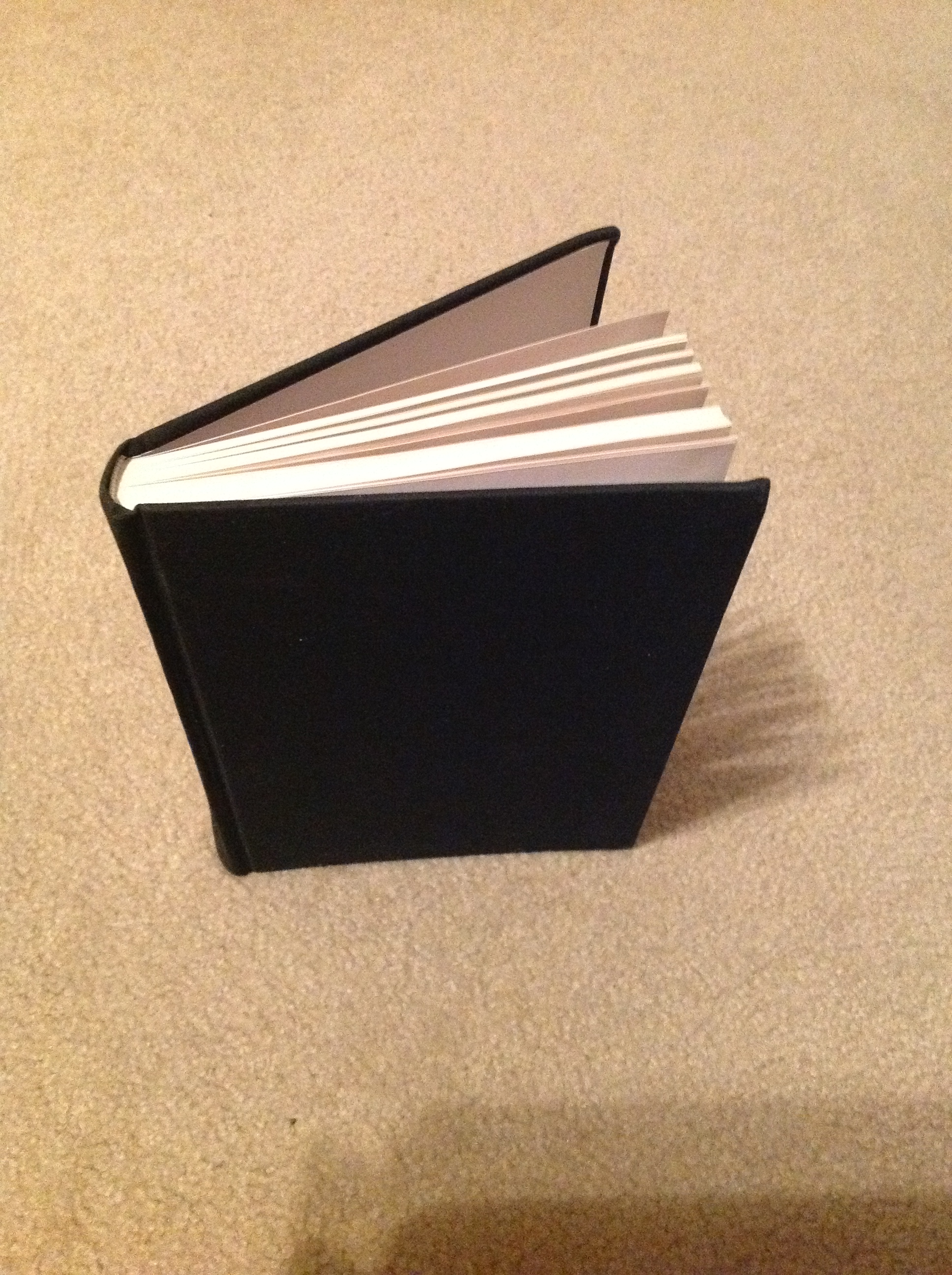
What was a little unusual was my contribution to the weight gain our luggage experienced. I bought more books than normal that day, though I don’t recall the titles of any of them. In fact, the only one I remember buying is the little hardcover book with the black cloth cover.  There was nothing printed on the cover, nor anything inside.  No page numbers…nothing.

I fell in love with the book.  I fell in love with the pure, uninterrupted blackness of the cloth cover and the pure, uninterrupted creamy whiteness of the book paper. There was something regal about it.  Though only eight and three-quarter inches high and six inches wide, it has a presence lacking in a lot of coffee table books I’ve seen.  It is a commanding book!

Of course, I bought it.  For just one dollar.

I inquired about the book with the librarian.  She said she thought it was just a case-bound sample…a book demo.

It could serve as a journal for someone, but not for me.  My handwriting is illegible; this book deserves something far better than my scrawl. But I can’t part with it.  I can’t give it to anyone else, even someone whose handwriting might be worthy of the book.  And I could never sell it; that would be like selling my soul.

To me, it is the book I haven’t written.  It is the hundreds of blank pages to which I haven’t contributed.  It is a symbol of hope and hopelessness.  It is my little black book.

Posted in Books | 1 Comment

Blood on Marble

Exercising…just exercising..my fictional muscles.
 

Blood dripping onto a marble floor has a unique sound.  The noise is lighter and has a gentler sensation than water.  Drops of water “thud” flatly when they hit the floor; blood has more of a high-pitched ring to it, making a sound like tiny crystals breaking as they hit the bottom of a well, far off in the distance.  And it looks different, too.  Aside from the color, of course.  Have you noticed that blood actually looks thinner than water?  Really.  When it drips onto the floor, or into the sink if you’re lucky, it splashes in much wider rings than water.  Instead of one drop breaking into a few, or even a few dozen, smaller droplets like water, a drop of blood breaks apart on impact, bursting into a mist of  tiny droplets, far smaller than droplets of water.

I would not have known this, had it not been for the razor blade that got caught in Jeremiah’s toothbrush.

Jeremiah accidentally knocked his dopp-kit to the floor just as Canyon was trying to step around him to get his watch off the counter.  Canyon was first to shower and shave that morning; he had hurried to get out so the rest of us could get ready to go, but he left his watch.  And Jeremiah’s elbow knocked the dopp kit off just as Canyon stepped in.  The Mach III razor was in the dopp kit, along with Jeremiah’s toothbrush.  Canyon’s heel came down on the business end of the razor, shattering the plastic case and sending one of the blades between the rows of bristles on Jeremiah’s toothbrush.

We heard the crunch of Canyon’s heel on plastic, but we didn’t see what took place inside the dopp kit.  It wasn’t until Jeremiah started to brush his teeth that the results of the misstep began to show themselves.  Of course, it wasn’t until much later that we figured out what had happened.  In the meantime, we learned the sound of blood is different than the sound of water.  At least on marble.

Three of us shared the motel room and its one bathroom.  Canyon and Jeremiah slept on the two double beds and I got the fold-out sofa.  The place had at one time been a lot more upscale.  The marble in the bathroom was the most obvious evidence the motel had seen far better days, but there were other signs, too.  The lobby.  The restaurant.  The now run-down gardens.  We stayed there because it was cheap and because we had to get out to the job site before 7:00 a.m.; it was close, a straight-shot to the rig.

Posted in Fiction | Leave a comment