
Culinary Hypocrisy

I was reminded this morning of an essay I read six years ago that made me pause and reflect on my fascination with food. The essayist, William Deresiewicz, asserts that food replaced art as the embodiment of high culture. Deresiewicz says the “foodie” movement, which he says began somewhere around the mid 1990s (I think it started much earlier, but I can’t claim my opinion has more credibility than his), triggered a social movement in which the adoration of and appreciation for sophisticated flavors supplant the arts.  Referring to food, he says:

It is costly. It requires knowledge and connoisseurship, which are themselves costly to develop. It is a badge of membership in the higher classes, an ideal example of what Thorstein Veblen, the great social critic of the Gilded Age, called conspicuous consumption. It is a vehicle of status aspiration and competition, an ever-present occasion for snobbery, one-upmanship and social aggression.

That is the paragraph that gave me pause. Had I allowed myself to unknowingly (or, even worse, knowingly and secretly) latch on to food as a symbol of my sophistication? The question bothered me. But, after mulling it over for a while, I decided I was not (and am not) guilty. Yet I think Deresiewicz was on to something. I’ve read and heard comments that give credence to his argument. I know of people who use their knowledge of scarce ingredients and their ability to distinguish between esoteric flavors as cultural cudgels against those who do not share their high sophistication. I find that level of arrogance deeply disturbing, yet I wonder whether, when I mock that undeserved snobbery, other people think I’m serious. And that, too, gave me pause. Perhaps, even in my mockery, I am lending credence to the idea that a ‘sophisticated palate’ differentiates between commoners and the cream of the cultural crop…and that I belong to the latter cohort. And that bothers me, too. Am I guilty of culinary hypocrisy?

I suppose the answers to my questions remain elusive; I do not know whether, subconsciously, I lend credibility to the notion that knowledge of and appreciation for food is a cultural milepost on the way to supremacy. I hope not. I hope, instead, that my fascination with food is simply this: a fascination with flavors and textures and colors that, collectively, satisfy my palate and please my senses. I hope my passion for food exists only to the extent that food is fun; not that it defines my value as a person. When I encounter recipes that call for obscenely expensive ingredients, I question whether anyone would even consider spending the money to buy them; it’s only food, after all. But affordability is relative, isn’t it? Perhaps if I’d climbed higher on the status ladder and had achieve greater wealth, I would be willing to spend the money. Again, I hope not. But who’s to know? Would a true food snob seek out cheap dives in search of a perfectly prepared chicken fried steak? I tell myself ‘no,’ but I wonder if that’s precisely the behavior one might expect from a snob.

So, I can’t answer my own questions with any degree of certainty. But I can endeavor to avoid being a food snob, while maintaining my interest in trying new foods and experimenting with flavors and learning more about them. And I can continue to smirk at and mock food-snob behavior, all the while looking in the mirror in an effort to avoid mocking myself.
Posted in Food, Materialism, Philosophy | Leave a comment

Seeing Smoke

Elvin Sharp awoke with a start. His eyes sprang open to reveal ribbons of soft blue and white light billowing from beneath the motel door. The swirling strips of light confused him. Light doesn’t curl like that, does it? Of course not. I must be dreaming, or waking from a dream. He lifted his neck from the pillow and shook his head, hoping to clear the haze in his brain that he thought must have caused the unsettling image. But light continued to surge from the threshold, twisting and rolling back upon itself. He sat upright and smelled burning wood, realizing what he saw.  Orange and red flashes from outside the room illuminated the smoke pouring in from the hallway. The temperature in the room soared. Streamers of grey and blue and white smoke morphed into a black cloud as Elvin swung his legs over the side of the bed. He tried to breathe but the dark fog filled his lungs with hot soot, triggering reflexive coughs, as he stumbled out of bed and fell to the floor. Elvin struggled to crawl toward the window but he didn’t make it all the way, slipping into unconsciousness just inches away from the outside wall.

When he awoke at six fifteen, the bed sheets were wet with perspiration and his hair was wet with sweat. He  remembered the dream; it was so real he could smell the burning wood, still. He turned toward the bedside table where a cold cone of burned incense sat on a saucer, a half-burned match stick alongside.

“Damn her, she controls even my dreams,” he said aloud, seeing in his mind’s eye an image of the woman who married his best friend a year earlier.

[Vignette alert.]

Posted in Fiction, Writing | Leave a comment

Photograph

The boy I was, looking earnestly into the camera,
could not have known his passion would melt,
after a thousand defeats, into painful indifference.
That hopeful lad, barely in his twenties, knew nothing
of failure. He believed intellect could take him
anywhere he wanted to go. His enthusiasm had not yet
been dulled by the sad scrape of detached cynicism.

Tears well up when I look at that boy, knowing what
I know about his dreams, dashed against the real
world; the world nobody explained to him, for fear
of breaking his heart, before he had a chance to try
to change it. He was a dreamer, that boy; when I see
one like him, I want to warn him about the nightmare
that’s coming, but I can’t bear to break his heart.

Posted in Poetry, Writing | Leave a comment

The Person You Have Been

Boy, could I tell you some stories! You probably wouldn’t believe them, even though they’re all true. See, when you’ve lived a life as crazy as mine, people think the stories you tell are pure fiction.

Nobody believes me when I talk about the time Hempster and I went scuba diving off the Great Barrier Reef. A great white shark got Hempster by the leg and almost dragged him to his death, but I stabbed the bastard in the eye with a piece of coral and it let him go. The reason Hempster limps now is that his left leg is shorter than his right, thanks to the surgery after the shark attack.

And people assume I made up my story about pissing on Pablo Escobar while he was sleeping off a bottle of single malt Scotch, but it’s absolutely true. See, Jesus Trujillo and I were in Medellín, hoping to make a deal with Escobar to take over rural distribution of cocaine in the Texas panhandle. Well, with Escobar you didn’t just make your case and get his answer. No, he had to know who he was dealing with before he made any commitments. So he kept us close for a week or so, just sizing us up. Every night, we’d party. I mean big time. Booze, weed, music, girls. It was wild! One night, Escobar broke his own rules and drank like a fish. That night, we all did. He passed out and I got the idea in my head that peeing all over him while he slept would be cool. Fortunately for me, Trujillo got us out of there before Escobar woke up. Obviously, we didn’t get distribution rights for the Texas panhandle. And I’m still alive, so Escobar didn’t find me. But he had to know it was me. And that gives me a little bit of satisfaction.

After our little foray into cocaine distribution, Trujillo and I got mixed up with a couple of guys who stole company checks and made counterfeit copies. They were into a fairly elaborate ruse in which fake checks were sent to people who were told the money was the prize for a contest they had entered. Before they received the checks, though, the guys called and said a mistake had been made; the checks were for double the proper amount. They were asked to cash them and wire half the money back to the company. About half the idiots did it. Anyway, Trujillo decided we’d be better at this scam than these guys, so one night he breaks in to their place and steals everything they had: checks, address lists, databases. Everything. Two days later, the Feds bust the guys. Because we figure the Feds know what they’re looking for, we ditch everything Trujillo stole. We never did take over the game, but now these guys are looking for us, assuming they got out of jail.

Then, there was the time a girlfriend, Mary, and I took a train from New York to Nova Scotia. We made love, right there in our seats, between every stop. You know about the ‘mile high club,’ right? Well, we formed the ‘riding the rails club.’ Nobody said a word, but I’m pretty sure everybody knew exactly what was going on. The reason I think so is that, when we got up to get off the train in Halifax, the whole car we were riding in stood and gave us a standing ovation.

Those times are all gone now, though. And what do I have to show for them? Not a damn thing. Nothing. Hempster is dying and Trujillo is dead. So is Escobar. I don’t know about Mary, but even if she’s alive she’d want nothing to do with me now. A lifetime of thrills with nothing to show for it but memories. And my memories are the kind that people look at with disdain. Contempt.

I could tell you more stories, but what’s the point? They all paint the same picture. They all tell the same tale. You know, if I could live my life over again, I might do it differently. I probably would, in fact. But you can’t un-do things you’ve done. You can’t un-be the person you’ve been.


Posted in Fiction, Writing | Leave a comment

Human Trafficking

I attended an interesting and informative, but disturbing, presentation this morning on human trafficking. I learned that human trafficking is not a problem limited to other countries but is of enormous concern right here in the USA. Sex trafficking, labor trafficking, and drug trafficking are three principal problems affecting large numbers of people in the U.S., with an especially significant impact on the young, who are particularly vulnerable. People who know how to take advantage of the chinks  in a person’s armor caused by emotional or physical vulnerabilities or abuse lure and/or force kids and young adults into prostitution, slave labor, and service as drug mules, among other functions. The presentation touched me and made me want to share my newfound knowledge. But something about the presentation and the organization behind it gives me pause.

Partners Against Trafficking Humans (PATH) endeavors to find and help victims of human trafficking; it advocates on behalf of trafficked victims in Arkansas. The organization’s efforts are admirable. But, again, something about PATH gives me pause. My issues are found in the following paragraphs from the organization’s website:

PATH’s Mission is to advocate on the behalf of those victimized by sex-trafficking, provide trauma focused restorative care and educate our communities. This is done through a number of services with a primary focus on providing a safe environment for rescued victims of sex-trafficking, sexual assault and prostitution to heal in a therapeutic, residential program of restoration and community reintegration, through a variety of Christ-centered services and recovery programs, offering hope for healing, personal growth and future success.

Our Philosophy
: God is at the center of all we do. We are committed to building God’s Kingdom and integrating faith, healing, learning and action.

Some might consider my objection to the injection of God and Christ into the organization’s philosophical foundation an example of my own bias and bigotry. Perhaps. But I view the religious context of the proffered services as revelatory; the insistence on bringing religion into a social service ostensibly aimed at helping victims escape traffickers strikes me as evangelism disguised as empathy. While I don’t doubt the sincerity of staff and volunteers in wanting to help victims of trafficking, it is impossible for me to classify their motives as purely altruistic. Because they bring religious belief into their activities, I can’t believe they are involved purely as humanitarians; they are, to one degree or another, “spreading the gospel,” as it were. While I have no evidence to suggest that the services provided to victims are overtly religious in nature, the organization’s proclamations of its religious core strongly suggests services predicated on religion.

All of my misgivings having been aired, let me go on to say the good done by PATH, and organizations like it, probably outweigh the damage done by covert or overt evangelism. I wonder whether, if confronted with my attitudes about its philosophy, the organization would refuse my offer to help, were I were to make one? I probably won’t ask. But, until I know, I cannot in good conscience offer money or other assistance to an organization that might use such resources to further a religious agenda integral to its efforts to extract and heal victims of human trafficking. At least that’s where I stand today.

Posted in Philosophy | Leave a comment

Grace

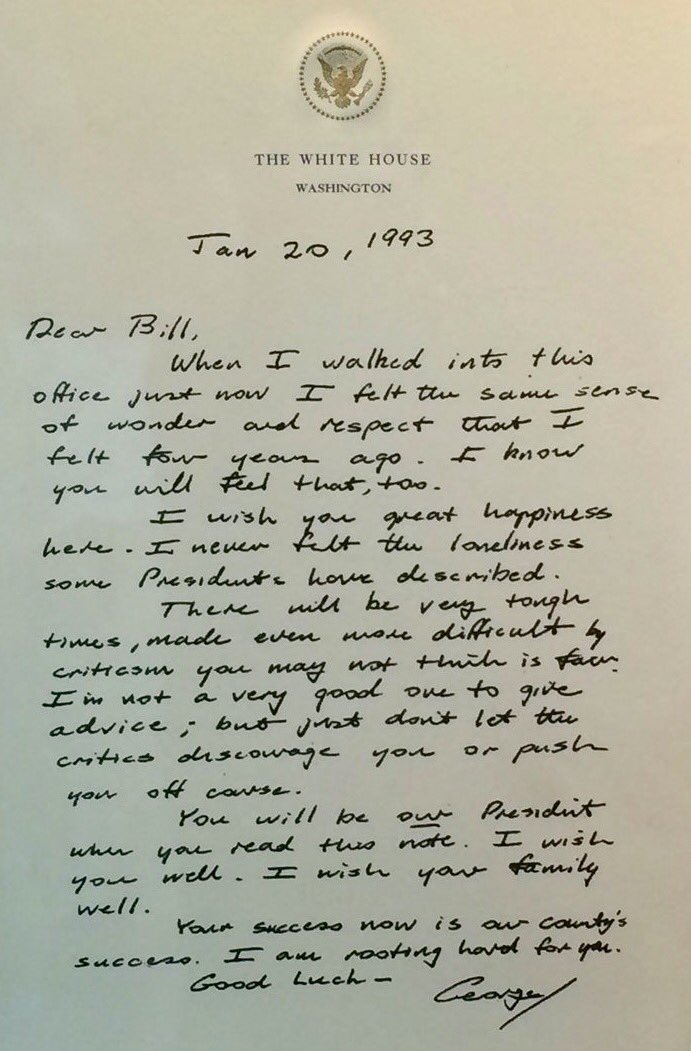
bushletterAn image of a hand-written letter George H.W. Bush left in the Oval Office on January 1993 for Bill Clinton has gone viral (click on image to enlarge). The letter exemplifies a flurry of shared sentiments that seem to have sparked what I hope is an attitude shift in the American psyche. The letter exudes decency and good will. It personifies a rebirth of the American spirit that seemed to have died during this agonizing political season, this seventeen-month visitation from the depths of a toxic well that showed us the worst of humanity.

Lately, as I read even partisan essays that rail against the positions of various candidates, I see occasional evidence of a writer intentionally avoiding personal attacks. I think—I hope—the acidic vitriol the past year and a half may finally have caused us to seek a way out of the caustic soup in which we have been drowning. We require a radical shift in political discourse, I think, if civil society is ever to recover from its near-death experience. But political discourse is not the only aspect of our lives that must change; all interpersonal interactions must change so that society—that is, each of us—tolerates only respect and dignity and civility in our discussions and dialogue.

I do not have to agree with George H.W. Bush to acknowledge his generosity of spirit. And I need not accept the arguments made by Trump or Clinton or Johnson or Stein or McMullin or their supporters to accede they may have legitimate reasons to hold them. Let me be the first to admit that, heretofore, I have contributed to the fury and venom. But I hope I am one of millions who tire of the acrimonious words and behaviors plaguing this election season and who wish to put them behind us as we try to bridge the fissures dividing us. That task would be immeasurably harder if, perish the thought, Trump were elected. But even then, perhaps especially then, the need for decency must outweigh the desire for “revenge.”

George H.W. Bush wrote a letter that, in my view, exudes grace that’s not in any sense religious but, rather, deeply and wonderfully human. Let us all follow his example.


Posted in Civility, Philosophy, Politics, Secular morality | Leave a comment

Birthday Decadence

Birthday Alarm (which I once used to remind me about birthdays of people with whom I did business) tells me I share my birthday with Dizzy Gillespie, Carrie Fisher, Alfred Nobel, and Benjamin Netanyahu. I should feel honored to be in the company of such astonishing talent and political prominence, because critical acclaim and deserved fame and leadership must course through my veins like blood pumps from brave hearts…

…but wait. I share my birthday with Kim Kardashian and Judge Judy Sheindlin, as well. So, could it be that arrogance and self-serving buffoonery also inhabit my DNA? Does my tenuous thread of connection with people who happened to be born on the same day and the same month as I, though in different years, suggest I might share attributes with those people?

I think not. I’ll take it a step further; I am as close to certain there is no connection as is possible. The very idea that any connection exists between personality traits and one’s birthday is,to put it politely, delusional. Am I absolutely certain? Of course not. I’m not absolutely certain my entire lifetime is not simply a dream taking place in someone else’s mind during that person’s fitful eight hours of sleep; but I’d be more than moderately surprised to learn that were true. Now, on to what’s real about this birthday, now that I’ve reached the halfway point in my life (I have sixty-three years remaining; I peered through a crack in the space-time continuum to witness my demise at age 126).

My favorite wife suggested this morning that we go out to celebrate my birthday with breakfast at The Quarter Cafe, in Hot Springs. We had not been there before and I’ve wanted to go (my intent has been to go at lunchtime, but I’m not one to decline an out-of-house breakfast experience), so I accepted.  Mi esposa hermosa ordered Country Ham Benedict, consisting of thick slices of ham served atop a biscuit with poached eggs. She chose sausage gravy for one of her eggs and hollandaise sauce for the other. Decadence on steroids! I selected the Creole Slammer, which consisted of eggs (I asked for poached), crawfish étouffée, a biscuit, and a choice of breakfast potatoes, cheese grits, or fresh fruit; I chose the potatoes (though I wanted the grits…I don’t know what came over me).

Fruit makes it healthy.

Fruit makes it healthy.

Étouffée for breakfast!

Étouffée for breakfast!

Posted in Aging, Food, Mythology | Leave a comment

Sinking into Fear and Politics

In terms of sleep, last night was moderately better than the several nights that preceded it. I think it only took me about thirty minutes to drift off to sleep after I went to bed at 12:30, though I was awake again an hour later, but only for ten or fifteen minutes. Wakefulness visited me twice more before four o’clock. Back to sleep shortly thereafter, though, and I did not awaken and get up until around six. Hallelujah! Sort of. In my view of the world, getting up at six is getting up late. And I don’t much like getting up late.

While sleep was marginally better, I spent the hours preceding it engaged in watching and then growling about the presidential debate. During my post-debate analysis of what I’d just watched, I came to the conclusion that people who support Trump are either delusional or demonic. I’d prefer to think they are simply delusional, but I think the more likely explanation is that they possess reprehensible attitudes; they can stomach ideas and even support concepts and behaviors that I find odious and unforgivable. After the election, if Trump loses, I will have to find a way to hold my nose and deal with those people as if they possess characteristics I consider human. If Trump wins, I will have to protect myself and my wife to the extent I can from the horrific consequences that most surely will befall us. I am not referring solely to economic and political consequences; I am referring to the impacts I would expect to see as civil society rapidly decays into a toxic atmosphere in which every breath breeds more hatred. I think I’m more tolerant of economic and political dislocations; I was able to deal with George W. Bush, as much as I did not like it. But I would find it damn near impossible to respond, in a positive manner, to wave after wave of uncivil discourse spewing from the White House and drowning the country in its untreated effluent.

Like so many others, concerned about the outcome of the election regardless of the “winner,” I am concerned that a Trump victory would be catastrophic. I am equally concerned that a Trump loss could trigger a retributive backlash among his rabid supporters that has the potential of ripping the country apart. Either way, Donald Trump would have succeeded in doing what World Wars I and II, the debacles of Korea, Vietnam, the Nixon white house, the Clinton impeachment, Iran-Contra, 9/11, the invasion of Iraq, and terrorism could not; bringing a great country to its knees. I hope I’m wrong on both counts; I hope my fears are simply over-dramatic responses to bizarre times in this country. Time, alone, will tell.

Posted in Politics | Leave a comment

Adaptive Jook

jookWell, insomuch as my efforts to sleep in recent hours were only modestly successful, there’s only one thing to do: post a photo of last night’s dinner with an explanation. What you see in the photo is bastardized adaptive jook. Let me explain. Jook (AKA juk) is the Korean name for what the Chinese (and I) call congee. It is a porridge of rice cooked so long in liquid that the individual kernels of rice have  broken down.  In the Korean version I adapted for last night’s meal, I cooked a ham bone and turkey carcass along with the rice. After a few hours, the I stripped the bone and carcass of meat and returned the meat to cook some more. I adapted by using a chicken carcass, due to the unavailability of dead turkeys. I further adapted after the meal was cooked by bastardizing my bowl of adaptive jook with the addition of soy sauce and sambal oelek, two garnishes that prove the inauthenticity of any congee or jook made in my house. Neither garnish is called for in recipes for Asian rice porridge, but behind my doors’ threshold, Asian rice porridge does not have the same appeal without them.

I’ve probably written about my opinions about “authenticity,” when it comes to ethnic cooking. I know I have strong opinions on the matter, which almost always translates into having written about them. Regardless, here goes: the only authenticity one ought to be concerned with with respect to foods is the base, underlying flavor profiles. If one were to visit the homes of a dozen people from any given culture outside the U.S. and ask the host to prepare a dish common to that culture, more often than not there would be variance between the dishes. They might have a fundamental similarity in underlying flavor, but each would be unique. So, which one is authentic? Every one of them. Transferring the recipes to the U.S., some ingredients might not be readily available; but if those hosts came home with me and prepared the same dishes, using available ingredients to mimic flavor profiles, the dish would be authentic, in my view.

That having been said, I would not be surprised to learn that my bastardized adaptive jook is a far cry from jook I might find in a home in Seoul. The recipe from which I created and bastardized my meal may have been an adapted recipe. The ingredients I used may be only distantly related to the ones used in the household in Seoul. But I enjoyed making it and I enjoyed eating it. So, my meal may have been authentic only in the sense that the core ingredients were related and the method of cooking resembled that used in Korea. So, did I eat a Korean meal last night? Hell if I know. If I did, I have to admit that I prefer a Chinese version I make in which the primary flavor enhancer is ground pork, rather than ham bone and chicken carcass. Nonetheless, I’m pleased to have made jook (also spelled juk). By the way, my limited research into jook (or congee) suggests that the dish is the same from Asian culture to Asian culture, with minor modifications to ingredients and to linguistic roots describing it.

Posted in Food | Leave a comment

Pale Lights in the Night

Very early in the morning, just after midnight, the dim night light in the bathroom provides just enough illumination for me to avoid bumping into bedroom furniture. An hour and a half later, the faint glow of the microwave’s clock does the same as I make my way out of the bedroom into the kitchen. By three in the morning, I follow the pale blue flicker of the modem’s lights toward the guest room, where I keep my notebook computer. That’s the room in which I do most of my writing. There, I can turn on the light without worry that I will wake my wife; I often worry that, if I turn on the kitchen or living area lights, I’ll wake her. It hasn’t happened yet, but I worry. I am, by nature, a worrier, even when evidence suggests it is a pointless pastime, as evidence usually does.

Lately, for three or four nights, anyway, I’ve had a great deal of experience with the different ways dim lights provide beacons for my forays about the house. I’ve had a great deal of trouble getting to sleep. I stare at the ceiling, or keep my eyes closed, and wait for sleep to come; forty-five minutes, an hour, two hours. And then, once I’ve finally drifted off, I awake again, either with a need to pee or a sense that sleep is trying to avoid me and, therefore, I must seek it out. I do that by wandering the house.

Perhaps the difficulty in going to sleep and staying asleep has to do with my recent affinity for massive amounts of iced tea in the evening. That should not be the cause, for I drink decaffeinated tea, but maybe the sheer volume of icy liquid is playing havoc with my sleep cycle.

But might there be an underlying psychological cause, something bothering me? Perhaps, though I can’t guess what it is. Yet it’s not outside the realm of possibility that I’ve allowed things that really have no business bothering me to do just that. I think I might need to recline on a couch in the presence of a skilled and gifted psychotherapist who could, through his or her superior skills in ferreting out motivation, uncover the culprit that’s causing my insomnia. Or, I could write string of consciousness blather in the off-chance I might simply allow the reason or reasons to slip out of my brain, down my arm, to my fingers, and onto the keyboard. I sometimes believe that’s the way I think; without a willing keyboard, I might be unable to form complete thoughts.  Even with a keyboard, my thoughts often clash with my fingers, refusing to have anything to do with them, in the fear my fingers might expose thoughts unsuited to polite company. Whatever the hell that means.

Returning to the lights, at times I am struck by the fact that the moon can fill the sky with brilliant light but, because of its location in relation to the windows in my house, I cannot rely on the moon for illumination. Instead, I must depend on electricity. Colored filaments and blinking lights and dim glows that offer clues that allow me, usually, to avoid slamming my head or my feet into something that too closely resembles the dead black air surrounding it.

Off I go, to try again to take a break from wakefulness.

Posted in Insomnia | Leave a comment

Race in America: 13th

Last night, I watched a documentary film, directed by Ava DuVernay and entitled 13th, named after the Thirteenth Amendment to the U.S. Constitution. Ostensibly, the Thirteenth Amendment outlawed and eliminated slavery. The film convincingly argues slavery was preserved and sustained through mass incarceration of people of color.

DuVernay argues that the words of the Thirteenth Amendment have been twisted by what she calls the prison industrial complex. The amendment reads as follows:

“Neither slavery nor involuntary servitude, except as a punishment for crime whereof the party shall have been duly convicted, shall exist within the United States, or any place subject to their jurisdiction.”

DuVernay posits that the words I’ve highlighted above have been used as a means of perpetuating slavery and controlling people of color. Her presentation offers a compelling argument that institutional racism is not simply a byproduct of prejudice and bigotry but, rather, an intentional mechanism to overcome the prohibition against slavery.  Data she incorporates into the documentary provide ample evidence to convince me that she is right. Assuming her numbers are correct (and I do make that assumption), the U.S. accounts for just five percent of the world’s population, yet the country accounts for twenty-five percent of incarcerated individuals worldwide. More than sixty percent of people in prison in the U.S. are people of color. Corrections Corporation of America and other for-profit prison management companies have contributed heavily to the American Legislative Action Council, a conservative assemblage of legislators and their corporate financiers, writing laws making incarceration of people of color a money-making opportunity. The “war on drugs” launched by the Nixon administration and supported by administrations since has treated people of color differently from others. For example, possession of crack cocaine, a cheaper product than powder cocaine and therefore easier for people of limited means to obtain, landed people in prison for life, whereas sentencing guidelines were much more lenient for suburban white users of the powdered form.

The prison population skyrocketed after the war on drugs was declared: 357,292 inmates in 1970; 513,900 in 1980, 2.3 million today. The Black community improperly bore huge proportions of the increases.

Prisoners today are used to produce products sold by many companies whose names most of us would recognize.  While some companies may have stopped the practice of contracting with prisons for product manufacture, in the past (and possibly today), Walmart, Victoria’s Secret, companies involved in telecommunications, and many others benefit from mass incarceration. In one example, the specifics of which I can not recall, a telecommunications company charged outrageously high rates for outgoing telephone calls home by inmates; in order to make a ten minute call, I believe, an inmate had to work three hours at a tiny hourly wage to pay for the call.

I am not a Pollyanna. I realize many people in prison are bad folks who need to be kept behind bars to protect society. But I cannot accept that a one-time user of crack cocaine with no other convictions of any kind should be put in prison for life without possibility of parole. The minimum sentencing laws, ostensibly adopted as harsh means of dealing with a scourge threatening this country, created a monstrous system of oppression. The massive numbers of people unjustly incarcerated for so long presents an enormous problem for society; we’ve warehoused these people and haven’t attempted to rehabilitate them or give them marketable skills, so releasing them without massive aid probably would boomerang. Yet keeping nonviolent offenders in prison under utterly unjust and oppressive sentences is just as bad or worse. I don’t have an answer. But I believe we must hold our political leaders’ feet to the fire and demand they address these injustices.

I encourage everyone to watch 13th. It’s available on Netflix. Invest one hour and forty minutes to learn what people of color, especially Blacks, deal with in society today. It is a sickening embarrassment. It won’t stop until White America joins with people of color to demand the dismantling of the prison industrial complex and the undoing of public policies that effectively subject a large proportion of our population to involuntary servitude as a means of enriching corporations and the politicians who reap the rewards for their obedience to their corporate masters.

Posted in Philosophy | Leave a comment

Flaws, Faults, and How We Define Them

If you’re looking for flaws, look inside yourself. Look at your own behaviors, behaviors for which you would condemn others were they to engage in them. If you judge other people for failing to meet standards and expectations you are incapable of meeting, the hypocrisy of your double standard will speak volumes about your character. Be firm with yourself for all those many flaws and take steps to attempt to correct them. But don’t be too hard on yourself; you probably are your own worst critic; you probably recognize those faults and already flog yourself for them. Understand that flaws comprise more than a fraction of each of us. Humans are no more perfect than any other creature, though the genesis of their flaws may be far more complex.

That having been said, I think it’s reasonable to assert that some flaws, some behaviors, are inexcusable. No pardon can erase the behaviors arising from them nor in many cases their effect. Some actions cannot be excused. Murder, for example, or rape. But what about actions that could lead to the inexcusable? A failed attempt at murder. A foiled sexual assault. What of those and a thousand other points along the continuum from accepted and appreciated to unacceptable and forbidden? Where do we as society draw lines? And how? More importantly, where do we as individuals draw our own lines? And, are they solid lines that reveal absolute limits, or do they creep back and forth along a shifting boundary?

The incivility of the political discourse since June 2015, and even before, suggests to me that this, and most, conversations fall on deaf ears. Instead, we throw barbs back and forth. I certainly have. Decency is a moving target. The definition of decency is flawed today. But so is the dictionary that allows it to be defined in ways harmful to social cohesiveness. We’re responsible for writing the dictionary, aren’t we?

Posted in Philosophy, Secular morality | Leave a comment

A Bit of Background

Whisper. Tell the story, but tell it at such low volume that the audience must strain to hear it. Tell it like the truth can’t bear loud noise. There, now you know the predicament I’m in. Truth dare not speak in a loud voice. 

I spent the night on the sofa. Not because I was sent there in punishment for bad behavior, but because I fell asleep after too many shots of whiskey. Who can understand how that comes to pass? Who among our parishioners can remember awakening at six in the morning, sitting on the sofa with the TV blaring? That’s what too much to drink and too little to think can do to a man. You just implode. You just become the vapor you hoped you’d never have to inhale.

My story began way before I began to tell it. It owes its beginning to seeds that sprouted after we sent fifty thousand of our finest young men to die in Vietnam. Do you know about that war? Do you know how we, this society of ours, treated the men we sent there? We cannot begin to understand the depths of our psychosis until we admit to what we did to the young men who did what they were told to do. 

So, now you have some sense of how it began. I can’t assure you it started quite that way, but it was something like that. It ripped through Melvin Toot’s brain like that. It caused his struggles. He was not to blame for his behavior, not any more than the cop who shot him was responsible for the fear that drove him to pull the trigger, killing an unarmed Melvin just days before his sixty-third birthday.  The thing is, if the cop hadn’t killed Melvin, he would have done it himself.  So, I need to tell the story of how it all played out, just so you’ll understand. Somebody has to reveal the truth. I didn’t wish it would be me, but sometimes you don’t have the choice. If I’m going to tell Melvin’s story, I’m going to have to be honest about myself. Please don’t judge me until you have all the facts. Please. Don’t assume you know what’s in my heart until I tell you. Life isn’t as simple as you may think.


Posted in Fiction, Writing | Leave a comment

Malaise

My waning interest in writing troubles me. Or, perhaps, it’s my willingness to invest my fingers in fiction that’s atrophied in recent weeks. I want not to write, but to have written. I think Dorothy Parker wrote something like that. I understand the sensibility. It’s as if my best writing, none of which is completely satisfactory, is all behind me. Ahead lie only poorly constructed sentences devoid of the beauty I wish for them. When I write, I feel as though my words are slogging through cold maple syrup that crystallizes a bit more with each key stroke. This is not writer’s block. This is different; this is the sense that language—every shred of meaning having been extracted from each word and every individual letter—is moribund. The language available to me may no longer be adequate to convey significant thoughts or emotions; it may no longer have the capacity to depict scenes, evoke ideas, or summon affection or antipathy. This is, of course, absurd. But that’s where my mind is going this morning. I’ve been awake for quite some time and am now working on a second or third cup of coffee, but my thoughts remain a porridge of mush and misgivings. I wonder if I should turn my attention away from fiction and focus, instead, on writing essays? Opinions and beliefs, many competing fiercely with one another, fill my head. Perhaps I should form them into cogent arguments by putting them in writing. I might thereby successfully claim one or the other of my many clashing ideas as truly my own, one I can champion without arguing against myself.  This long, convoluted paragraph has taken far too long to compose. The malaise has won for now.

Posted in Philosophy, Writing | 1 Comment

Broken

Redemption is a fallacy, a wish without reality.
Mistakes are not corrected, they’re simply patched and painted.
Atonement comes through action, if it ever comes at all,
penance is a token, a souvenir of all that’s wrong.
Forgiveness is just a hope to make whole what we have broken.

Posted in Poetry | Leave a comment

Without a Plan

I’m drinking coffee in a thunderstorm. Well, not really IN a thunderstorm; that is, I’m not getting soaked. But I hear it. Cracks of thunder punctuate the sound of rain pounding on the roof. I can only imagine what the wind and rain are doing to the leaves on the trees that only recently commenced the annual process of denuding themselves. I spent a few hours outside two days ago, electric leaf blower in hand, in an attempt to get a head start on clearing out the leaf fall. That, my friends, was a delusional and utterly quixotic undertaking, akin to sitting on a sand dune in a gale in an effort to keep each grain of silica safely affixed to the ground. The leaves I managed, last year, to encourage down the steep hill behind the house now feed pine seedlings, another force of nature I would rather not have to fight. So, too, will the leaves I chase this season. I am a hamster on a wheel, chasing after something just beyond my line of sight,  in a futile attempt to reach freedom. Ah, but it gives me something to do, right? I might just as well roll a stone up a hill, watch it roll down, and repeat the process. Eternal punishment for a multitude of my sins.

Today, we drive to Little Rock to see about selecting furniture to replace some delivered just a few days ago. After delivery, we decided some of the stuff was not suitable. So, the seller will send a truck to take them back. And we will, with good fortune, find something that better suits us at the same furniture store, in which case the new stuff will arrive in exchange for the original purchase. Otherwise, we’ll have empty spaces to fill and will have to look elsewhere. After the trek to Little Rock, we’ll go to Hot Springs for the first of a three session class to learn about jazz. And, later, I will contemplate what I’m after in what’s left of this life of mine. I never actually decided what I wanted to be when I grew up. And here, suddenly, I’m all grown up without a plan. I do hope it’s not simply to blow leaves or roll stones, though those are better than many other possibilities.


Posted in Philosophy | 2 Comments

Trapped in a Mine

Today, while looking through old notebooks, I came across a note I wrote six years ago. Late in the evening of October 12, 2010. The note, dated October 12, 2010 and marked with the time I wrote it 10:28 p.m. read, “I am deliriously happy with tears in my eyes. They’re bringing the miners to the surface.” I knew, instantly, the subject of the note, even though there was no more specificity in what I wrote. It reminded me of a post I wrote last year a few days after the fifth anniversary of the rescue of thirty-three men (thirty-two Chilean and one Bolivian miners) who finally returned to the surface after sixty-nine days trapped in the mine. In last year’s post, I recalled the flood of emotions that the rescue attempt and its ultimate success triggered. Today’s discovery of that note brought back all those emotions, too. But my memory of exactly what happened, other than my emotional reaction to it, was a little fuzzy. So I did some research to try to recall details about the event that touched me so deeply.

The story that ended with such spectacular joy began with a monstrous cave-in on August 5, 2010. The San José mine, located in the Atacama Desert about forty-five miles north of Copiapó, Chile, was an old copper and gold mine whose owners had a history of breaches of safety regulations. A number of miners had died in the years before the August 2010  calamity and the company had been accused of ignoring miners’ complaints about unsafe conditions.

Two groups of workers were in the mine when the cave-in occurred. A group nearest the mine’s entrance escaped immediately after the cave-in, but thirty-three men were trapped. Initially, the men tried to escape through ventilation shafts, but the ladders required by mining safety codes were missing. Additional ground movement made the ventilation shafts unusable by rescuers.  The men organized into groups to take care of specific survival tasks during their ordeal. They rationed emergency survival supplies intended to last for only two or three days so that they lasted two weeks, instead.

While the trapped men collaborated with one another in their efforts to survive and cope with the horror of being trapped below ground and with no assurances they would be found, rescuers worked feverishly to find where they were in the mine and rescue them. Several boreholes were drilled in an attempt to locate the men. On August 19, two weeks into the rescue operation, one of the drills reached a space where they believed the miners were trapped but encountered no signs of life. On August 22, the eighth borehole broke through into the miners’ location. The men, who for days had heard sounds of drills approaching them, had written notes to send up to rescuers. When the drill broke through, they attached one such note to the drill tip with insulation tape. The note read: “Estamos bien en el refugio los 33” (meaning, roughly, in English, “We are well in the shelter, the 33”).

Between the time the drill reached the men and their rescue, food and water was sent down to them, but by the time they were finally brought to the surface in mid-October, they had lost an average of eighteen pounds each. In addition to strain on their bodies, their ordeal took its toll on their minds. From what I have read, only their recognition that they had to work together as a cohesive team kept them from utterly cracking, psychologically, during the more than two months they spent underground.

The shift foreman, Luis Urzúa, is credited with leading the men through the nightmare with sensitivity and wit. I read somewhere that he said, after he came to the surface (the last man out), he said, “It’s been a bit of a long shift.”  I think the stories I heard during the ordeal, about how the men were dealing with the crisis facing them, may have been the source of my exceedingly emotional response to their final rescue. When they started being lifted to the surface, I felt as if these were members of my family who were being saved. And when Urzúa finally left the mine, I was overjoyed. I wanted all the people who worked for those long weeks on the rescue to get as much recognition as the miners, though I knew the spotlight late that night and into the early morning rightfully belonged to the miners.

As I think about this event that weighed on my mind for the entire time the men were trapped, I cannot even begin to imagine how much more heavily it weighed on the people directly affected by it. I felt emotional pain by proxy. I think I want to read the words of someone who actually went through the entire episode. I am sure there are good books about it. Maybe I’ll find one. I suspect films have been made about it, too. Maybe I’ll find one of them, as well.

Posted in Compassion, Emotion, Memories | 2 Comments

Decrepit and Decaying

Evidence of advancing age and inadequate exercise showed their ugly faces yesterday as I tried to prep for today’s planned paint festival. The urgency of overcoming my procrastination in getting the work done became apparent as I looked at the calendar, realizing new furniture is to be delivered only four days hence, on Tuesday. So, I went into a frenzy of applying blue painter’s tape to protect trim, built-in shelving, and other such stuff that I want to avoid painting. The suggestion of my mortality was clearest when I began taping baseboards. My knees screamed in agony when I knelt on the bare wood floors. Even after providing a soft rubber cushion to support them, they shrieked in pain, protesting the torture to which I subjected them. But it wasn’t until I attempted to stand after kneeling for a while that the real, stark evidence became apparent. Had I not been fortunate that a chair was nearby to serve as a means of pulling myself upright, I would have remained on the floor last night, unable to stand.

Clearly, a whole body transplant is in order. If only I could download from my brain the knowledge and memories and emotions and personality characteristics I wish to retain and save them to a temporary storage device. If only I could then upload those attributes into a new brain that’s part of a well-conditioned twenty-five-year-old body with all the right qualities: strong arms and legs, narrow waist, six-pack abs, well-defined pectoral muscles, a set of sparkling white teeth lacking discernible diastemata, and all the other features necessary for physical and performance perfection.

Alas, we’re probably at least thirty years—maybe thirty thousand—from the eventual capacity to undergo body and brain rebooting. So, for now, I’ll have to settle for what I have and make do. Thus, I’ll have to paint with the same arthritic hands that protest when I make a fist. I’ll climb the ladder with feet that tend to get cramps when I confine them to athletic shoes for too many hours.

The act of preparing for, and then engaging in, painting is a young man’s game. If I were more flush and less frugal, I would hire it out. But I am neither. So, today, I paint.

Posted in Aging | Leave a comment

Beneath the Daylight Streets

When I lived in Chicago, the fact that Michigan Avenue and Wacker Drive—both main streets in the thriving downtown/loop area—had multiple levels fascinated me. The pedestrian stairway entrances descending to those streets were my introductions to multi-level streets in the city because my wife and I lived very near some of those entrances. We explored lower Michigan Avenue and lower Wacker, both by foot, and in our car, out of curiosity; there was rarely any other reason to go beneath the daylight streets, except to visit the Billy Goat Tavern of Saturday Night Live fame. The first Billy Goat Tavern opened in 1934 when William ‘Billy Goat’ Sianis bought the Lincoln Tavern on West Madison; it moved to lower Michigan Avenue in 1964. The story goes that, ten years after he took ownership of the tavern, the Republican National Convention met in Chicago. Sianis, a cunning and crafty marketer, caused quite a stir when he posted a sign on his business, saying “No Republicans Allowed.” Predictably, word got out to the Republican delegates, who thronged the tavern with demands for service. The ensuing publicity helped generate enormous visibility for the Billy Goat Tavern, which translated into increased business and a spike in Sianis’ revenue.

Supposedly, a year after the Republican National Convention and Dewey’s loss to President Roosevelt and three years before Dewey’s loss to Truman, Sianis brought his tavern mascot, pet goat named Murphy, to Game 4 of the 1945 World Series. Despite having paid for box seat tickets, the Cubs’ owner allegedly ejected Sianis and Murphy due to Murphy’s odor. The story says Sianis placed a curse on the team that they would not win another pennant or play in a World Series again, saying “Them Cubs, they ain’t gonna win no more.” The Cubs have not played in a World Series since 1945. This year, though, according to various stories I’ve heard on NPR, they are the best team in the league, so maybe the curse will break.

It wasn’t just the Billy Goat Tavern that intrigued me about the sub-surface streets of Chicago. Another aspect of the lower levels is their access to building freight entries. Buildings with main entrances on daylight streets tend to receive deliveries underground,. Though not entirely absent freight doors, the fact that these buildings are served below grade helps the heavy traffic above ground stay snarled, rather than at a standstill.

Another aspect of below-grade streets is that, at least when we lived there, the homeless tended to flock to the lower-levels during the worst parts of winter. Though not necessarily warm, sleeping on those streets protected the homeless from the fiercest winter winds and frigid temperatures.

Michigan Avenue and Wacker Drive are not the only streets with subsurface brethren. Randolph, Water, and others join their more famous brothers to form a complex hidden network of streets beneath the daylight streets. I explored a little about Chicago’s multilevel streets to refresh my memory and, in the course of my research, came upon information about the multilevel streets of Seattle, called the Seattle Underground. And seeing the term “underground” used in this context, I remembered my first visits to Underground Atlanta, called a “city beneath the streets.” That visit took place between 1979 and 1982; I worked for an association at the time that met in Atlanta regularly. Underground Atlanta, though, is a different beast if my memory serves me correctly. But it is, indeed, a place beneath the daylight streets.

I suspect a thousand stories could be told about life beneath the daylight streets of Chicago or Seattle or Atlanta. But I’ve been away from Chicago for too long to tell stories based in current-day fact and I know far less about subsurface Seattle and Atlanta. I moved away from Chicago in early 1989 to take up temporary residence in White Plains, New York and environs to work for an organization I moved to Dallas about eight months later. I did not see a lot of White Plains while I was there due to my work load, but it did not seem like a city with a life beneath the daylight streets. Nor did Dallas. There’s something edgy and rough about Chicago’s underbelly that most other cities cannot, and possibly do not wish to, duplicate.

Maybe one day I’ll visit Chicago and take a look underground to refresh my memories of that world. With enough exposure and adequate imagination, perhaps I might be able to create a realistic story, after all. I just wish I knew more about everything. I would love to be a polymath but, alas, I was born without either the ability or the discipline to absorb comprehensive knowledge about many things. The other night, attending a potluck dinner, I got into a conversation with a guy, during which we summarized our respective backgrounds. On hearing of my exposure to many fields of endeavor vis-à-vis my work in association management, he said I must know a great deal about many disciplines. I corrected his misapprehension by clarifying that I know very little about very much; my knowledge is wide and shallow.

I now realize I’ve rattled on for far too long. If I had a shred of decency, I would delete this post so that those who visit my blog would not be subjected to this out-of-left-field diatribe. But, apparently, I have no decency. A friend of mine occasionally says to me, “Have you no decency, sir?!” I laugh, but secretly I know it’s just beneath the surface, but not far.

Posted in Memories, Urban planning, Writing | Leave a comment

Social Evenings Can Change Dull to Dynamic

This evening, my wife and I attended the second Wines of the World dinner organized by the manager of the Coronado Center, a venue operated by our property owners association. The first event, focusing on the food and wine of France, was interesting but had plenty of flaws that almost made us decide not to attend the second. I’m glad we did not let the problems of the inaugural event keep us from tonight’s program. We had a hell of a good time!

Tonight’s event was labeled Wines and Beers of the World, Germany. Unlike the first event, it was held in the venue’s outside patio, which was a brilliant move. And, unlike the first event, the food and drinks were served; for logistical reasons, the food and drinks at the first event required guests to go through a poorly-orchestrated buffet line and wait in line for wine. Not tonight. We received service relatively quickly, and the beers and wines served were good. Some of the food could have been better prepared or served but the event was, all things considered, a success. The price of the second event increased by fifty percent from the first; it was a well-deserved increase, considering the dramatic improvement in the service. And, at the end of the evening, it became apparent (to me, anyway) why the event had improved; the venue manager listened to and acted on feedback he had gotten from the first. His willingness to listen was on display when, tonight, several people suggested the next event not focus on wines and food of Italy and Spain but, rather, wines and food of one or the other. He responded by saying the next event will focus on Spain, with Italy coming later.

Aside from the food and drink, we were fortunate to sit at a table with people who were…how do I put this…fun! Janine knew one of the women and I knew one of the men (and she knew a couple of others, but didn’t realize it). The group was a blast. They talked about places they’d been, food they liked, wines they enjoyed. And laughter! There was a lot of laughter!

Though I was the youngest person at the table, I felt like I was among a bunch of people who were very young at heart. It felt wonderful! I had rather low expectation for this evening; those low expectations were exceeded by two orders of magnitude.


Posted in Beer, Happiness, Humor, Wine | Leave a comment

Kilns and Flights and Preference for Empty Space

Yesterday, I went to the sculpture studio early and spent a short while working on a bust that’s in the same visual style as many of my masks; odd and alien. For many reasons, not the least of which was that I needed to drive to pick up my wife at the airport later, I left and did various errands. As I was engaged in my errands, I daydreamed about how nice it would be if I did not have to drive twenty-five minutes one-way to deal with sculpture-related tasks. If only I had a kiln, I thought to myself. That thought was fleeting, though, as I calculated when I’d have to leave to get to the airport at just the right time to meet my wife, who was returning from a brief trip to Charleston, South Carolina. While I was calculating time and distance in my travel plans, my wife texted to say she was on the way to the airport, quite early, because the Hurricane Matthew evacuations already underway were creating traffic issues; she had no idea how long it would take to get to the airport.

After receiving her text message, kiln-buying opportunities started flooding in. First, a woman called and said Nancy told her I might know where she could find a used kiln. Until I mentioned the call to my wife last night, I did not know Nancy’s identity; my wife knew, because she had told Nancy of my interest in buying a kiln. I told the caller I did not know of any for sale, but that I was in the market to buy one. She said she has one for sale; someone traded it to her for some china dishes, but she wanted a jewelry kiln, not a large one.  I know little else, except that I will go look at the kiln this morning. The other opportunity came in the form of a phone call from a skilled potter who works part-time at the college where I take sculpture classes. I had written on a chalk board in the studio that I would like to buy a kiln. The second caller asked if I had found one. Inasmuch as I had not, I told her as much and she went on to explain that she knew of a woman who has a good one for sale at a price that represents good value. So, I called the woman and learned, during the course of our conversation, that we had been in the same class a year or so ago. Due to scheduling issues, I won’t be able to go take a look at the second kiln until a week from Friday.

Jammed roads led to the airport back in Charleston. My wife’s overbooked flight to Atlanta had a very long waiting list. The airport was clogged with travelers including many vacationers attempting to flee the oncoming storm. My wife spent considerable time at the airport, boarding pass safely in hand, waiting for the on-time flight.

Once we returned home, I looked up on the walls where most of my masks once hung. We took them down so I could paint the wall. I painted that one wall, but still have others to do. But, what’s important is that, with the new paint, we decided we really preferred the wall empty. So that leads me to question whether I really want to buy a kiln, because I may not want to make more masks if I have no place to display them.

What an odd quandary. Too many masks and not enough available wall.

Posted in Art, Travel | Leave a comment

Bat Boy

Last night, toward the end of the PBS Newshour, I watched a segment about the retirement of long time Dodgers’ play-by-play announcer, Vin Scully. The segment honored the eighty-eight-year-old man’s sixty-eight year career. Despite my lifelong disinterest in sports, the segment on his career mesmerized me. I had heard the man’s name on newscasts or sportscasts before, but I hadn’t paid much attention. I wasn’t interested in sports. But listing to a several-years-old interview of Scully by Jeffrey Brown, I learned how sports, at least baseball, can represent both joy and hope in ways that, I think, other sports can’t. Hearing Scully speak in reverential awe of listening to the roar of the crowd, after the team rewarded fans’ loyalty, was an emotional experience. It made me want to enjoy baseball. Actually, of all the sports, the only ones I have actually enjoyed watching are baseball and soccer. Baseball, though, seems more refined, better suited to people who think. Why? I have no idea; it’s just my self-serving emotional response to questioning myself about why I favor baseball.

Watching and listening to Scully last night, I felt time slip away. I felt like I was living in the 1950s, when innocence was, or seemed to be, more prevalent. If I could recapture that sense of innocence and joy and purity that Scully’s remembrance brought rushing back last night, I’d watch baseball every night. Hell, I’d become a bat boy.

Posted in Emotion, Philosophy | Leave a comment

Today is Genuflectorious

I ask the question: is there a law that compels us to label what is commonly the first workday of the week ‘Monday?’ Are we required to call the second day ‘Tuesday?’ And must weekends always fall on ‘Saturday’ and ‘Sunday?’ What prevents us from calling those days, those life events, by different names? If I were to call the day you call ‘Monday’ by another name, say ‘Lugubrionus,’ would that action break the law? If, instead of referring to the second after ‘Lugubrionus,’ I said the day would respond more favorably to ‘Phalaymor,’ would I be subject to arrest?

These thoughts do not belong in the mind of a normal, natural, decent citizen. No, they belong in the mind of a madman. And I readily accept the moniker. It is an honor to be classified among the abnormal, the unnatural, the indecent.

Were I in charge of the universe, each day of the week periodically would be assigned a new sobriquet.  Doing so, though, would cast me as a member of the improper, the wrong and the wretched. But that is a grand distinction, a tribute leading almost to apotheosis (see what I did there, how I got that word to fit in this paragraph?).

For now, let’s make the following transitions:

Sunday=Genuflectorious
Monday=Lugubrionus
Tuesday=Afflictia
Wednesday=Phalaymor
Thursday=Dehydratio
Friday=Inebriata
Saturday=Tranquilismo

I admit, it may take some time to get used to this new scheme of day-naming. And perhaps it will not catch on. One never knows, though, until one tries.

Posted in Absurdist Fantasy | Leave a comment

On the Verge

Yesterday, a Facebook friend  posted an appreciative comment on another person’s post. The post was a young man’s progress report on his effort to “reboot” himself. He had made the promise to himself a year earlier to reinvent himself through changes in behavior, attitude, and experience. His promise was not unique; he made the usual promises to himself: cut down on the beer, exercise more, read more, be more understanding of others, and so forth. I don’t remember the guy’s name, nor can I find the information simply by looking at my friend’s Facebook page; my internet browser history is no help. And it’s not a problem, either. Because the specifics of the post are not important; the way the guy’s words made me feel are.

For some reason, the writer’s genuine delight at his one year of progress toward becoming a better person was inspirational in ways I can’t begin to describe. Yet, his glee was simultaneously upsetting because I’ve made those promises to myself—recently, in fact—only to break them in short order. But something about this man’s appreciation for his success, and my Facebook friend’s acknowledgement and regard for it, brought me out of my embarrassment to a new place. It brought me to a place that allows me to acknowledge my failures, but to plan my successes. Between now and my birthday, later this month, I will craft both a set of goals for myself and a series of steps I will take to achieve them. Then, on my birthday, I will announce the goals and the process by which I plan to achieve them. My goals will not be solely directed toward improving myself and my life, but the lives of people close to me. At some point in one’s life, the promises one makes to himself must come with consequences for breaking them. So I will make a solemn vow that my birthday this year will either be followed by a joyous celebration one year hence  or it will be met with the deserved consequences of failure.

This is not the equivalent of a New Year’s resolution. It’s a new life resolution, a new me resolution, and new happiness-for-those-who-surround-me resolution. It is perhaps the most important resolution I’ve ever made. And it was sparked by an appreciative expression and congratulatory comment on Facebook. Go figure.

Posted in Resolutions | Leave a comment

Caffeine and Convenience

Do pieces of electronics equipment undergo sympathetic experiences? For instance, does a coffee maker get sick when a smart phone dies? I ask this as part of a serious inquiry into the behavior of my coffee maker this morning. When I pushed the “brew” button, it bellowed with a sound like the noise made by an injured calf. Yesterday, my smart phone either died or went into a coma. I’ll take my cell phone in this afternoon for either an autopsy or a resurrection; inasmuch as I’m not a believer, I am not expecting a miracle today. Instead, I expect to be told I’ll need to relieve my bank account of several hundred dollars if I ever want to surf the web  and text and talk on the phone from the same device again.

Though that is an upsetting thought, this morning’s distressing symptoms of illness from the coffee maker were even more terrifying. What if, unlike this morning, tomorrow the beast fails to recover from its ailment and, instead, succumbs to the heartache of losing its companion, the smart phone? The idea of waking to a dead coffee maker is almost too much to bear. I must admit an ugly truth. My bereavement would not arise from the machine’s demise but, rather, would spring from the empty space in my caffeine-starved gullet. That’s right, I would be more concerned about how the machine’s death affected me than about its passing. And in that way I am a clone of Donald Trump. Now that, truly, is a sobering and disgusting thought. I may stop drinking coffee. And I lived without a smart phone for many years. Perhaps I’m capable of living without one again.

What kind of person am I, really? If you see me sipping on a cup of coffee and talking on a cell phone, slap me. For I deserve a punishment far worse than that.

Posted in Philosophy | Leave a comment