Old Stories

Skimming old stories I wrote, and even ones I started and abandoned, is a little like sorting through old photos. Photos are two dimensional triggers that may, if given enough attention, draw memories out of the tangled gauze of dim recollections. But stories are laden with emotional meat on the bones; they paint full-scale portraits of experience the way photos don’t. I suppose photographs evoke memories, while stories preserve them.

Posted in Just Thinking | 2 Comments

Iceland, Yes, Iceland

Have you ever wanted to go to Iceland? Yeah.  Me, too.  How about Finland? Yeah, I’ve been there once (just one day in Helsinki); I want to go back and spend a bit more time.

On a whim, I checked into flights from New York to Helsinki, with a seven-day stopover in Reykjavik. The price amazed me. For $936.37 per passenger, all fees and taxes and flight services included, you could leave New York on July 12, spend eight days in and around Reykjavik (or, I suppose, travel on from there), and then fly from Reykjavik to Helsinki on July 20. One week later, on August 3, you’d catch your flight back to New York, with a one-hour layover in Reykjavik (with a change of planes).  I have enough frequent flyer miles to cover round trip airfare, Little Rock to New York (though I’d have to go in the day before the flight to Reykjavik and probably on return).

The only problems with this plan are these: even at the attractive prices, when I consider the additional costs of food and lodging in Iceland and Finland, it starts to get expensive; plus, my wife is not as apt as I to just decide, on the spur of the moment, to do something like I’ve described. Planning is her thing; procrastination and spontaneous, haphazard action is mine.

But, if you have a hankering to go to Iceland and Finland, I’ve done some of the homework for you.  Here are some of your options:

Iceland

Posted in Just Thinking, Travel | Leave a comment

Food and Music and Coincidental Clothes

Minty2The unfortunate reality of yesterday’s lunch was this: the food did not tip the orgasmeter as I hoped it would. The amuse bouche was all right, though its presentation and the explanation given by the server were disappointing. The butternut squash soup was tasty, but the fact that it was barely luke warm did nothing to impress us. And the mussels mouclade and spinach mousse wasn’t delivered, at least not for all of us. My sister-in-law and I both were served a version of the dish in which scallops substituted for mussels. Not bad, mind you, but after tasting my wife’s dish, with mussels, ours was a distant second in flavor (especially since the menu that drew us to the place specified mussels). The real disappointment was the beef Wellington; overcooked, oddly “personalized” with individual pieces of meat wrapped in a pastry shell. Ah, well, it could have been worse. The advertised dessert, crème brûlée, did not materialize; a substitute involving blue berries, whipped cream, cookies , and a smear of strawberry jam, all of which were almost hidden under a giant mint leaf, was acceptable, though.


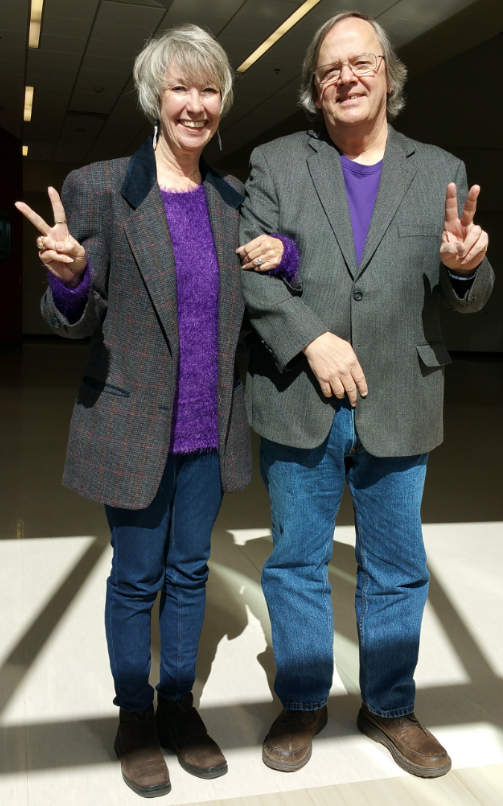
PulaskiShot2The best part of the day was the odd coincidence that my sister-in-law and I dressed as twins. Completely unplanned, we both wore grey jackets, purple shirts, jeans, and brown shoes. It was as if the universe was speaking to us; “you are soul mates, my friends, and I am dressing you alike so you will see just how well you fit one another.” Well, we DID wear similar clothes. And the colors were so damn close. I mean, how could it be that we both wore grey jackets? My favorite wife was behind the camera, capturing the coincidence for posterity. Coincidence on steroids, I say.

That was the first part of the day. After putting that strange coincidence to bed, we returned home to relax and let an over-sized lunch settle. There had been talk of what to have for dinner, but it was apparent to mi esposa and me that there was no room nor any reason for dinner. So we just chilled. And then the three of us embarked on the late afternoon/ evening adventure, which took us to the Garland County Library for a jazz concert featuring television and movie theme music. The program consisted of music from:

  • A medley from Star Wars, James Bond flicks, The Pink Panther, and Rocky
  • The Flintstones
  • MASH (Suicide is Painless)
  • On Golden Pond
  • I Love Lucy
  • Mission Impossible
  • The Muppets
  • A Disney medley: A Whole New World, Beauty & and the Beast, and Somewhere Out There
  • The Godfather
  • The Candy Man
  • Linus and Lucy (Peanuts theme music)
  • Hawaii 5-0
  • and a few extras.

My favorites were The Muppets (written by Sam Pottle & Jim Henson, I learned after the show) and the Peanuts theme music, written by Vince Guaraldi. I am enamored of everything I’ve heard that Guaraldi wrote (Cast Your Fate to the Wind is, perhaps, my all time favorite).

The six-man band playing the music was exceptional. Nathan Carman, the young saxophonist, is an incredibly talented guy who, in my view, really shows what the sax can do. Garry Henson played trumpet; when he got really wound up, he was on fire. Dr. John Leisenring was mesmerizing as he played the slide trombone.  David Higginbotham, who we’ve heard several times before, played the standup bass like a pro. And the drummer, Paul Stivitts, along with the keyboardist and band leader, Clyde Pound, sewed the group together seamlessly. Several of these guys (Higginbotham, Pound, Stivitts, and Leisenring) are playing next Sunday at the Valentine Morning Jazz Service (“New Orleans and Up the River”) at the Unitarian Universalist Village Church; we’ll be there.

All right, I’ve devoted entirely too much time to yesterday and later this week and not enough time to writing a short story contest entry and a piece for next week’s writers’ critique group meeting. After another cup of coffee, I will get to work. But I wanted to document coincidence and good times, first. And so I did.

Posted in Food, Music | Leave a comment

Fancy Lunch

Today, I willingly go off the South Beach diet at lunch time. The menu for today at the Pulaski Technical College Culinary Arts program Food Production IV lunch consists of:

  • Butternut Squash soup
  • Mussels Mouclade and Spinach Mousse
  • Beef Wellington
  • Crème Brulee

Before looking at the menu, I had never heard of mussels mouclade. After a wee bit of web surfing, I found a recipe for mussels mouclade with spinach mousse here, which also is the source of the photo below.

I have had beef Wellington, though it’s been quite some time. Coincidentally, not long ago I found a recipe for beef Wellington for two, quite a trick given the cut of beef involved in the dish. Now, I wonder whether I saved it? No matter; I doubt I’ll be making it any time soon.

Posted in Food | Leave a comment

Not My Words

The lyrics of Leonard Cohen’s poem/song, Sisters of Mercy, are among the most powerful I have ever heard uttered. This morning, some of them are on my mind.

Yes, you who must leave everything that you cannot control.
It begins with your family, but soon it comes around to your soul.
Well I’ve been where you’re hanging, I think I can see how you’re pinned:
When you’re not feeling holy, your loneliness says that you’ve sinned.

And then, in a later verse, he strikes at the heart of everything that constitutes humanity:

If your life is a leaf that the seasons tear off and condemn,
they will bind you with love that is graceful and green as a stem.

This explains, as clearly as anything I’ve ever read or heard, the reason people turn to religion. Religion provides answers, on close inspection, for questions that have no answers. Yet we insist on answers, whether right or wrong, logical or illogical, true or false. And that’s all right, I suppose. We all see the answers, and the questions, from a different perspective.

Posted in Just Thinking | Leave a comment

Under the Veneer

“These damn conversations just won’t stop. If I were capable of holding my tongue, the issues would simply fade away. But, no, it seems I can’t let my flippant comments pass into their deserved oblivion. I am powerless; I simply cannot remain silent. I counter my disparaging comments and my snide sotto voce remarks. I respond to them. And, I might add, my responses can be acidic, acrid, acrimonious, and astringent in the extreme.

“The problem, of course, is that the dialog takes place in my head. That’s not where dialog belongs. Wouldn’t you agree? Don’t you think dialog, by its very nature, ought to involve at least two people? I know, you might argue that I am by my very nature at least two people. But that’s not what I mean, is it? No, it’s not and you know any such multiple personalities or personas or what have you are irrelevant to—and in fact, utterly out of place in—this soliloquy, don’t you?

“Now that we’ve reached accord on that matter, let me mention something I think I failed to share earlier, before we awoke.

“She smiled at me so sweetly that I thought she must be visiting my grave, though I knew with some degree of certainty there would be no grave. No, after I’m gone there will be just a bag made of heavy-duty plastic—strong enough to prevent any remnants of bone from poking through—holding the remains after my incineration. At any rate, she smiled at me; you know, that cudgel of a smile that serves as her weapon of choice?

“I said to her, ‘Oh, Miss Greta, how nice to see you today! How are you?’ And she continued to display that diaphanous sneer, utterly incapable of hiding her disdain for me. Of course, I’m sure she had no intention of hiding her contempt; she artfully concealed it only from you. I saw it for what it was. She wanted nothing more than to disembowel me and feed me into the wood-chipper. But you saw in her sweet smile a white flag; a burying of the hatchet. God, you are an easy mark, my friend. You are an easy mark.”

Posted in Fiction, Writing | Leave a comment

Opposites Attract

The clear, blue sky would be of no consequence to us if not for its contrast with low, grey, growling clouds showering us with rain and snow and hail and mist. A still, quiet morning is appealing in part because it is so different from those early waking hours punctuated with howling winds and claps of thunder. But those shrieking gusts  and roiling clouds and cataclysmic reverberations from the sky have their appeal, too, don’t they? And it’s precisely because they diverge so sharply from their opposites that we find them alluring.

Posted in Philosophy, Weather | 2 Comments

Hazards

One of the hazards of conducting research for writing a piece of fiction is becoming so intrigued by the subject of the research that the writing doesn’t get done. I know this because I’ve been told it happens and, unfortunately, I’ve had first-hand experience.

My latest venture into the bowels of the rabbit-warren-from-which-there-is-no-escape took place this morning, when I looked into the structure higher education in Norway in connection with a piece I started writing a while ago.  Two hours in, after learning far more than I would ever want or need to use in my writing, I realized I had become ensnared by a topic with only tangential relevance to my story.

The story for which I was conducting my due diligence research (basically, fact-checking to ensure that my writing would, in general, reflect the real world of advanced degrees awarded in Norwegian universities), does not require any knowledge of the European Higher Education Area, the Bologna Convention, the Budapest-Vienna Declaration of March 2010, the Lisbon Recognition Convention, nor the Magna Charta Universitatum. Yet I spent my time lavishly this morning on cursory learning about topics irrelevant to what I am writing.

Despite my auto-distractive behavior, though, I learned enough bits and pieces about Norwegian higher education to merit making notes about material that might fit well into what I write if I should decide to bend the plot a bit. More likely, though, I will look back at my notes a few months or a few years hence and will curse myself for being so easily distracted from writing in favor of something far more appealing in that moment when I should have focused on my task at hand.

Someone—and probably many someones—suggested to me that it’s better to write and write and write, then return to research to enable one to “clean up” what one has written. I can’t seem to do it that way. I have to know more about what I’m writing, while I’m writing. Otherwise, I feel like I’m playing fast and loose with the facts; this makes little sense, of course, because I’m writing fiction which, by definition, plays fast and loose with the facts. But never mind logic. Or, I should say, never mind the injection of logic into illogical cogitations.

If nothing else, though, this morning’s exercise in futility might yet serve as a rich reserve of subject matter for my writing because the character about whom I’m doing the research is a writer. I can well imagine him losing himself while following rabbits down long, winding paths rather than keeping his eyes on the fox that sparked him to sprint down that country lane from whence the rabbits departed.

Posted in Writing | 2 Comments

What Are We—What Am I—Going to Do About This?

Chance encounters sometimes lead one to think about things that might rarely bubble to the surface of consciousness were it not for prompting by that meeting. Yesterday was one such occasion.

While attending a Garvan Gardens workshop entitled Cooking with Fresh Herbs: Mardi Gras Edition, we sat at a table with a guy whose name tag read “Greg.” He spoke of his involvement with United Way of Garland County and, through that engagement, his support of the Ouachita Children’s Center. He then mentioned the number of homeless people in and around Hot Springs and the number of children who are homeless, because either their parents are in the justice system or simply cannot afford housing. Though his comments constituted only a fraction of the conversation around the table, they are the ones that came to mind this morning as I recalled yesterday’s truly enjoyable session.

As we sat eating a salad enhanced by the balsamic vinegar dressing  we had watched being made a bit earlier, a dressing infused with wonderful fresh herbs, Greg mentioned the number, I think he said thirty-one, of students in Mountain Pine schools who are homeless. Either they move from place to place seeking temporary shelter or they live in tents because that’s the best their parents can do for them.

Later, as we enjoyed the gumbo and bread we had watched the workshop leader prepare as he explained the ingredients he was using and their role in the flavor and texture of the dish, Greg said homelessness in Garland County is a growing problem like it is in so many other places.

It seems to me that, with the resources we as a society collectively enjoy, it’s utterly absurd for children to be homeless. While I fully recognize that some adult homeless choose to live in that way, due to psychological issues I don’t pretend to fully understand, I find it hard to accept that we allow children to struggle in that way. I have never had children and don’t plan to start now, so I cannot say what might be involved in bringing those children in from the cold. I am wholly unprepared to host a child in my home. But isn’t there something I might do, sharing my limited fixed resources, to contribute in some small way to addressing the problem? It may not be my responsibility; but then, again, perhaps it is. Perhaps the responsibility falls to all of us to do something.

It’s an issue that merits more than a little thought and more than a little compassion, I think.

Posted in Compassion, Empathy, Justice, Philosophy | Leave a comment

On Taking Oneself a Little Less Seriously

Dawn, ripening to the hue of a pumpkin, crept out of the night sky behind streaks of thin grey clouds ripping across the horizon like claws.”

The questions, of course, are these: Who is Dawn and why is she creeping out of the night sky? And, of equal importance, why is she ripening to the hue of a pumpkin?

These questions, and more like them, cause many writers to abandon their craft in favor of pursuing a career in septic tank installation.

No, I’m not making fun of anyone but myself. I wrote the sentence between the quotation marks, not as an opportunity to laugh but as a means of describing the onslaught of a peculiar morning. That sentence is the outcome of trying too hard to find yet another way to experience the commonplace.

Posted in Writing | Leave a comment

Edgar Mitchell

I read this morning of the death of Edgar Mitchell, the Apollo 14 astronaut who was one of only twelve humans to have walked on the moon. Apollo 14 launched on January 31, 1971; the lunar landing took place on February 5; Mitchell became the sixth person to walk on the surface of the moon.

Mitchell, and others like him, define the spirit of adventure. I am overcome with profound sadness as I reflect on what he and the thousands of physicists and engineers and other scientists accomplished less than a lifetime ago—accomplishments that stand in stark contrast to so many more mundane advances today.

Our society seemed to have possessed a remarkable sense of adventure and a willingness to take enormous risks during the period of lunar exploration; it seems to me that admirable characteristic has slipped from all but the precious few.

Mitchell had some unusual perspectives on the universe, but I’d say a man with a willingness to explore beyond the boundaries of the sky has every right to them. Regardless of how I might feel about them, I hold him in high esteem and I weep for the loss of someone who taught us a thing or two about what is possible with enough passion and drive.

Posted in Just Thinking | Leave a comment

Foreign to the Fields

I stop my car by the side of the distant, desolate black top highway,
a road with little purpose but for farmers to reach their fields;
long-dried tracks of tractor tire mud offer evidence of the reason for the road.

Shutting off the engine and opening the window, I listen for quiet. Instead
I hear wind whistling through a barbed wire fence and the sounds of shrinking metal
as the motor cools under the hood. Birds abandon power lines for safer distance.

Fields of soy beans and sorghum surround me. A roadside ditch conspires
with fence posts and barbed wire to keep my car and me away from that range,
those acres of tillage nursed and cultivated to maximize production.

The scent of new growth and decomposing shards of yesterday’s crops
fills my nostrils and lifts my spirits. As I look across the fence
I feel that moist, black earth breathe, the heavy sigh of a lover.

My trip to the countryside began with a need to reach back to my roots,
not the pedigree of my family but the lineage of mankind, the origins
of that tiny seductive space in my brain that draws me to fresh-turned earth.

What is it, I wonder, that draws me to places like this, vast fields of
fertile soil where trees once stood, before farmers’ conquests? Did the farmers
search for the same thing I seek; did they know better than I what that was?

Unlike me, the farmers know this land; they know what it wants and needs and
what it gives in return. They know its solitude and the strength of its bonds
to that tiny seductive space in their brains that draws them to fresh-turned earth.

We share something, these farmers and I, that we don’t and can’t understand,
an ancient and aching connection, an attachment long ago buried, yet fresh as the soil.
I am foreign to these fields, but my human history is right here, under my feet.

Posted in Poetry | Leave a comment

Baiser Français

We are in the early stages of planning a trip to southern France. My approach to preparation for the trip involves learning some of the more mundane aspects of French life, with an eye toward enabling us to blend in, to the extent possible. We do not want our appearance to scream “American Tourists!” It’s not that we have any special concerns about France; I would want to prepare in the same fashion were our destination Iceland or Portugal, Ethiopia or Nepal, Paraguay or Italy. “When in Rome…” you know.

One of the first things I investigated was attire. What would shout, loudly, that we are American tourists? To my horror, I discovered that the attire I wear on a regular basis here at home would qualify as irrefutable evidence of the place I call home: faded jeans, shorts, t-shirts emblazoned with a cute phrase, white sneakers. My long and getting longer unkempt hair, too, would offer clues of my provenance. According to some of the material I read about “blending in,” I should plan my appearance and wardrobe to include the following:

  • Casual, natural fabric long pants (not jeans), fitted well and, especially, fitted so the trouser legs are just long enough to reach my shoes, but not so long as to “pool” or gather in folds above my feet.
  • Plain shirts, whether tees or buttoned, with no slogans, symbols, etc. identifying a place or a perspective.
  • Ideally, a casual, well-fitting, light-colored l linen jacket.
  • Comfortable, unostentatious leather walking shoes.
  • If I need a place to store things that won’t fit in my pockets, a European-style man-bag would be a reasonable alternative (and, if I’m carrying a camera, it should fit unobtrusively into the bag); NO fannie pack.
  • Properly trimmed hair that suggests like I care about and pay attention to how I look.

Aside from appearances, though, we need to plan to communicate. I have always felt that travelers have an obligation to attempt to speak the language of their hosts whenever possible. Even though we might encounter many French people who speak English, I consider it rude to assume they do. It is equally obnoxious to think they have an obligation to attempt to understand English for my benefit. So (and my readings affirm this), it is incumbent on us to learn not only some useful phrases, but to attempt to pronounce those phrases properly. No doubt there will be occasions in which we cannot communicate well in either direction; then, it is incumbent on the traveler (and not the host) to pull out the hidden phrase book and use the appropriate phrases. One of the first French phrases I plan to commit to memory (to use while I quickly pull out my phrase book) is this or something like it that may be more appropriate: Je suis désolé. Je ne parle pas français. Est-il possible que vous parlez un peu anglais? [I am sorry. I do not speak French. Is it possible that you speak some English?]

Unrelated to the trip, but of great interest nonetheless, I learned that the power brokers among the French linguistic elite (AKA the Académie française) long ago decided to modify the spelling and/or graphical representation of sounds of some twenty-four hundred (2400) French works. Their decision will be implemented, formally, later this year. Here are some words of explanation from The Connexion, a French English-language newspaper:

Among the noticeable differences, the letter ‘i’ can, from September, be dropped from the word ‘oignon’, and nénuphar, the traditional spelling of the French word for water-lily, will become nénufar.

Meanwhile, hyphens are set to disappear from certain words – including week-end, mille-pattes (centipedes), pique-nique, and porte-monnaie (purse).

More controversially, the circumflex will no longer be necessary above the letters ‘u’ or ‘i’ – so maîtresse will become maitresse.

Just as I was planning to expose myself to French (not “to the French,” mind you), they are making changes that will, in my mind, anglicise the language.  Bastards!  Ah, but I should not judge, for I know little of the motives that led to this abomination unto the lord of language! I suspect Donald Trump may have had something to do with it, but my suspicions have no basis in demonstrable fact. But there’s this gut feeling, you know? I should stop this!

Instead, I should devote myself to learning more about, and practicing, the baiser français.

More about our upcoming trip to France when the time is right and I feel like sharing more about it. [I suspect it will be after our return from France, so don’t hold your breath.]


Posted in Just Thinking, Travel | 1 Comment

Treating Ourselves Like Thesauri

Who am I? What constitutes ‘me?’ Those questions, and more like them, have been asked for millennia; I suspect for as long as humankind has been consciously aware of its existence as a part, or master, of nature.

I have asked those questions for as long as I can remember. I still do. But I am asking them, now, from a perspective that’s slightly different from the outlook or philosophy that has governed my perception of the world for most of my life.

Today, I wonder whether I am  an amalgam of millions of “pieces” that collectively define ‘me.’ That is, am I the sum of my parts in a way that would be fundamentally altered were some of those parts missing or, conversely, were those pieces augmented by new components I might collect along the way? Perhaps some concrete examples will help move the concept from a hypothetical abstraction to a plausible reality.

My facial features, my voice, the shape of my body, and the hair on my head all contribute to who I am. While superficial, they arguably establish the framework upon which my personality rests.  The questions that have begun to arise in my mind involve the extent to which the superficial aspects of my being, and the foundation within, inform my personality; the me in ‘me.’ Would my personality change, for example, if I were to lose an arm and an eye? Would I become someone different if I were to lose the use of my legs? Conversely, what effect, if any, might there be on my thought processes if my pudgy body were to become tight and taut? Would six-pack abs and an acrobat’s body alter my interaction with the world around me, thus changing ‘me’ into ‘not me’ but someone else quite a bit like ‘me’ (at least in some respects)?

I wonder whether—with significant changes to my physical self or, for that matter to my mind—the way I define myself today would no longer be adequate. I wonder whether I would need new descriptors to describe the somewhat different ‘same old me’ in much the same way that I use a synonym in place of a word or term that’s adequate but calls for something different; like a thesaurus.

Going deeper, at what point do changes in one’s physical or mental or emotional state fundamentally alter the ‘me’ that I have come to know and others think they know? Would a brain tumor that alters my personality create a new me, or would it simply alter the me I had been until the tumor did its damage? If a cardiovascular abnormality robbed my brain of sufficient blood flow, causing me to be unable to speak and see and hear and think, who would the resulting mute and blind and deaf and dull man be? Would that shell of my former self be me? Or would I have disappeared, the real me existing only in the recollections of those who knew me beforehand?

These are not rhetorical questions; they are serious issues that cause me to wonder who, really, I am. And who are you? At what point, even though you might be alive and breathing and perfectly healthy, do you become someone else, someone I do not know?

Let’s keep exploring this.

Say I knew you quite well and spent a great deal of time with you, over a period of twenty years, until we moved to different places. We lost touch; didn’t talk, didn’t write, didn’t experience the things we used to experience together during those twenty years. In those intervening years, your life experiences and mine have been very different. You, who had avoided religion and its trappings while we knew one another, became deeply involved with a church and eventually became an evangelical minister. Your views on politics changed, too, shifting from middle-of-the-road Republicrat to firebrand Tea Partier.

During that same period, my life experiences went in a different direction. My ambivalence toward religion morphed into fervent antipathy and then rabid loathing. I, who had been a Demopublican, morphed into an unapologetic Socialist.

Are we the same people we once were, just shaped by different experiences? Or have we become different people? If the latter, at what point along the way did the transformation occur? And might it be possible for one or both of us to retrace our steps and become who we once were?

We have to redefine ourselves, but we have limited access to new terms to describe who we once were and who we have become. So we simply use synonyms appropriate to the context.  Each of us wonders what happened to the other guy we used to know, but we might forget to ask what happened to the guy who inhabited our skin.

Thomas Wolfe’s posthumously published novel got the heart of the question right. It goes beyond place and time and to the heart of oneself; you find you can’t go home again because you can’t even define what home is, especially where self is concerned. You can no longer go to the dictionary to find the definition of self; you have to go to the thesaurus to seek out a suitable alternative.

Once you answer the question about self, albeit unsatisfactorily, you begin to ask the question about others. Is the woman you married…the woman you married? Are the siblings who grew up in the same house in which you grew up the same siblings you knew as a child? I imagine people with children ask the question with an even greater sense of wonder and horror and urgency; are those people the same ones whose diapers I changed and for whom I sacrificed so much?

Ultimately, we give ourselves the answers we require to maintain our sanity.  Of course they’re the same people and I am the same person; we’ve just changed and adjusted ourselves along the way. But we don’t really know the answers. I suspect we really don’t want to know. I think we’re afraid to ask the questions, most of the time.

If we could view a high-speed film of the ways our lives played out, I think we’d be stunned to see the changes in us and in the people around us. Are we changing because they are changing, or vice versa? Have we spent our lives modulating who we are so someone else can be who they are? Or have they made that sacrifice on our behalf?

All of these things are too hard to think about; they can bring about regret and depression, regardless of who we are and how we came to be that person. Yet they’re issues that merit consideration, I think. And conversation. But the conversations really should involve beer or wine or, and this may be best, hard liquor. Regardless of whether you call it whiskey, whisky, bourbon, Scotch, or another name altogether.

Posted in Philosophy | Leave a comment

Breaking the Block

It’s not that I can’t write. It’s not writer’s block. Nothing like that at all. No, it’s that I’m simply not in a frame of mind suitable for writing the sort of material I usually enjoy writing. Until recently, when this sort of mood struck me, I felt pressure to find a way around it or through it. But I don’t feel that pressure now. My attitude is that I’ll write when I feel like writing. Yes, I know; I’m writing now. But this isn’t really writing, at least it’s not writing in the sense of producing creative fiction; that’s what I consider writing. That, and poetry.

I could write poetry now, and in fact I have written a bit of poetry within the last day or so, but not poetry I feel comfortable posting here. Sometime, poetry is so purely personal that it has no place outside its producer; even if I chose to share it, I’m confident people would misread meanings and emotions that I don’t intend to convey. So it will remain hidden from all eyes but mine unless and until I decide to share it.

When I decided to drop out of my sculpture class recently, I coincidentally opted out of my commitment to myself to write something every day. So, some days I am shirking my self-imposed obligation to be creative. That isn’t entirely true; I have been attempting to be creative in other realms, but until I have evidence of modest success or abject failure, I’ll keep those endeavors to myself, as well.

I suspect I may just need a break. A break from myself, in some ways, and perhaps a break from what has become a routine that’s a little too predictable and insufficiently interesting or exciting. Perhaps a little road trip would do the trick. Perhaps not. Maybe a road trip without my computer and with my smart phone dumbed down so that all it can do is place and receive calls; no emails, no texts, no Facebook, no Internet, period.

I wonder whether, if I were to drive into a small town and seek work, I would be able to quickly find a job of some sort? Aside from wondering about my success in such an endeavor, I wonder whether I would really want to do that. Is my sanity in question in the same way that my motivation is of debatable strength?

You probably didn’t want to read this today, did you? Actually, you didn’t read this today, at last not this far down, did you? I know I probably wouldn’t have done, except that I wrote it and I feel a certain sense of obligation.

Posted in Just Thinking | 3 Comments

Who I Was

In recent months, I have become fascinated with (or, perhaps, fixated on) what I wrote years ago on my first blog. I’m sure I’ve recently mentioned, here, my obsession with my earlier writings. Reading what I wrote reveals to me the personality of someone with whom I no longer share a brain and body. Well, that may be a stretch; we may share both, but we’ve ‘grown apart,’ if you will.

On the one hand, I find that firebrand appealing and wish I could resurrect his passion for matters that, today, seem unworthy of getting all worked up about. On the other, I look back and wonder why he spent such extraordinary amounts of mental energy ranting about such stuff. In either case, the fire in his belly seems to have been a case of arson; that inferno could not have erupted spontaneously. For example, here’s the text of a tongue-in-cheek rant from September 2007:

I’m considering changing my company name and line of business. It would be Associated Hatred & Malevolence, Inc., which will specialize in euthanizing nasty and unruly clients of professional service firms, after first doing to them what they tend to do to my company when the mood strikes. My title in the rebranded firm will be Supreme Incubus. I will employ an Executive Vice Succubus to deal with the clients for which my nature may not be appropriate.

If you’d like to apply for a position with the firm, submit your resume, along with references which will attest to your experience with gallows humor, jocular homicidal rages, and facetious torture. Must be facile with all manner of weaponry, including explosives, knives, guns, nuclear arms, and flamethrowers.

A year before that vituperative outburst, I posted a recipe I had not yet tried (and still, to this day, have not done) for green tomato soup. I ended that post with:

It goes without saying, but say it I will, that anyone who prepares, longs for, or has ever had, green tomato soup should behave responsibly. Part of that responsible behavior involves making sure to vote in all meaningful elections—voting for people with progressive ideas and attitudes—and doing all within their power to defeat the fascist machine that is tearing away at the heart of this country.

There. I’ve combined my two passions: food and progressive politics.

A month after the initial vituperation, I wrote about a road trip my wife and I took to Arkansas and beyond, during which we visited Little Rock. While there, we visited the Clinton Presidential Library and had lunch at Loca Luna, a place we visited again not long ago; the food continues to be exquisite.

With all the adjustments in my self and in my life during the eleven years since I first started blogging, there remains a few of the embers that ignite the flames of passion in me. The passions have changed, and the propellant that ignites those embers is a higher grade fuel, but they remain there, somewhere beneath the surface; and sometimes in full view.

I look back at what I wrote during my early years of blogging and think there was an authenticity in my spontaneous expressions that is sometimes missing now. I over think what I write, what I say. I tend to be more conscious that what I write may be misinterpreted. In the ‘old days’ of my blogs, I knew there was almost no one watching what I wrote but me. And, even if someone happened upon what I wrote, they would not know who wrote it (save for the few with whom I shared my pseudonym). So I felt a freedom to expose who I was, what I felt; even venting rage was less of an ordeal, because I knew I, the real I, would not be judged. While a reader might take issue with what I wrote and might even consider the writer a monstrous beast, it didn’t matter; because I was hidden behind a veil. Now, I’m not.

I can’t feel comfortable being myself because being myself would reveal who I am. And that’s an uncomfortable person to be. And, so, I read old blog posts to get a glimpse of who I was.

Posted in Just Thinking | Leave a comment

Mistakes

Mistakes become larger than life, taking on more power and greater significance than they deserve. It’s as if a person assumes a single mistake is part of a lengthy pattern of blunders firmly nestled in a concrete case, even before the cement has time to set. He tends to treat himself, after just one gaffe, like he’s irreparably broken. Perfection, after all, requires perfection; there’s no room for deviation from purity. One either makes the grade or he doesn’t.

Exposing oneself to such rough, unforgiving treatment is unnecessary and reprehensible. But the indefensible act of extending that characterization to others cuts even deeper and causes even more damage. I wonder whether the tendency to assign blame  to someone else and to classify a person’s single misstep as indicative of a pattern is simply a reflexive attempt to avoid that unforgiving treatment of oneself? Is it so important to deflect pain from oneself that it becomes acceptable to redirect it outward?

This is the sort of psychological exploration that can produce intriguing fictional characters. Absent the safe distance of fantasy, the same inquiry is far less appealing.

Posted in Just Thinking | Leave a comment

On Death and Dying

As I listened to parts of a radio interview yesterday morning about new ways to think about the concept of death, I felt my mind adjusting itself to a new perspective. The interview, with an artist who created “death suits” impregnated with mushroom spores for corpses to wear for burial, dealt with an idea about death that is not foreign to me, but probably would be shocking to most people I know. Her idea is to “plant” people upon their death so that they would serve as nutrients for mushrooms, thereby accelerating their biodegradation. Mushrooms, she said, are extremely efficient converters of human remains into soil. The concept, in essence, is to celebrate the transition of the body from nutrient consumer to nutrient.

While I was contemplating her ideas, the radio program went on to address issues related to death and dying. One segment involved a conversation with an EMT who explained he had changed from liar to truth-teller when asked by mortally injured or ill patients whether they were going to die. At one point, he stopped giving them false hope and, instead, told them the truth. Without fail, he said, the patients became calm and seemed to be completely accepting of their impending death. Some asked, in one way or another, for forgiveness. Some expressed regrets about their lives. Others asked the EMT to pass along messages of love and encouragement to their families.

The next interview (the entire program was devoted to death and dying, in case you hadn’t guessed it) was with a doctor who had, before entering medical school, been electrocuted. He lost one arm and both legs; then, later, he went to medical school. He runs a hospice/ palliative care facility. He spoke of the need to educate doctors about what people who are dying (and their families) need in a patient’s waning days. They do not need the cold and efficient throughput of hyper-efficient hospitals; instead, they need the dignity and respect and genuine care of an institution designed with end-of-life in mind.

I was struck by the matter-of-fact manner in which death and dying was treated throughout the program. Each program segment emphasized that the natural course of life leads to death, regardless of the means of death—whether calmly slipping away due to illness or old age or, on the other hand, ending suddenly or violently through accident or suicide or whatever. A theme repeated during the program was that death is a normal transition—albeit one we never personally comprehend in a way that lets us share the experience—from life to its absence.

In spite of its universality and inevitability, humans tend to look at death as something to fear. And I guess it is, if one considers its effects on the ones left to suffer the emptiness created by the death of a loved one. But that perspective is biased toward the living, not the dead. If one looks at death analytically, or as close to analytically as one can do with such an emotional subject, I think the emotions we feel are not fears of death, but angst about what we might experience as it nears. In addition to that personal emotion related to our own experience, I suspect the prospect of one’s death coincides with compassion for those left with an empty hole to fill.

Quite aside from all the philosophical questions that arose during the radio program and my attempts, and the attempts by program guests and hosts, to answer them, the most meaningful thing for me about the program was this: it got me to think about what society does to smooth the transition from life to death. One person’s comments, in particular, struck a chord with me. He stressed that end-of-life care has evolved into a focus on prolonging life at all costs at the expense of enhancing and easing the transition from life to death.

The speaker described a common scene in a hospital in which a terminally ill patient is covered with tubes and wires, enduring the ceaseless beeps and chirps of electronic devices monitoring heart rate and respiration and brain activity and blood flow. When the body finally overcomes every heroic effort to prevent its transition to death, those devices continue to drone on, their incessant noise changing, perhaps, but not stopping. And then, a team of efficient people disconnect the wires and tubes and roll the patient away while another team cleans the room and readies it for the next terminally ill patient to be subjected to the same efforts to extend life for just a little longer, regardless of the quality of life, or lack thereof.

I wonder what those dying patients, those who can communicate, would say if given options about their last days. Would they ask for another four or five days, or even a week or a month, attached to tubes and wires, their bodily functions usurped by machinery and bags? Or would they prefer the quiet of a hospice, a place where the focus in not on extending life but easing the transition through palliative care?

I suspect relatively few of us actively want to die; we want to continue to experience what we have come to know as life. We want to remain in the company of loved ones and we want to be there for them. But don’t we also recognize that our choices eventually narrow to the point that our options (or those of our caregivers) are either to die as peacefully as possible in the company of caring people or to claw ferociously to life at the expense of our own comfort and dignity?

Thinking through the radio program, and following up with a flood of thoughts of my own, the importance of material possessions suddenly disappears.

I wonder, if given the choice between spending a week in a hospice with a dying person to help ease their transition and taking ownership of a new vehicle with leather seats and prime stereo, what percentage of us would eschew the car?

I am afraid to know the answer; I am afraid it would explain the tubes and wires and machinery. I am afraid the answer would explain the sterile efficiency of heroic end-of-life efforts.

Posted in Death | 2 Comments

Looking Back

You look back at the goals you set but never worked to achieve,
the person you wished you were but never tried to be, and
the life you wanted to live but never dared to try.

When you glance back at those failures, you shrink from
yourself in shame; is there a way back from those labyrinthine
detours you made in lieu of believing in yourself?

You ponder all those easy choices that now look hard and
cold in the harsh light of blinding hindsight, hoping beyond
the boundaries of belief there’s a way to unmake them.

Echoes of “it’s never too late” ring in your ears, insipid
bromides that promise to retract bad judgment as a misstep
off a path, rather than an existential leap off a ledge.

That’s a pessimist’s perspective, that reliance on distrust
when doubt was the culprit, that demon who put you on the path to
abandoning your dreams and settling for an unsatisfactory surrogate.

Listen, again, to the adages; pay heed to the apophthegm that
offers the opportunity for salvation; the alternative is
to drown in deserved shame, wondering what might have been.

Seeds, buried in the remnants of a forest scorched by fire
and entombed under a mountain of ash and mud, sprout. The death
of a single seedling doesn’t deter new growth forests.

Pain is the price we pay for the lives we live, yet when we
try to cut the cost we discover we sever more than gristle.
Surgeons and butchers work with different tools.

Put away the scalpel and set aside the cleaver and knife.
Take up sutures, put out fires, nurture seedlings. The only
shame is unrepentant regret and missed second chances.

Posted in Poetry, Writing | Leave a comment

They Litter the Landscape

I once knew a guy who was, without question, very bright.  I respected his sharp wit and his ability to sell himself.  His attributes served him well in many ways.  He made a nice income and was able to convince people who mattered that his income was both “deserved” and inadequate.  His supporters argued he was underpaid; “he would be a bargain at twice the price!” He was especially skillful in convincing his staff, at least some of them, that he was their strongest supporter.  In my view, he saw them purely as rungs on his ladder.  If they were valuable rungs, he treated them accordingly; if they weren’t, he disposed of them as if they were sacks of trash.

His skills as an orator were extraordinary.  His remarkable dramatic skills allowed him to easily and convincingly offer believable—but utterly false—expressions of empathy, sympathy, and care.

I did not stay around him long.  My role in that environment had been sold as something it was not and something he did not intend it to be; he saw me as a potentially valuable rung on the ladder, though.  I had to get out of the poisonous atmosphere he created if I were to avoid suffocation and to escape being infected with his virulent egotism.  And so I did, though not soon enough.

When he finally marched into the sunset, long after I had gone on to other things, I gather he took with him a financial package of significant size. And, instead of using his resources to support philanthropic endeavors in his second incarnation, my understanding is that he cultivated an even more manifest lust for the toys of conspicuous consumption and a greed-fueled-lifestyle, flaunting his financial spoils. Some people fawn over it; I find it offensive and immoral.

Some people, of course, might assume from my comments that I am jealous. If that’s what they want to think, that’s fine—they would be wrong, but they are free to think it. In fact, I admire people who put their skills to good use and, as a consequence, build a solid financial base that enables them to enjoy the finer things that money can buy.  But a lifestyle so overtly dedicated to enhancing one’s own personal status and financial empire at the expense of others is offensive.  Not to mention; it suggests the person living that lie is attempting to make up for a core failing, a character flaw of enormous magnitude.

Today, as I watch in horror at the growing popularity of Donald Trump and people of his ilk, I am deeply discouraged that the spoils of self-aggrandizement and raw, heartless greed are becoming the beacon around which a growing number of Americans are gathering. Look around; you see them everywhere. I don’t want to see them in the faces of friends and family, or in the face I see in the mirror.

Posted in Greed | 2 Comments

Platform

Black streaks and a film of grey grime already covered the mounds of snow, pushed against the curbs and sidewalks by plows an hour earlier. This gritty reality was utterly unlike the fresh beauty of winter snows he remembered from life on a farm in the Texas panhandle. Here, waking to a fresh snowfall didn’t spark wonder at the magic of nature; no, here it seemed to trigger disgust, as if the snow had a motive, an intent…a clear plan to ruin the commute to work or require extra time to get unruly kids ready for school.

Kentner slogged through the wet slush, across an intersection where salt had half-melted a flow of grey and white chunks. Most of the shop windows along the way were dark and would stay that way for another hour, but behind the glass fronts of a donut shop and a breakfast diner along the way, lights blazed and stone-faced early risers waited in line for food and coffee. Kentner considered stopping to grab a roll and coffee, but the lines dissuaded him. He had no patience for small-talk with angry commuters looking for someone to blame for the snow.

As he approached  a kolache shop half a block from the train station, he heard a commotion.  He slowed his pace as he neared the flare-up.

“Get out! My customers don’t wanna step over a panhandler! You wanna stay warm, you go to the station! You get outta my doorway!”

“All right, all right. I’m going. You don’t have to be so rude about it.”

“I’m not rude! You’re rude for blocking my door!”

“I’m not blocking your door. I’m five feet away from your door! But I’m going. You don’t want me here, I’m going.”

“Damn right I don’t want you here! You go!”

Kentner judged the shopkeeper, a woman, to be in her late fifties or early sixties. He thought she might have a slight accent. Perhaps she had been an immigrant? Whatever kindness she had been shown when she entered this country, he thought, had left her. She was hard and cold, just like this frigid morning, Kentner sensed; she was the sort of person he’d hoped he left behind in the panhandle.

Kentner couldn’t tell much about the object of the woman’s ire. He had been sitting in front of the shop, leaning against the window about five feet from the entry, his legs straight in front of him, blocking part of the sidewalk but leaving plenty of room for people to walk around him. As the man arose, Kentner saw he was wrapped in a blanket from his chin to his feet. The man grabbed a small backpack, worn and dirty, that sat beside him, and struggled to his feet.

The shopkeeper, seeming satisfied the man would leave, went inside to tend to her customers. Now that Kentner was closer, the man looked middle-aged or a little older. But Kentner knew, having seen enough homeless people on the streets, he might be much younger. Life on the street can age a person fast.

By the time Kentner reached the shop doorway, the man had made it a couple of doors beyond the kolache shop. Picking up his pace, Kentner caught up to him and spoke.

“Hey, sorry the old woman is such a horse’s ass. Here,” he said, as he reached toward the man with a ten dollar bill in his hand, “buy yourself some breakfast, pal.”

The man hesitated, then took the money. “Thanks, man! I appreciate that. I most surely will buy me some breakfast! Maybe I’ll buy it from her!”

“Do yourself a favor and find someplace else. She’ll just give you more grief.”

The man looked hard at Kentner for a moment. “I suppose you’re right. I got enough grief without her adding to it. Thanks again, man. I appreciate your generosity.”

He turned and continued to walk toward the station.

Kentner backtracked to the kolache shop and went inside, getting in line behind two shivering women.

When it was his turn to order, he said, “I’d like four rhubarb and walnut kolaches.”

“Okay, eight dollars.”

Kentner reached into his wallet and reached for a twenty but stopped, instead deliberately pulled out a ten, and handed it to the woman.

“Okay, two dollars change.”

“No, I gave you a twenty; I need twelve dollars change.”

“No sir, you gave me ten. No twenty.”

“No, ma’am, I gave you a twenty.”

“Sir, you give me ten dollars. You get two dollars change! Not twelve.”

“Listen, lady, I don’t want to get into a big argument with you, but either you give me my twelve dollars change or I’m going to get the police in here and they’ll decide whether you’re trying to cheat me!”

“Fine! You call police! I call police if you don’t get out my shop!”

Kentner did not respond. He stood staring at the woman, waiting for her to follow-up on her threat. She stood her ground by remaining silent. Behind him, another patron took his side.

“Lady, give him his damn change! If you’re gonna rip off customers, I’m not gonna buy nothing from you!”

Finally, she relented. “Okay. I give you twelve dollar. But you leave and you no come back here; you cheat me!” She threw a ten and two ones on the counter. He smiled at her and took them.

“Thank you so much, ma’am. Have a great day!”

Kentner turned, walked out of the shop, reaching into the bag of kolaches, and headed toward the station.

He climbed down the slushy stairs toward the platform. At the base of the stairs, the man he’d encountered in front of the woman’s shop was sitting on a bench near a fruit stand, peeling a banana.

“Hey, pal, here’s something to go with your banana,” Kentner said, handing the man the sack with the two remaining kolaches.

Posted in Writing | 3 Comments

Do It Yourself?

I dropped off a pair of my jeans with a local embroidery/sewing/alterations shop yesterday. The jeans need a repair; my predilection for pulling on a belt loop to hike up my jeans before they slip over my hips and fall to the floor caused injury to the fabric. It wasn’t that the threads attaching the belt loop to the jeans fabric had broken or frayed. Rather, my habit of pulling up on the belt loop tore a hole in the underlying denim. The belt loop remained firmly affixed to the piece of cloth torn from the jeans. The cost will be only a couple of dollars; I thought to myself as I was leaving the shop, “if you knew how to sew and had a sewing machine, you could have fixed this without paying someone else.”  And it’s true.

But it’s also true that, if I had the requisite equipment and knew how to use it, I could repair the weld on the metal potting table I’ve been trying to refurbish. And if I had the necessary supplies, and could boast the expertise to use them, I could weave my over-used and badly abused belts into works of art. I could, if properly equipped and trained, do all the maintenance work on our cars and could diagnose and treat diseases and injuries that might befall either my wife or me.

So, the questions bubble to the surface. At what point does the “what if” question become ludicrous? At what stage of the process of deciding whether to “do it yourself” or hire someone else to do it for you does the scale tilt? And what mechanism triggers the decision either way?

I tried to put the matter in another context by asking myself: at what point would I hire someone else to write this blog or write short stories? I couldn’t conceive of asking anyone to do this work for me. I asked: when might I commission someone else to create masks for me, instead of making them myself? That was a more difficult question to answer. I don’t have a kiln, so the question involved assessing whether I would hire someone for the entire process, or just to fire the pieces. And that question remains unanswered. Incidentally, I won’t be making masks (or at least firing them) for awhile; I opted to withdraw from the fifth sculpture/pottery class in which I had enrolled (my reasons have nothing to do with the topic of this rambling diatribe).

The answers to these and a thousand other questions are not as simple and straightforward as I might have thought. There’s a lot involved in deciding whether the investment in time, practice, equipment, education, etc., etc., etc. required to become self-sufficient in any sphere of endeavor is worthwhile. It’s an organic process that, I think, is unique to each of us.

Ultimately, I suppose the answers for each of us arise from a complex, and possibly convoluted, assessment of the costs versus benefits involved in such spheres. Here, I refer to costs and benefits not merely in the concrete, material sense; instead, the assessment also involves estimating the value of satisfaction against the various costs of attaining it.

What an odd set of concepts to give myself over to this morning. I wonder if I have enough to do. I wonder if I have enough to think. I wonder if I am occupying my mind with drivel to avoid dwelling on something painful and important…or something painful and meaningless.

Posted in Just Thinking | Leave a comment

Diagnosis

Yesterday, as I mindlessly wandered through postings on Facebook, I came across a notice telling me that an acquaintance had made a comment on the Facebook page of another person, a person I do not know and had never heard of. The person’s page announced that the poster was diagnosed, the day before, with terminal bone cancer and was told he could expect the cancer to claim his life within six months. I clicked on the public post and read many of the more than one hundred ‘supportive’ comments made in response to it.

The thing that struck me most about all of the responses was this: every single one of them proclaimed they prayed for him. Many, if not most, of them suggested their prayers would be answered and that the six-month death sentence, therefore, would not be carried out. Perhaps the well-wishers actually believed what they wrote. But I suspect that most anticipate that they will have lost a friend within six months. If that’s so, why do they offer up platitudes? Why pretend a miracle will somehow save this man’s life?

In my view, there’s something decidedly cruel about making such bold assertions about someone’s future, assertions that contrast with a doctor’s diagnosis. I understand, of course, that doctors are just as fallible as the rest of us and that the course of even aggressive, murderous diseases can unexpectedly change. But to essentially promise that prayer will alter the course of a disease seems arrogant and cruel. If the recipient of those delusional platitudes is a rational person, I suspect he will dismiss them as the ramblings of incoherent, deluded idiots and will proceed with plans as if there were no guarantees beyond the immediate future.

While the promises may have been genuine expressions of hope, I see them as far more harmful than helpful. I’ll admit to a strong bias against willing self-delusion, though. Regardless, I feel for the poor guy who received the heartbreaking, earth-shattering diagnosis; what a stark, ugly reminder of one’s mortality.

Posted in Just Thinking | 6 Comments

Uneasy Certainty

We each treat our language as the only one, the single tongue
suitable for humankind, yet we know with uneasy certainty
that ours is one of thousands spoken on this tiny planet. We search
the skies in the hope of finding answers, knowing with uneasy
certainty that our skies are but a single blood cell in a
circulatory system one hundred billions times larger than
the Milky Way and all its neighboring galaxies.

We are amused at the ancient Greeks and their childish beliefs
in Poseidon and Zeus, Aphrodite and Apollo, yet we sense with
uneasy certainty that the search for meaning began with pleas
to a controlling cosmos. With uneasy certainty, we sense that
search is a struggle filled with maddeningly expressive
human emotions and human frailties, human traits emphatic in
their fragility, yet boundless in their arrogant belligerence.

We are afraid of humility, sensing with an uneasy certainty that
acknowledgement of the ultimate impotence of the human race is
tantamount to deference to the unknown, as if we have the capacity
to know what hides outside the boundaries of our capability to
comprehend. Unless we know, we sense with uneasy certainty, we are
powerless, so we contrive constructs that will explain the inexplicable,
failing to recognize the frivolity of the ancient Greeks in ourselves.

We sense with uneasy certainty that our paths follow an elliptical
orbit around secrets we simply cannot unlock, secrets hidden not
through willful disguise but by natural obscurity, the same way some
sounds are withheld from our ears but given freely to the ears of
dogs, who become our masters when we let our guards down. The complexity
that bedevils our waking hours and sets us afire with passion for answers
always leads us to the uneasy certainty that life is what it is, nothing more.

Posted in Poetry | 3 Comments

Springboard

Yesterday, during an email exchange with a friend (who was aboard a train from Newark, bound for Atlantic City), we discussed his angst about being stuck on the train. He was annoyed that he had not flown to Philadelphia, as he had originally planned, then rented a car to drive to Atlantic City. His client recommended travel from Newark to Atlantic City  via train; he was unhappy that he had acquiesced. He was probably annoyed, too, that he has seen far too little of his wife in recent days and was thinking about how many days it will be before he sees her again.

I suggested to him that he use the experience as a springboard for adventure. Specifically, I suggested: “You, sir, are on an adventure that lends itself to the page! Write about the escapades, thereby adding to their mystery and allure!”

My advice was to watch the people around him and concoct their stories as a way of enhancing an otherwise unappealing experience.  I imagined who might be near him to kick off the process:

“A woman sitting near you just murdered her husband’s mistress. Behind her, a little girl nervously twists her hair as she contemplates what to tell her parents about her worse-than-expected grade in quantum physics. Another woman, a dowdy dresser in shades of brown, wipes tears from her eyes, remembering her son’s last words to her before he hung up the phone from calling her from his station in Pakistan: ‘Love you, Mom, see you in two months.’ The poignancy of that message, coming as it did just minutes before he was killed in a suicide bomb attack, is beyond the capacity of grief to comprehend.”

He responded as follows: “No, there is only one couple near me. They are Hispanic and have been continuously playing loud videos on the their iPhones.” He suggested I come up with something for THAT!

It was at that point that I realized how much it has become second nature to me to simply make things up out of thin air.

I imagined the face of a woman sitting on a train; she looked nervous, a bit disheveled, utterly distracted. I noticed, but didn’t write it down, that she was sweating, the kind of sweat that occurs not from exertion, but from fear. And so I imagined her story. As I did the story of the little girl behind her. And, finally, the dowdy woman traveling alone on the train to who knows where; probably to an empty house, a place where she will never again hear the voice of her son.

While I can readily imagine these snippets, the hard part for me is to imagine life beyond those scenes, taking the story along through its arc and, ultimately, to resolution of the conflict wrought early on in the tale.

I’m learning, though. Teaching myself, at times, and allowing others to teach me. Reading is an invaluable part of the process, but then it is an invaluable part of almost any process.

Posted in Writing | 2 Comments